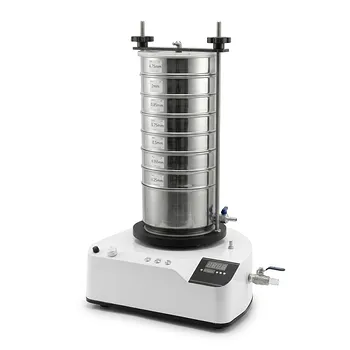
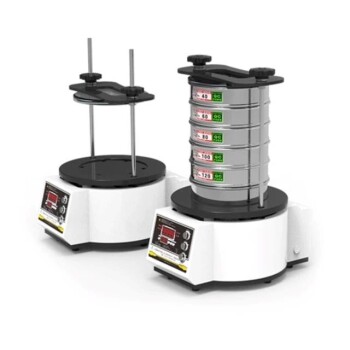
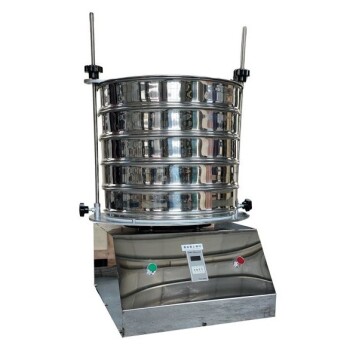
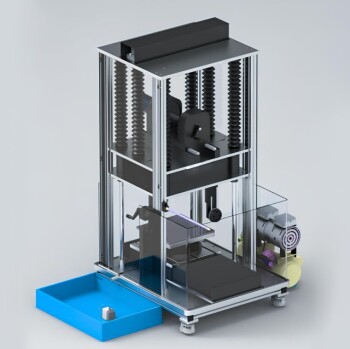
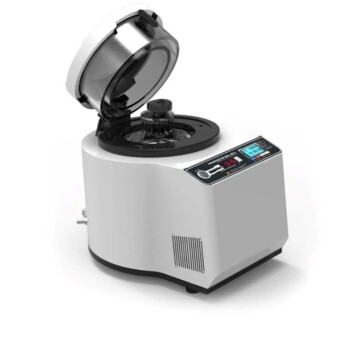
The primary purpose of using high-precision vibrating sieving systems is to rigorously classify wood chips into specific, uniform size ranges. By utilizing multiple layers of screens with varying mesh sizes, these systems isolate particles within precise parameters, such as 36 to 54 micrometers. This ensures that the raw wood material is transformed into a consistent reinforcing filler suitable for high-quality composite manufacturing.
Core Takeaway Strict particle size control is the foundation of structural integrity in Wood-Plastic Composites. Uniform filler dimensions allow for even dispersion within the polymer matrix, directly reducing failure points and enhancing the overall mechanical performance of the final product.
Achieving Material Uniformity
To understand why this equipment is necessary, we must look at how it physically prepares the material.
Multi-Layer Classification
High-precision systems do not simply filter out "large" pieces; they stratify material.
By using multiple layers of screens, the system segregates wood chips based on exact mesh sizes.
Defining the Micro-Scale
The reference specifically notes ranges such as 36 micrometers to 54 micrometers.
This level of precision moves beyond general "sawdust" and creates a highly engineered filler material.
The Impact on Composite Performance
The deep need for this technology lies in the physics of how the filler interacts with the plastic.
Ensuring Even Dispersion
For a composite to be strong, the wood filler must be spread perfectly evenly throughout the polymer (plastic) matrix.
Uniform particle dimensions facilitate this mixing process, preventing clumping or resin-rich areas that lack reinforcement.
Reducing Stress Concentration
This is the most critical technical benefit. Irregular or oversized particles act as stress concentration points.
These are specific spots where mechanical loads gather, often leading to cracks or structural failure.
Improving Structural Stability
By eliminating these stress points through strict size control, the mechanical properties of the composite are significantly improved.
The result is a final product that is not only stronger but also more stable under load.
Common Pitfalls to Avoid
When selecting or operating sieving equipment, it is crucial to understand the risks of inadequate processing.
The Risk of Wide Size Distribution
Allowing a wide range of particle sizes to enter the matrix compromises the material's integrity.
Without strict control, you introduce unpredictability into the material's mechanical behavior.
Neglecting the "Reinforcing Phase"
The wood chip is not just a filler; it is the reinforcing phase of the composite.
Treating the sieving process as a secondary step rather than a primary quality control measure will result in a composite that fails to meet structural standards.
Making the Right Choice for Your Goal
To maximize the quality of your Wood-Plastic Composites, apply these principles:
- If your primary focus is mechanical strength: Prioritize sieving systems that offer the tightest possible mesh control to minimize stress concentration points.
- If your primary focus is product consistency: Ensure your system utilizes multiple screen layers to maintain strict uniformity across large batches of filler.
Precision in preparation is the prerequisite for performance in application.
Summary Table:
| Feature | Function in WPC Production | Mechanical Benefit |
|---|---|---|
| Multi-Layer Classification | Segregates wood chips into precise mesh ranges | Ensures consistent material quality |
| Micro-Scale Precision | Targets specific sizes (e.g., 36-54 μm) | Transforms sawdust into engineered filler |
| Uniform Dispersion | Facilitates even mixing with polymer matrix | Eliminates clumping and resin-rich spots |
| Stress Mitigation | Removes irregular/oversized particles | Reduces failure points and structural cracks |
Elevate Your Composite Manufacturing with KINTEK Precision
Unlock the full potential of your materials with KINTEK’s industry-leading sieving equipment and crushing systems. Whether you are developing high-performance Wood-Plastic Composites or conducting advanced battery research, our laboratory solutions provide the rigorous control necessary for superior structural integrity.
Why choose KINTEK?
- Comprehensive Range: From high-precision vibrating sieves to high-temperature furnaces and hydraulic presses.
- Tailored Performance: Systems designed to minimize stress concentration and maximize material uniformity.
- Expert Support: Specialized tools for every stage, including autoclaves, electrolytic cells, and essential ceramic consumables.
Ensure your reinforcing fillers meet the highest standards. Contact KINTEK today to find the perfect equipment for your laboratory and production needs!
References
- Halla Shehap, Saif Hussien. Recycling of Wood – Plastic Composite Prepared from Poly (Ethylene Terephthalate) and Wood Sawdust. DOI: 10.30684/etj.v39i11.2203
This article is also based on technical information from Kintek Solution Knowledge Base .
Related Products
- Laboratory Vibratory Sieve Shaker Machine for Dry and Wet Three-Dimensional Sieving
- Vibratory Sieve Shaker Machine Dry Three-Dimensional Vibrating Sieve
- Laboratory Vibratory Sieve Shaker Machine Slap Vibrating Sieve
- Laboratory Wet Three-Dimensional Vibratory Sieve Shaker Machine
- Laboratory Test Sieves and Vibratory Sieve Shaker Machine
People Also Ask
- How does a laboratory vibratory sieve shaker facilitate the microstructural study of gas-atomized alloy powders?
- What role does a laboratory vibrating sieve shaker play in the LiFePO4 powder processing workflow? Ensure Batch Quality
- Why use a vibratory sieve shaker for PET powder? Achieve Precise Particle Size Control for Chemical Research
- What is the principle of vibratory sieve shaker? Achieve Accurate Particle Size Analysis
- What is the function of a vibratory sieve shaker? Achieve Precise Particle Size Analysis