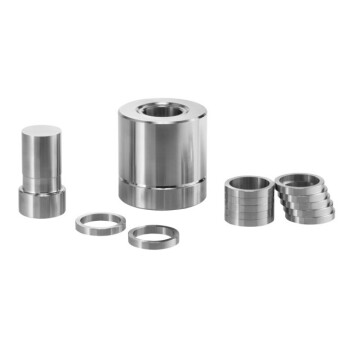
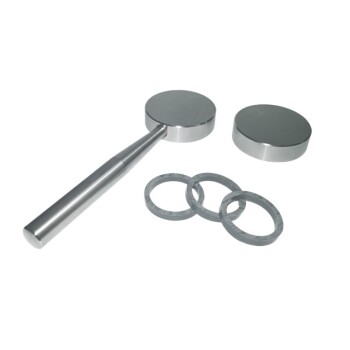
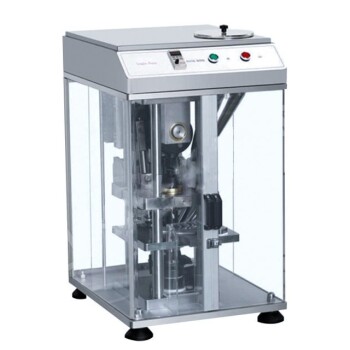
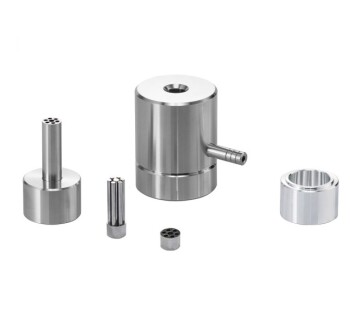
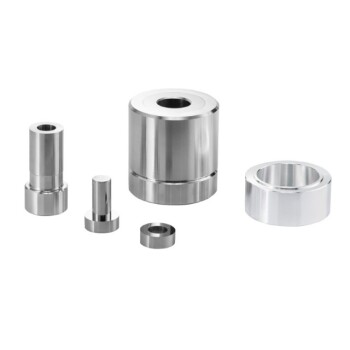
In the synthesis of $M_4AlC_3$ precursors, the high-pressure powder pellet press serves as the critical bridge between raw material mixing and chemical transformation. By applying pressures up to 500 MPa, the press transforms loose mixtures of metal powders (Vanadium, Niobium, or Tantalum) and graphite into dense, solid discs. This mechanical compaction is essential to ensure that the subsequent high-temperature sintering process results in high-purity MAX phase materials.
The pellet press functions by maximizing interfacial contact and minimizing diffusion distances between reactant particles. This creates a dense "green body" that facilitates rapid, uniform chemical reactions and prevents material disintegration during the sintering stage.
Optimizing Solid-Phase Reaction Kinetics
Maximizing Interfacial Contact Area
The primary role of the high-pressure press is to force individual particles of transition metals, aluminum, and carbon into intimate physical contact. In solid-state synthesis, reactions only occur where particles touch; high pressure ensures these contact points are maximized across the entire volume of the precursor.
Reducing Solid-Phase Diffusion Distances
By compressing the powder mixture into a dense disc, the press significantly reduces the empty space (voids) between atoms. This shortens the path that atoms must travel to interact with one another, which is a decisive factor in achieving a complete chemical reaction and avoiding unreacted "dead zones" in the final material.
Ensuring Phase Purity
High phase purity in $M_4AlC_3$ requires precise stoichiometry and uniform reaction conditions. The high-pressure environment ensures that the reactants are homogeneously distributed and physically locked together, preventing the formation of unwanted secondary phases during the heating cycle.
Establishing Structural and Thermal Stability
Achieving High Packing Density
The press applies sufficient force—often exceeding 480 MPa—to induce plastic deformation and physical interlocking of the metal particles. This eliminates internal pores and increases the packing density of the green compact, providing a stable foundation for the formation of "particle necks" during sintering.
Resistance to Thermal Shock
Precursors must maintain their geometric integrity when subjected to the extreme temperatures of a furnace. A well-pressed pellet possesses the mechanical strength to resist disintegrating or cracking due to thermal expansion or the intensity of the aluminothermic reactions occurring within the material.
Consistency of Geometry and Density
The use of a pellet press ensures that every precursor disc has consistent dimensions and density. This uniformity is vital for industrial scalability, as it ensures that the heat distribution and reaction rates remain predictable across different batches of material.
Understanding the Trade-offs
The Risk of Over-Compaction
While high pressure is beneficial, exceeding the optimal limit can lead to internal stresses within the pellet. This may cause "capping" or laminating, where the pellet splits into layers upon being released from the die, potentially ruining the precursor before it even reaches the furnace.
Die Wear and Contamination
Using extremely high pressures accelerates the mechanical wear on the hardened steel or tungsten carbide dies. Over time, this wear can introduce microscopic metallic contaminants into the $M_4AlC_3$ precursor, which may negatively impact the electromagnetic or mechanical properties of the final MAX phase ceramic.
Pressure Gradients in Large Pellets
In thicker pellets, pressure may not be distributed evenly from the top to the center, leading to density gradients. This can result in non-uniform shrinkage during sintering, which might cause the final $M_4AlC_3$ sample to warp or develop internal micro-cracks.
How to Apply This to Your Synthesis Process
To achieve the best results when preparing $M_4AlC_3$ precursors, the pressing stage must be tailored to the specific transition metal and particle size of your raw materials.
- If your primary focus is Phase Purity: Utilize the maximum recommended pressure (up to 500 MPa) to ensure the shortest possible diffusion distances between the $M$ and $Al/C$ components.
- If your primary focus is Structural Integrity: Ensure the powder is uniformly mixed and consider a dwell time (holding the pressure for 1–2 minutes) to allow for better particle interlocking and air escape.
- If your primary focus is Die Longevity: Apply a thin layer of stearic acid or a similar lubricant to the die walls to reduce friction and prevent the $M_4AlC_3$ precursor from sticking.
Properly calibrated high-pressure compaction is the fundamental prerequisite for transforming raw elemental powders into high-performance MAX phase ceramics.
Summary Table:
| Role in Synthesis | Key Benefit | Technical Achievement |
|---|---|---|
| Mechanical Compaction | Maximizes interfacial contact | Pressures up to 500 MPa |
| Diffusion Optimization | Shortens atomic travel paths | Minimizes voids & dead zones |
| Structural Stability | Resists thermal shock/cracking | High packing density & interlocking |
| Phase Control | Ensures chemical homogeneity | Prevents unwanted secondary phases |
Elevate Your MAX Phase Research with KINTEK
Ready to achieve high-purity $M_4AlC_3$ materials with uncompromising consistency? KINTEK specializes in precision laboratory equipment designed for the most demanding material science applications.
We provide a comprehensive range of high-pressure hydraulic presses (pellet, hot, and isostatic) and high-temperature furnaces (vacuum, tube, and atmosphere) tailored to optimize your precursor preparation and sintering workflows. From crushing and milling systems to high-purity ceramic crucibles, our solutions ensure maximum interfacial contact and phase purity for your advanced ceramics.
Unlock superior material performance—Contact our experts today for a custom quote!
References
- Yanan Huang, Yuping Sun. Defect‐Free Few‐Layer M<sub>4</sub>C<sub>3</sub>T<sub>x</sub> (M = V, Nb, Ta) MXene Nanosheets: Synthesis, Characterization, and Physicochemical Properties. DOI: 10.1002/advs.202302882
This article is also based on technical information from Kintek Solution Knowledge Base .
Related Products
- XRF Boric Acid Lab Powder Pellet Pressing Mold for Laboratory Use
- XRF & KBR steel ring lab Powder Pellet Pressing Mold for FTIR
- XRF & KBR plastic ring lab Powder Pellet Pressing Mold for FTIR
- kbr pellet press 2t
- Automatic Laboratory Hydraulic Press for XRF & KBR Pellet Press
People Also Ask
- What is the purpose of using a mold for pellet pressing when preparing catalyst test samples? Ensure Data Consistency
- What is the XRF method of sampling? Achieve Accurate Elemental Analysis with Proper Sample Prep
- What is the XRF pressed pellet method? A Fast, Cost-Effective Sample Prep Guide
- How are samples prepared for XRF analysis? Achieve Accurate and Reliable Results
- How do you make XRF pellets? A 4-Step Guide to Flawless Sample Preparation