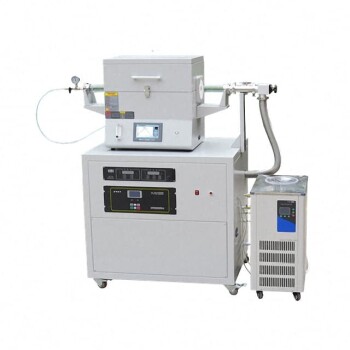
The high vacuum tube furnace serves as the critical reaction chamber for the simultaneous reduction, nitrogen-doping, and chemical etching of graphene oxide. By providing a precisely controlled high-temperature environment—typically around 800°C—under a high-purity nitrogen or inert atmosphere, the furnace facilitates the removal of oxygen functional groups and the structural incorporation of nitrogen. This specialized equipment is essential for transforming insulating graphene oxide into a highly conductive, porous framework suitable for advanced energy storage and catalysis.
The high vacuum tube furnace provides the extreme thermal energy and oxygen-free environment required to execute the chemical reactions that define PNrGO. It acts as the catalyst for three concurrent processes: the thermal reduction of the carbon lattice, the atomic substitution of nitrogen, and the chemical etching of pores.
The Synthesis Environment: Temperature and Atmosphere
Controlled Thermal Energy
The furnace maintains a stable high-temperature environment, generally reaching 800°C to 900°C, which provides the kinetic energy necessary for chemical bonds to break and reform. This intense heat is the primary driver for eliminating oxygen-containing functional groups that impede electrical conductivity.
Oxygen-Free Protective Atmosphere
By utilizing a high-purity nitrogen (N2) or argon (Ar) atmosphere, the furnace prevents the carbon material from combusting or oxidizing at high temperatures. This inert environment is non-negotiable for preserving the integrity of the graphene sheets while they undergo chemical transformation.
High Vacuum Precision
The high vacuum capability (often reaching levels less than 10^-6 mbar) ensures that any residual air or moisture is removed before heating. This ensures the purity of the final PNrGO product and prevents unwanted side reactions that could degrade the material's performance.
Chemical Transformation and Nitrogen Doping
Facilitating Nitrogen Incorporation
In the preparation of PNrGO, precursors like urea are typically mixed with graphene oxide. The tube furnace provides the thermal stimulus required for nitrogen atoms from the urea to penetrate and bond within the sp2 aromatic network of the graphene.
Restoration of Conductivity
As the furnace heats the material, it repairs the carbon plane regularity that was damaged during the initial oxidation of the graphene. This restoration of the conductive network converts the material from a semiconductor into a highly conductive carrier.
Removal of Functional Groups
The high-temperature environment causes the rapid decomposition of oxygen groups, which are released as gases such as carbon dioxide. This process is vital for "cleaning" the graphene surface to make it active for electrochemical applications.
Engineering the Porous Structure
Chemical Etching via KOH
When potassium hydroxide (KOH) is present in the mixture, the furnace's heat triggers a chemical etching process. This reaction eats away at sections of the graphene layers, creating a rich porous structure that significantly increases the material's surface area.
Instantaneous Pressure for Pore Creation
High heating rates within the furnace can cause oxygen groups to decompose so rapidly that they create internal gas pressure between the graphene layers. This pressure acts as a mechanical force, "punching" nanoscale pores into the sheets and preventing them from restacking.
Honeycomb Morphology Formation
The stable thermal environment allows for the formation of a stable honeycomb-like architecture. This morphology is critical for applications like supercapacitors, where ions need to move quickly through a network of open pores.
Understanding the Trade-offs
Equipment Wear and Corrosive Agents
Using chemical activators like KOH at 800°C can be highly corrosive to the quartz or alumina tubes used in the furnace. Frequent use for etching processes may reduce the lifespan of the furnace components compared to standard annealing.
Temperature vs. Surface Area
While higher temperatures (above 900°C) improve conductivity by removing more oxygen, they can sometimes cause pore collapse or excessive shrinkage of the material. Balancing the temperature is critical to maintaining high surface area without sacrificing electrical performance.
Vacuum vs. Throughput
Achieving an ultra-high vacuum provides the highest purity but increases processing time and energy consumption. For industrial scaling, manufacturers must often weigh the benefits of a "deep" vacuum against the speed of a continuous flow inert gas system.
How to Apply This to Your Project
Making the Right Choice for Your Goal
To achieve the best results with PNrGO synthesis, your furnace parameters should align with your specific performance requirements.
- If your primary focus is Maximum Conductivity: Prioritize higher temperatures (850°C-900°C) and a deep vacuum to ensure the complete removal of oxygen groups and the repair of the carbon lattice.
- If your primary focus is High Surface Area: Focus on the precise control of the KOH-to-GO ratio and use moderate heating rates to allow for uniform chemical etching and pore development.
- If your primary focus is Nitrogen Content: Ensure the furnace is operating under a high-purity nitrogen atmosphere and maintain a stable dwell time at 800°C to maximize the substitution of nitrogen into the lattice.
By mastering the thermal and atmospheric variables of the high vacuum tube furnace, you can precisely tune the electrochemical properties of PNrGO for any high-performance application.
Summary Table:
| Process | Function in PNrGO Synthesis | Key Parameters |
|---|---|---|
| Thermal Reduction | Removes oxygen functional groups and restores electrical conductivity. | 800°C - 900°C |
| Nitrogen Doping | Facilitates the atomic substitution of nitrogen into the carbon lattice. | High-purity N2 or Ar |
| Chemical Etching | Triggers reactions (e.g., with KOH) to create a high-surface-area porous structure. | Precise Thermal Dwell |
| Atmosphere Control | Prevents oxidation and ensures product purity by removing residual air. | Vacuum < 10^-6 mbar |
Elevate Your Nanomaterial Research with KINTEK
Achieving the perfect PNrGO framework requires absolute precision in temperature and atmospheric control. KINTEK specializes in high-performance laboratory equipment designed for the most demanding synthesis processes. Our comprehensive range of high vacuum tube furnaces, CVD systems, and atmosphere-controlled furnaces provide the stability and purity needed for superior graphene engineering.
Beyond heating, we offer a full suite of tools including crushing and milling systems, high-temperature reactors, and essential consumables like cruibles and ceramics to support your entire workflow.
Ready to optimize your lab’s efficiency and material performance? Contact KINTEK today for a consultation on the ideal furnace and equipment configuration for your specific research goals.
References
- Qing Wei, Mingxi Wang. Porous nitrogen-doped reduced graphene oxide-supported CuO@Cu2O hybrid electrodes for highly sensitive enzyme-free glucose biosensor. DOI: 10.1016/j.isci.2023.106155
This article is also based on technical information from Kintek Solution Knowledge Base .
Related Products
- Laboratory High Pressure Vacuum Tube Furnace
- 1700℃ Controlled Atmosphere Furnace Nitrogen Inert Atmosphere Furnace
- Vacuum Sealed Continuous Working Rotary Tube Furnace Rotating Tube Furnace
- 1200℃ Split Tube Furnace with Quartz Tube Laboratory Tubular Furnace
- Ultra-High Temperature Graphite Vacuum Graphitization Furnace
People Also Ask
- What is the role of a high-vacuum tube furnace in preparing Co3S4@NiS2/C composite materials? Expert Synthesis Insights
- What is the primary function of a high-vacuum tube furnace in CVD synthesis of Sb-doped Bi2Se3? Precision Growth Control
- What role does a high-vacuum tube furnace play in synthesizing manganese nitride? Achieve Precise Phase & Stoichiometry.
- Role of High-Pressure Tube Furnace in Ru/OMC Synthesis: Achieve Precise Reduction & Nanostructure Control
- What is the primary function of a high-pressure tube furnace in the preparation of Laver biochar? Expert Pyrolysis Guide