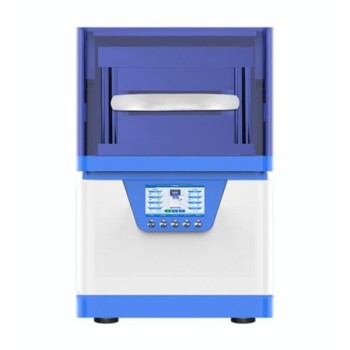
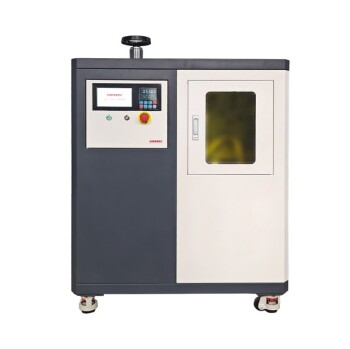
The primary role of a hot pressing system in Thallium Bromide (TlBr) detector production is to transform zone-refined raw materials into high-density bulk crystals through the simultaneous application of high temperature and constant axial pressure. This process is not merely about shaping the material; it is a critical structural refinement stage that eliminates internal stresses, controls crystal orientation, and ensures the structural consistency required for high-efficiency photon-counting detectors.
Core Insight: The hot pressing system acts as a "thermomechanical coupler," utilizing precise heat (455-465°C) and pressure (~30 kN) to induce plastic flow. This eliminates microscopic defects and aligns the crystal lattice, directly dictating the detector's charge collection efficiency and energy resolution.
The Mechanics of Structural Refinement
Achieving High-Density Consolidation
The fundamental task of the hot pressing system is to convert purified TlBr powder or raw material into a solid, void-free mass.
By applying constant axial pressure (typically around 30 kN) while heating the material, the system promotes plastic flow. This forces particles to bond intimately, effectively eliminating internal pores and voids that would otherwise trap charge carriers.
Precise Thermomechanical Coupling
Success relies on maintaining a specific environment where temperature and pressure work in tandem.
The system typically operates within a narrow high-temperature window, often between 455°C and 465°C, for a duration of several hours. This controlled environment ensures that the material consolidates via solid-phase molding rather than melting, preserving the chemical purity achieved during earlier zone refining.
Elimination of Residual Stress
One of the most critical functions of the hot press, as highlighted in the primary reference, is the removal of internal stresses.
Uneven cooling or compression can lock tension into a crystal, which degrades detector performance. The hot pressing system's ability to maintain stable pressure during the heating cycle relaxes the material, ensuring the final bulk crystal is mechanically stable and stress-free.
Impact on Detector Performance
Controlling Crystal Orientation
For a semiconductor detector to function correctly, charge carriers must move efficiently through the lattice.
The hot pressing process allows manufacturers to influence the crystalline orientation of the TlBr. By strictly controlling the thermomechanical conditions, the system induces specific lattice alignments that optimize the material for charge transport.
Enhancing Charge Collection Efficiency
The structural integrity achieved during hot pressing directly correlates to the electronic performance of the final device.
Because the process reduces internal defects and aligns the crystal structure, the resulting detectors exhibit higher charge collection efficiency. This minimizes signal loss as electrons move through the detector volume.
Optimizing Gamma-Ray Attenuation
High-density crystals produced via this method demonstrate superior physical properties.
The uniform density ensures consistent interaction with incoming radiation. This leads to higher gamma-ray attenuation coefficients, making the final detector highly sensitive and efficient at stopping and measuring high-energy photons.
Understanding the Critical Variables
The Risk of Parameter Drift
While hot pressing is effective, it is highly sensitive to process variables.
If the temperature deviates even slightly from the optimal range (e.g., outside the 455-465°C window), the material may fail to bond correctly or suffer from thermal shock. Similarly, fluctuations in axial pressure can reintroduce the very stresses the process is designed to eliminate.
Density vs. Integrity Trade-offs
Applying higher pressure can increase density, but it carries the risk of damaging the crystal structure if not balanced with adequate heat.
The system must balance the force required to close pores against the material's plasticity limit. An imbalance here results in crystals that appear dense on the surface but contain micro-cracks or non-uniformities deep within the bulk material.
Making the Right Choice for Your Goal
To maximize the yield of detector-grade TlBr crystals, you must tailor the hot pressing parameters to your specific performance metrics.
- If your primary focus is Energy Resolution: Prioritize precise temperature control (455-465°C) to ensure optimal crystal lattice orientation and charge transport properties.
- If your primary focus is Structural Integrity: Focus on maintaining constant, stable axial pressure (~30 kN) to ensure complete pore elimination and maximum density without inducing mechanical fracture.
Summary: The hot pressing system is the defining link between raw purified material and a functioning detector, determining the final device's sensitivity and resolution through precise stress elimination and lattice alignment.
Summary Table:
| Process Parameter | Target Value | Functional Role in TlBr Production |
|---|---|---|
| Temperature Range | 455°C - 465°C | Enables solid-phase molding and lattice alignment without melting. |
| Axial Pressure | ~30 kN | Eliminates internal voids and pores to achieve high-density consolidation. |
| Process Duration | Several Hours | Relaxes internal stresses and ensures mechanical stability of the bulk crystal. |
| Key Outcome | Structural Refinement | Optimizes charge transport efficiency and energy resolution for detectors. |
Elevate Your Semiconductor Research with KINTEK
Precise thermomechanical control is the backbone of high-performance Thallium Bromide (TlBr) detectors. At KINTEK, we specialize in advanced laboratory equipment and consumables, providing the high-precision hot pressing systems and hydraulic presses essential for achieving the density and structural integrity your research demands.
From high-temperature furnaces (muffle, vacuum, CVD) to isostatic presses and PTFE consumables, our portfolio is designed to eliminate process variables and maximize your yield.
Ready to optimize your crystal growth and material consolidation?
Contact KINTEK Today for a Tailored Solution
References
- Miroslav Vlček. Radiation sensitivity of chalcogenide glasses thin films prepared by spin coating. DOI: 10.21175/rad.abstr.book.2023.19.12
This article is also based on technical information from Kintek Solution Knowledge Base .
Related Products
- Automatic Heated Hydraulic Press Machine with Heated Plates for Laboratory Hot Press
- Heated Hydraulic Press Machine with Heated Plates Split Manual Laboratory Hot Press
- Heated Hydraulic Press Machine with Heated Plates for Vacuum Box Laboratory Hot Press
- Heated Hydraulic Press Machine with Heated Plates for Vacuum Box Laboratory Hot Press
- Automatic Heated Hydraulic Press Machine with Heated Plates for Laboratory Hot Press 25T 30T 50T
People Also Ask
- What are the core advantages of using a laboratory hot press to produce Bi2Se3? Achieve 93% Density & High Conductivity
- How does a laboratory hot press contribute to LATP/polymer composite electrolytes? Achieving Dense, High-Conductivity Films
- How does a three-stage pressure program affect rice husk particleboards? Optimize Bond Strength & Stability
- What is the purpose of a laboratory hot press in the encapsulation stage of solar cell assembly? Ensure Hermetic Seals
- What are the primary advantages of using a laboratory hot press in forming PEO/LLZTO? Unlock Solvent-Free Efficiency