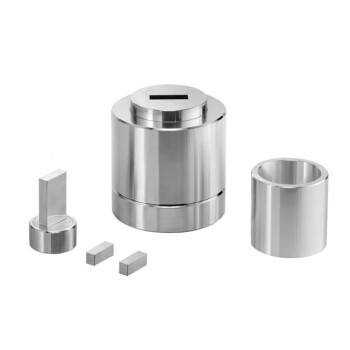
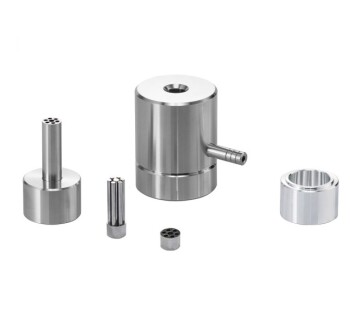
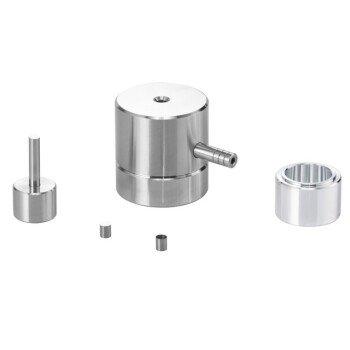
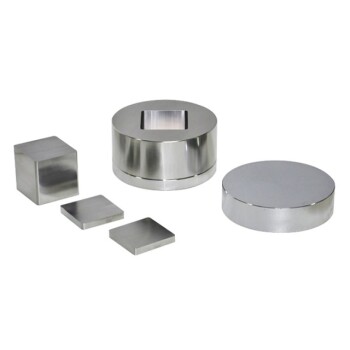
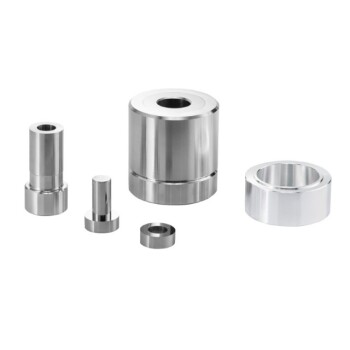
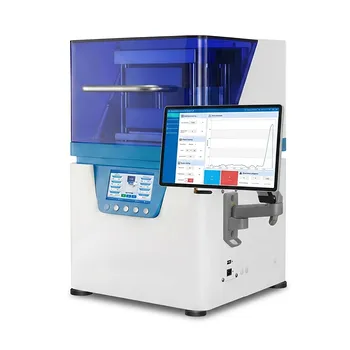
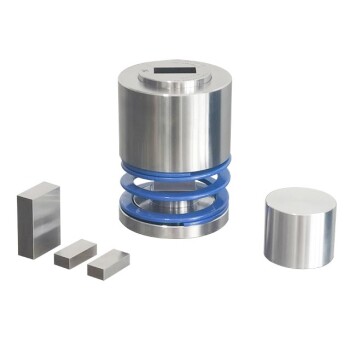
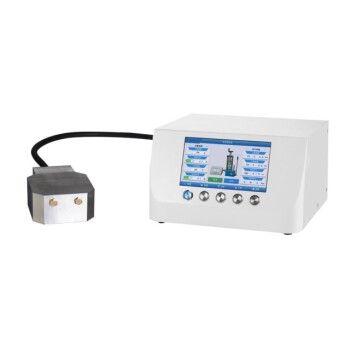
The laboratory hydraulic press and mold system are essential for transforming loose corn stalk powder into standardized, high-density pellets for thermal analysis. By applying a specific pressure—typically around 8 MPa—the press compresses pulverized biomass into a fixed diameter and height. This preparation is critical because it ensures consistent physical boundaries, which directly dictates how heat and mass move through the sample during the pyrolysis process.
The primary role of a hydraulic press in corn stalk pyrolysis is to eliminate the variables of raw material morphology. By creating uniform pellets, researchers can ensure that experimental data is repeatable and accurately reflects the behavior of biomass in industrial-scale applications.
Standardizing Physical Morphology
Controlling Sample Dimensions
A hydraulic press uses specialized molds to ensure every sample has the exact same diameter and height. This uniformity is vital for comparative studies where volume and surface area must remain constant. Without this control, variations in sample shape would lead to inconsistent results across different test runs.
Simulating Industrial Conditions
The pressing process effectively simulates industrial biomass pelletizing, providing a bridge between laboratory research and real-world application. It increases the bulk density of the corn stalk powder, mimicking how the material is handled in commercial energy production. This allows researchers to predict how dense fuel pellets will behave in large-scale reactors.
Optimizing Heat and Mass Transfer
Eliminating Conduction Inconsistencies
Loose biomass powder contains irregular air pockets that can cause unpredictable heat conduction. The hydraulic press creates uniform internal porosity, ensuring that heat is distributed evenly throughout the sample. This precision is necessary to obtain reliable kinetic data during the pyrolysis reaction.
Enhancing Particle Contact
High-pressure molding forces individual corn stalk particles into tight physical contact, eliminating large voids. This rearrangement at the microscopic level facilitates more efficient energy transfer between particles. Better contact ensures the entire sample reaches the target pyrolysis temperature simultaneously, preventing "cold spots."
Ensuring Data Integrity and Handling
Mechanical Stability for Handling
The press creates a "green body" with sufficient mechanical strength to be handled without crumbling. This stability allows the researcher to move the sample from the mold to the reactor without losing mass or altering its shape. Consistent sample integrity is a prerequisite for accurate post-pyrolysis weighing and structural analysis.
Repeatability of Experiments
By precisely controlling the pressing force, the laboratory hydraulic press ensures uniform density across all samples in a series. This consistency is the foundation of scientific reliability, allowing researchers to attribute changes in pyrolysis behavior to chemical variables rather than physical differences. It ensures that the resulting data can be verified and reproduced by other laboratories.
Understanding Technical Trade-offs
Balancing Density and Degassing
While high density improves heat conduction, over-compressing a sample can inhibit the release of volatile gases during pyrolysis. If the pressure is too high, the internal pressure of the pellet may rise excessively, potentially fracturing the sample or altering the chemical pathway. Researchers must find the "sweet spot" where density is maximized without compromising mass transfer.
Morphological Alterations
Applying extreme pressure can physically alter the cellular structure of the corn stalk. While this creates a uniform sample, it may move the material further away from its natural state, which might be a downside for studies focused on raw biomass behavior. It is critical to document the specific pressure used (e.g., 8 MPa) to account for these structural changes in the final analysis.
How to Apply This to Your Research
Implementation Strategies
To achieve the most reliable results in corn stalk pyrolysis, the preparation method should be tailored to the specific goals of the study.
- If your primary focus is industrial scalability: Use a hydraulic press to match the bulk density and dimensions of commercial fuel pellets to ensure your data translates to the field.
- If your primary focus is kinetic modeling: Prioritize precise pressure control to ensure uniform porosity, which minimizes the "noise" caused by uneven heat transfer.
- If your primary focus is chemical composition (FTIR): Ensure the press is used to create a stable, thin disc to eliminate scattering interference in the optical path during characterization.
Standardizing the physical state of your biomass through precise hydraulic pressing is the most effective way to transform raw observations into high-quality, actionable data.
Summary Table:
| Key Role | Technical Benefit | Impact on Research |
|---|---|---|
| Standardization | Uniform dimensions (diameter/height) | Eliminates morphological variables for repeatability |
| Densification | Increases bulk density to ~8 MPa | Simulates industrial biomass pelletizing conditions |
| Heat Transfer | Eliminates irregular air pockets | Ensures uniform internal temperature distribution |
| Mass Transfer | Controls internal porosity | Optimizes the release of volatile gases during reaction |
| Mechanical Stability | Creates a durable "green body" | Prevents sample crumbling during reactor loading |
Elevate Your Biomass Research with KINTEK Precision
Achieving reliable corn stalk pyrolysis results requires absolute consistency in sample preparation. KINTEK specializes in high-performance laboratory hydraulic presses (pellet, hot, and isostatic) and precision-engineered molds designed to transform loose biomass into standardized, high-density samples.
Our expertise extends across the entire laboratory workflow. From crushing and milling systems for raw material preparation to high-temperature furnaces (muffle, tube, vacuum) and high-pressure reactors for thermal analysis, we provide the tools necessary for scientific excellence. Whether you are a researcher requiring precise kinetic modeling or a distributor seeking reliable OEM/ODM support and certified equipment, KINTEK delivers the durability and accuracy your projects demand.
Ready to standardize your research and achieve superior data integrity?
Contact a KINTEK Specialist Today
References
- Lijie Li, Xianrui Kong. Effects of pyrolysis temperature on the release characteristics of polycyclic aromatic hydrocarbons during pyrolysis of corn stover pellet. DOI: 10.15376/biores.18.1.2112-2136
This article is also based on technical information from Kintek Solution Knowledge Base .
Related Products
- Ball Press Mold for Lab
- Assemble Square Lab Press Mold for Laboratory Applications
- Anti-Cracking Press Mold for Lab Use
- Round Bidirectional Press Mold for Lab
- Special Shape Press Mold for Lab
People Also Ask
- What are the advantages of using a laboratory hydraulic press for hot pressing? Achieve Peak Nano-Composite Density
- How to use a press mold? Master the Art of Creating Consistent Ceramic Forms
- What is the press mould method? A Guide to Consistent, Detailed Ceramic Forms
- What is the purpose of specialized pressure devices in sulfide solid-state batteries? Ensure Chemo-Mechanical Stability
- Why are pressure molds with non-conductive resin inner walls required for battery testing? Ensure Data Accuracy