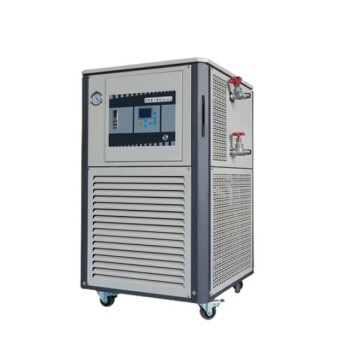
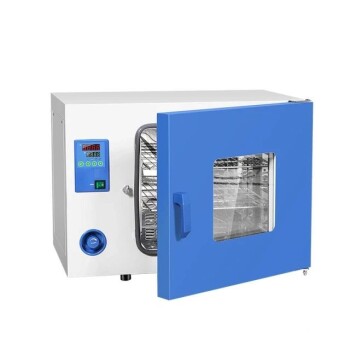
The primary role of the reactor is to act as a kinetic facilitator. It provides the necessary thermal energy and mechanical shear required to force the reaction between urea and orthophosphoric acid, a process that is otherwise inhibited by urea's chemical structure. Without this specific environment, the synthesis of stable diurea phosphate complexes would be inefficient or impossible.
Due to the inherent low reactivity of urea's amino group, this synthesis requires an aggressive reaction environment. The reactor drives this process by maintaining a stable 100°C temperature and utilizing high-intensity stirring to overcome significant kinetic barriers.
The Chemical Barrier to Synthesis
To understand the necessity of the equipment, one must first understand the chemical challenge it solves.
The Inhibiting Effect of the Carbonyl Group
Urea is not naturally prone to reacting with orthophosphoric acid under ambient conditions. The carbonyl group present in the urea molecule significantly weakens the ability of the amino group to react.
Low Reaction Activity
This structural characteristic results in very low reaction activity. The reactants naturally resist the transformation required to create complex phosphates.
Consequently, the process faces high kinetic barriers. These barriers prevent the reaction from starting or proceeding at a useful rate without external intervention.
Mechanisms of the Reactor
The reactor overcomes these chemical limitations through two synchronized physical mechanisms: thermal activation and mechanical force.
Thermal Activation at 100°C
The reactor is designed to maintain a stable, elevated temperature of 100°C throughout the process.
This thermal energy is critical for exciting the molecules. It increases the frequency and energy of collisions between the urea and the acid, compensating for the amino group's lack of natural reactivity.
High-Intensity Mechanical Mixing
Heat alone is insufficient to ensure a consistent reaction. The reactor employs high-intensity stirring to provide aggressive mechanical mixing.
This mechanical force ensures uniform distribution of heat and reactants. It physically forces the molecules into contact, driving the reaction forward despite the chemical resistance.
Ensuring Reaction Completion
By combining heat and stirring, the reactor ensures the synthesis reaches completion within a practical timeframe of 4 to 5 hours.
The result is the production of chemically stable complexes, specifically utilized as effective corrosion inhibitors.
Understanding the Trade-offs
While this reactor configuration is effective, it presents specific operational considerations.
Energy vs. Reaction Success
The process is energy-intensive. It requires the continuous input of power to maintain high temperatures and vigorous stirring for several hours.
However, attempting to conserve energy by lowering the temperature or reducing stirring speed is a critical error. Inadequate energy input will fail to overcome the kinetic barriers, leading to incomplete synthesis.
The Importance of Stability
The reference emphasizes a stable temperature. Fluctuations in heat or mixing intensity can disrupt the reaction kinetics, potentially compromising the stability of the final corrosion inhibitor product.
Making the Right Choice for Your Goal
When configuring a synthesis process for urea-orthophosphoric acid complexes, your equipment parameters determine your success.
- If your primary focus is Process Efficiency: Ensure your reactor can reach and strictly maintain 100°C to guarantee the reaction completes within the 4 to 5-hour window.
- If your primary focus is Product Quality: Prioritize high-intensity stirring capabilities to ensure the thorough mixing required for chemically stable corrosion inhibitors.
The reactor is not merely a vessel; it is the active agent that bridges the gap between urea's chemical inertness and the creation of high-value industrial complexes.
Summary Table:
| Feature | Parameter | Purpose in Synthesis |
|---|---|---|
| Temperature | Stable 100°C | Overcomes amino group inactivity; provides thermal activation. |
| Stirring Intensity | High-Intensity | Provides mechanical shear to overcome kinetic barriers. |
| Reaction Time | 4 to 5 Hours | Ensures complete synthesis of stable phosphate complexes. |
| Primary Goal | Kinetic Facilitation | Drives reaction despite the inhibiting carbonyl group in urea. |
| Final Product | Corrosion Inhibitor | Creates chemically stable complexes for industrial use. |
Upgrade Your Lab with KINTEK’s Precision Reactor Systems
Don't let kinetic barriers stall your research. KINTEK specializes in advanced laboratory equipment designed to handle the most demanding chemical syntheses. Our high-temperature high-pressure reactors and autoclaves provide the precise 100°C stability and high-intensity mechanical shear required to transform inert urea into high-value complexes.
From high-temperature furnaces and crushing systems to specialized PTFE consumables and ceramics, we empower researchers with the tools needed for chemical stability and process efficiency.
Ready to optimize your synthesis results? Contact our technical experts today to find the perfect reactor configuration for your laboratory needs.
References
- Vagif М. Abbasov, Y Academician. COMPARATIVE STUDY OF COMPLEXES WITH DIFFERENT MOLE RATIO OF ORTHOPHOSPHORIC ACID AND CARBAMIDE AGAINST CORROSION AND SALT PRECIPITATION. DOI: 10.36719/1726-4685/96/656-665
This article is also based on technical information from Kintek Solution Knowledge Base .
Related Products
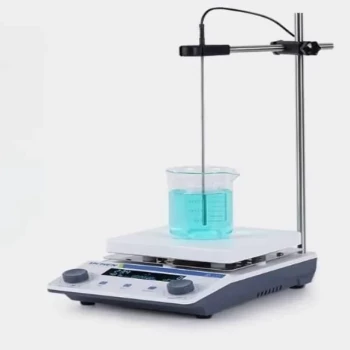
- Laboratory Small Constant Temperature Heated Magnetic Stirrer Heater and Stirrer
- Customizable Laboratory High Temperature High Pressure Reactors for Diverse Scientific Applications
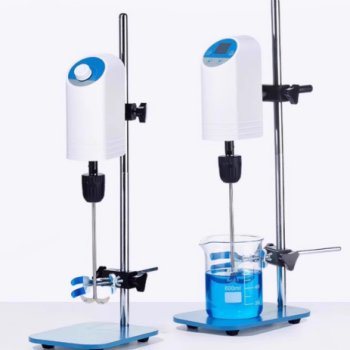
- High Performance Laboratory Stirrers for Diverse Applications
- Customizable High Pressure Reactors for Advanced Scientific and Industrial Applications
- High Temperature Constant Temperature Heating Circulator Water Bath Chiller Circulator for Reaction Bath
People Also Ask
- What role does a magnetic stirrer with heating play in ZnO nanoparticle synthesis? Precision Control for Quality Results
- What role does a constant temperature heating magnetic stirrer play in MFC-HAp synthesis? Achieve Material Homogeneity
- What is the function of a laboratory magnetic stirrer in Ni–Cr–P electrodeposition? Optimize Ion Transport & Coating
- Why is a laboratory magnetic stirrer required for benzoic acid esters? Boost Reaction Speed & Yield with High RPM
- What role does a laboratory magnetic stirrer play in TiO2 and TiO2-Ag sol preparation? Master Chemical Kinetics