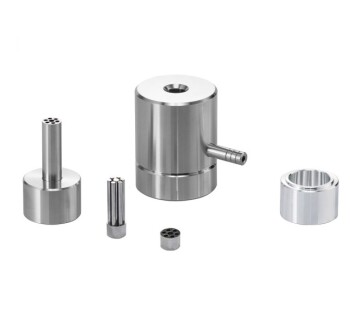
Graphite molds act as the critical interface between the vacuum hot press machinery and the raw metal-ceramic composite materials. They serve not merely as passive containers, but as active components that facilitate the simultaneous application of extreme heat and pressure required for densification.
Core Takeaway In vacuum hot pressing, graphite molds function primarily as the pressure-transmitting medium and the thermal regulator. Their unique combination of high-temperature mechanical strength and thermal conductivity ensures the composite powder is compacted uniformly and heated efficiently, resulting in a dense, dimensionally accurate, and structurally homogeneous product.
The Core Functions of the Mold
Facilitating Uniform Pressure Transmission
The primary reference highlights that the mold is the primary medium for pressure transmission. During sintering, the hot press applies uniaxial force (often between 20 MPa and 100 MPa) to the mold assembly.
Because graphite retains exceptional mechanical strength at high temperatures, it does not deform significantly under this load. It transmits the axial pressure directly into the powder compact. This ensures that the densification force reaches the core of the material, preventing porosity and ensuring a solid structure.
Thermal Management and Heating
Graphite possesses superior thermal conductivity, which is vital for the sintering process. The mold absorbs heat from the furnace elements and transfers it rapidly to the composite powder inside.
This high conductivity ensures the "thermal field" remains uniform. Uniform heating prevents thermal gradients that could lead to warping, cracking, or uneven microstructures within the metal-ceramic composite.
Geometric Definition and Containment
The mold acts as the containment vessel, defining the final shape and dimensional precision of the product. It holds the loose powder or stacked foil layers in the correct alignment during the initial heating phases.
By maintaining rigidity at temperatures often exceeding 1000°C, the mold ensures the final sintered billet retains the exact geometry intended, minimizing the need for extensive post-process machining.
Why Graphite is the Material of Choice
High-Temperature Structural Integrity
Unlike many metals that soften under heat, graphite maintains—and in some grades increases—its strength at sintering temperatures (e.g., 950°C to 1373 K).
This allows the mold to serve as a load-bearing component. It creates a rigid constraint that forces the powder particles to rearrange and bond mechanically and metallurgically, rather than allowing the mold walls to bulge outward.
Chemical Environment Control
Graphite creates a local reducing atmosphere within the vacuum chamber. Carbon from the mold can react with residual oxygen, scavenging it before it attacks the metal powders.
This protects sensitive metal components from oxidation, which is critical for establishing a strong interface between the metal and ceramic phases.
Friction and Lubricity
Graphite naturally exhibits lubricity, which aids in the mechanics of pressing. This property reduces friction between the powder and the mold walls.
Lower wall friction ensures that the applied pressure is not lost at the edges but is transmitted effectively throughout the powder volume, promoting uniform density.
Understanding the Trade-offs
Chemical Reactivity Risks
While graphite is generally chemically inert (for example, to Al-Si alloys as noted in supplementary data), it is not universally compatible. At high temperatures, carbon can diffuse into certain metals to form unwanted carbides, potentially altering the composite's properties.
Component Lifespan
Graphite molds are considered critical consumables. Despite their strength, the combination of extreme thermal cycling, high mechanical pressure, and potential chemical erosion means they degrade over time. They must be monitored for surface wear to maintain dimensional tolerances.
Thermal Expansion Mismatch
The Coefficient of Thermal Expansion (CTE) of graphite must be considered relative to the composite. If the composite shrinks significantly less than the graphite during cooling, the mold can lock onto the part, making demolding difficult or causing stress fractures.
Making the Right Choice for Your Goal
To optimize your sintering process, align your mold design with your specific objectives:
- If your primary focus is High Density: Prioritize graphite grades with maximum high-temperature compressive strength to withstand pressures exceeding 50 MPa without deformation.
- If your primary focus is Structural Homogeneity: Ensure the mold wall thickness is uniform to maximize the benefits of graphite's thermal conductivity for even heating.
- If your primary focus is Surface Purity: Rely on the reducing nature of graphite to scavenge oxygen, but verify the chemical compatibility to prevent unwanted carbide layer formation on the composite surface.
Graphite molds are the indispensable "enablers" of the hot pressing process, translating raw force and heat into precision and structural integrity.
Summary Table:
| Core Function | Description | Impact on Composite Quality |
|---|---|---|
| Pressure Transmission | Uniaxial force transfer (20–100 MPa) | Ensures maximum densification & zero porosity |
| Thermal Management | High conductivity heating (up to 1373K+) | Prevents warping & creates uniform microstructure |
| Geometric Control | High-temperature structural integrity | Maintains precise dimensional tolerances |
| Chemical Control | Creating a reducing atmosphere | Prevents metal oxidation & improves phase bonding |
| Friction Reduction | Natural lubricity of graphite | Minimizes wall friction for uniform density distribution |
Elevate Your Material Research with KINTEK Precision Solutions
Maximize the integrity of your metal-ceramic composites with KINTEK’s high-performance laboratory solutions. From advanced high-temperature vacuum hot pressing furnaces and hydraulic presses to precision-engineered graphite crucibles and ceramics, we provide the tools necessary for superior densification and structural homogeneity.
Whether you are focusing on high-density sintering or complex battery research, our comprehensive range of crushing, milling, and high-pressure reactors ensures your lab achieves peak efficiency and repeatable results. Partner with KINTEK today for expert equipment guidance and custom solutions!
Related Products
- 2200 ℃ Graphite Vacuum Heat Treat Furnace
- Ultra-High Temperature Graphite Vacuum Graphitization Furnace
- Vacuum Heat Treat and Pressure Sintering Furnace for High Temperature Applications
- Horizontal High Temperature Graphite Vacuum Graphitization Furnace
- Vertical High Temperature Graphite Vacuum Graphitization Furnace
People Also Ask
- Why do you heat treat in a vacuum? Achieve Perfect Surface Finish and Material Integrity
- How does heat transmit in a vacuum? Mastering Thermal Radiation for Purity & Precision
- What is the process of vacuum heat treating? Achieve Superior Hardening with a Clean, Bright Finish
- How does a vacuum heat treat furnace work? Achieve Pristine, Oxide-Free Metal Parts
- What is graphite heating? A Guide to Durable, High-Temp Industrial Furnace Solutions