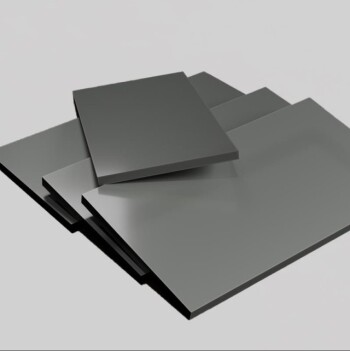
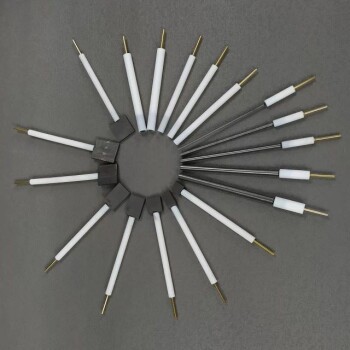
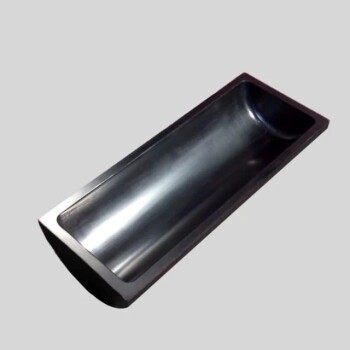
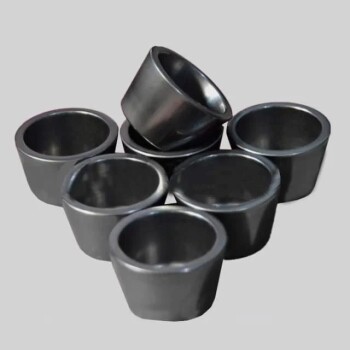
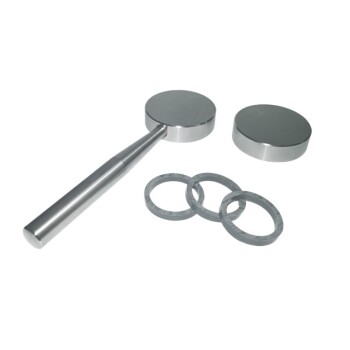
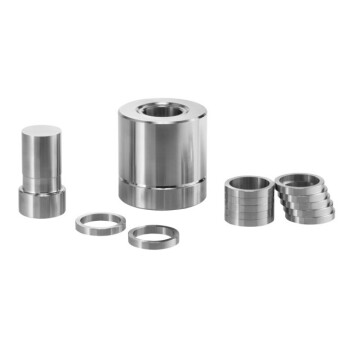
High-strength graphite molds serve as the critical interface between mechanical force and material transformation. During the vacuum hot-press sintering of Ti/Al2O3 composites, these molds function primarily as high-temperature resistant containers that define the macroscopic shape of the laminated samples. Crucially, they act as a transmission medium, converting vertical force from hydraulic cylinders into the internal pressure required to bond the titanium and alumina layers at extreme conditions like 1450°C and 25 MPa.
Core Takeaway The graphite mold is not merely a passive container; it is an active mechanical component that facilitates the plastic deformation of metal layers. Its ability to withstand high thermal loads while transferring hydraulic pressure is the fundamental mechanism that enables diffusion bonding between dissimilar materials like Titanium and Alumina.
The Mechanics of Pressure-Assisted Sintering
Vertical Force Transmission
The primary technical function of the graphite mold is to act as a pressure transfer medium. The mold acts effectively as a piston, vertically transmitting the uniaxial force generated by the hydraulic cylinders directly to the sample stack.
This transmission must be uniform to prevent defects. The mold ensures that the 25 MPa of pressure is applied evenly across the entire surface area of the composite, rather than concentrating at contact points.
Enabling Diffusion Bonding
The application of pressure via the mold is what drives the material science of the process. The transmitted force facilitates plastic deformation in the titanium layers and ensures intimate contact with the Al2O3 layers.
This physical contact is a prerequisite for diffusion bonding. By forcing the layers together at the atomic level, the mold allows atoms to migrate across the interface, creating a cohesive composite structure.
Maintaining Macroscopic Shape
At sintering temperatures of 1450°C, materials can soften or shift. The high-strength graphite mold serves as a rigid containment vessel that maintains the dimensional stability of the laminated stack.
This containment prevents the "squeezing out" of the metal phase and ensures the final product retains the intended geometry. It acts as a positioning tool, keeping the multi-layer stack aligned throughout the thermal cycle.
Thermal Regulation
Graphite is selected not just for strength, but for its thermal conductivity. While the primary reference emphasizes pressure, the mold also plays a vital role in transferring heat from the furnace elements to the sample.
This ensures a uniform temperature distribution throughout the sintering zone. Uniform heating is critical to preventing thermal gradients that could lead to warping or uneven densification of the composite.
Operational Considerations and Limitations
The Consumable Nature of Molds
It is important to recognize that these molds are "core consumables." Despite their high strength, the harsh environment of vacuum hot-pressing eventually degrades the graphite structure.
Repeated cycling between room temperature and 1450°C, combined with high mechanical stress, limits their lifespan. They must be inspected regularly to ensure surface finish and structural integrity are not compromised.
Dimensional Stability at Extremes
While graphite is thermally stable, the specific grade used must match the process parameters. The mold must maintain its shape without deformation under 25 MPa of pressure.
If the mold deforms even slightly, the pressure transmission becomes uneven. This can lead to localized non-bonding or variations in the thickness of the final composite plate.
Optimizing Your Sintering Strategy
To achieve high-quality Ti/Al2O3 composites, your choice of mold and process parameters must align with your specific objectives.
- If your primary focus is Interfacial Bonding Strength: Prioritize the mold's ability to act as a pressure medium; ensure the fit between the punch and die is precise to maximize pressure transmission to the layers.
- If your primary focus is Dimensional Precision: Focus on the high-temperature strength grade of the graphite to ensure zero deformation of the container walls at 1450°C.
- If your primary focus is Microstructural Homogeneity: Leverage the thermal conductivity of the mold by ensuring a consistent wall thickness for uniform heat transfer to the sample.
Ultimately, the graphite mold is the guarantor of the process, translating raw energy into the precise physical conditions required to fuse metal and ceramic.
Summary Table:
| Function | Description | Key Benefit |
|---|---|---|
| Pressure Transmission | Converts hydraulic force into internal pressure (25 MPa) | Facilitates plastic deformation & bonding |
| Structural Containment | Rigid vessel that maintains sample geometry at 1450°C | Prevents metal phase leakage & warping |
| Thermal Regulation | High thermal conductivity for heat transfer | Ensures uniform temperature distribution |
| Interface Driver | Forces atomic-level contact between Ti and Al2O3 | Enables robust diffusion bonding |
Precision engineering starts with the right equipment. KINTEK specializes in advanced laboratory solutions for high-temperature and high-pressure materials research. From high-strength graphite molds and hydraulic pellet presses to state-of-the-art vacuum hot-press furnaces and autoclaves, we provide the tools researchers need to master diffusion bonding and sintering. Whether you require crushing systems, PTFE consumables, or specialized induction melting furnaces, our experts are ready to enhance your lab's performance. Optimize your sintering process—contact KINTEK today!
Related Products
- Carbon Graphite Plate Manufactured by Isostatic Pressing Method
- High Purity Pure Graphite Crucible for Evaporation
- Graphite Disc Rod and Sheet Electrode Electrochemical Graphite Electrode
- Carbon Graphite Boat -Laboratory Tube Furnace with Cover
- High Purity Pure Graphite Crucible for Electron Beam Evaporation
People Also Ask
- What is the process of isostatic graphite manufacturing? Achieve Unmatched Material Uniformity and Performance
- What is isostatic graphite? The Ultimate Material for High-Tech and High-Temperature Applications
- What is the density of isostatic graphite? Unlock Superior Performance for Demanding Applications
- How big is the isostatic pressing market? A Deep Dive into the $1.2B+ Advanced Manufacturing Enabler
- Why Use an Isostatic or High-Precision Hydraulic Press for Li/LLZO/Li Batteries? Master Solid-State Interfaces