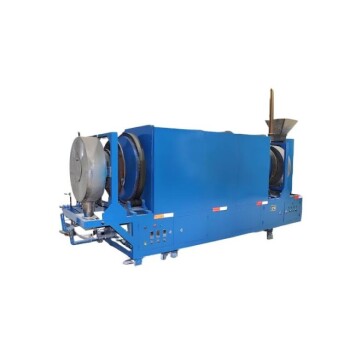
The high-temperature tube furnace acts as the primary reactor for the thermal transformation of polymer precursors into porous silicon oxycarbide (SiOC) ceramics. It provides a strictly controlled environment—typically between 800 °C and 1400 °C—under an inert atmosphere like nitrogen (N2) or argon (Ar). By precisely managing heating rates and isothermal dwell times, the furnace drives the decomposition of organic components and the final curing of the inorganic ceramic network.
The tube furnace is the critical tool for regulating the kinetics of pyrolysis, ensuring the transition from organic precursor to inorganic ceramic yields a specific, high-performance microstructure. It provides the thermal energy required to break chemical bonds and rearrange atoms into a stable SiOC matrix while preventing oxidation.
Atmospheric Control and Chemical Stability
Prevention of Oxidative Degradation
The furnace provides a strictly controlled inert protective atmosphere that is essential for maintaining the integrity of the SiOC matrix. Without the airtight performance of a tube furnace, oxygen would react with the carbon and ceramic phases at high temperatures, leading to material degradation.
Removal of Volatile Byproducts
During pyrolysis, organic components decompose and release volatile phenyl-substituted cyclosiloxanes and other gases. The furnace’s constant gas flow (e.g., flowing nitrogen) continuously removes these volatiles, preventing them from redepositing on the sample or interfering with the chemical transition.
Protection of Equipment and Purity
Using high-quality crucibles within the furnace ensures that sample volatiles do not corrode the inner walls of the furnace tube. This maintains a clean environment and prevents cross-contamination, which is vital for achieving high-purity ceramic structures.
Thermal Kinetics and Structural Integrity
Regulating the Heating Rate to Prevent Cracking
The furnace employs programmable heating rates, often as slow as 1 K/min to 5 °C/min, to guide the material through the sensitive transition state. Controlled heating allows gases to escape the porous structure gradually, which is essential for producing dense, crack-free amorphous ceramic structures.
Facilitating Solid-State Reactions
The furnace provides the kinetic energy necessary to break chemical bonds in the precursor gels and allow atoms to rearrange. This stable thermal environment enables the formation of new structures, such as triclinic crystal systems or specific amorphous networks, depending on the peak temperature.
Isothermal Zones and Final Curing
A high-temperature isothermal zone ensures that the entire sample experiences uniform heat for a set duration. This dwell time is critical for the final curing of the ceramic network and ensures that the material reaches a completely single-phase or desired amorphous state.
Microstructural and Compositional Tuning
Regulating Nanoparticle Precipitation
In specialized SiOC ceramics, such as those containing nickel, the furnace directly regulates the in-situ precipitation and nucleation of nanoparticles. By accurately controlling the temperature curves, the furnace determines the final grain size distribution of these particles within the ceramic matrix.
Achieving Controlled Porosity and Densification
The furnace manages the thermal decomposition of polymer precursors into the amorphous silicon oxycarbide matrix while promoting atomic diffusion. This process is what allows researchers to fine-tune the balance between densification and the preservation of the desired porous microstructure.
Understanding the Trade-offs
Heating Rate vs. Processing Time
While slow heating rates are necessary to prevent structural failure and cracking in porous ceramics, they significantly increase total processing time. Finding the optimal equilibrium between a fast cycle and structural integrity is a common challenge in pyrolysis scaling.
Atmospheric Purity vs. Cost
Maintaining a high-purity argon flow is often more effective at preventing oxidation than nitrogen, but it comes at a higher operational cost. Furthermore, any leak in the tube furnace seals can result in the unintentional oxidation of the carbon phase, ruining the batch despite correct temperature settings.
Crucible Reactivity
At temperatures exceeding 1300 °C, some crucible materials may become chemically active or bond with the SiOC sample. Choosing chemically inert crucibles with high thermal stability is a requirement to avoid contamination of the ceramic or damage to the furnace tube.
Making the Right Choice for Your Goal
How to Apply This to Your Project
To achieve the best results with your high-temperature tube furnace, align your parameters with your primary material objective:
- If your primary focus is structural integrity: Prioritize a very low heating rate (1-2 °C/min) and a high-purity inert gas flow to ensure volatiles escape without causing internal micro-cracks.
- If your primary focus is nanoparticle integration: Focus on precise dwell times and peak temperature control to regulate the nucleation and growth of secondary phases within the SiOC matrix.
- If your primary focus is high-temperature stability: Utilize temperatures at the upper end of the range (1300 °C - 1400 °C) to ensure full conversion and a more stable, single-phase inorganic network.
By mastering the furnace's thermal and atmospheric variables, you can precisely engineer the final mechanical and chemical properties of porous SiOC ceramics.
Summary Table:
| Key Feature | Role in Pyrolysis Process | Impact on SiOC Ceramics |
|---|---|---|
| Atmosphere Control | Provides inert N2/Ar flow | Prevents oxidation and removes volatile byproducts |
| Thermal Kinetics | Programmable heating rates (1-5 K/min) | Prevents structural cracking and ensures densification |
| Isothermal Zones | Uniform heat dwell times | Facilitates final curing and phase stability |
| Microstructural Tuning | Temperature curve regulation | Controls nanoparticle nucleation and grain size distribution |
| Chemical Stability | Sealed, high-purity environment | Maintains material purity and prevents contamination |
Elevate Your Material Synthesis with KINTEK Precision
Achieving the perfect porous SiOC ceramic structure requires more than just heat—it requires total atmospheric and thermal control. KINTEK specializes in high-performance laboratory equipment, providing the advanced high-temperature tube, vacuum, and atmosphere furnaces essential for successful pyrolysis.
Beyond reactors, we offer a comprehensive suite of tools including crushing and milling systems, high-purity crucibles, and ceramic consumables designed to withstand the most rigorous thermal cycles. Whether you are a researcher focused on nanoparticle integration or a manufacturer scaling ceramic production, KINTEK delivers the reliability and expertise you need.
Ready to optimize your pyrolysis process? Contact our experts today to find the ideal furnace and consumable solutions for your lab’s unique requirements!
References
- Gang Yi, Yuxi Yu. Molecular Aggregation Strategy for Pore Generation in SiOC Ceramics Induced by the Conjugation Force of Phenyl. DOI: 10.3390/polym15122676
This article is also based on technical information from Kintek Solution Knowledge Base .
Related Products
- High Temperature Alumina (Al2O3) Furnace Tube for Engineering Advanced Fine Ceramics
- 1700℃ Laboratory High Temperature Tube Furnace with Alumina Tube
- 1400℃ Laboratory High Temperature Tube Furnace with Alumina Tube
- 1200℃ Split Tube Furnace with Quartz Tube Laboratory Tubular Furnace
- Vacuum Heat Treat and Pressure Sintering Furnace for High Temperature Applications
People Also Ask
- What is the primary function of an Alumina (Al2O3) tube in LLZTO sintering? Optimize Your Thermal Processing
- What role does a high-alumina furnace tube play in high-temperature nickel slag reduction? Ensure 1400°C Precision
- How does an alumina tube furnace with a controlled atmosphere simulate conditions in CSP environments? Master Accuracy.
- How do you clean an alumina tube furnace? Extend Tube Life with Proper Maintenance
- How to clean an alumina tube furnace? Extend Tube Life and Ensure Experimental Purity