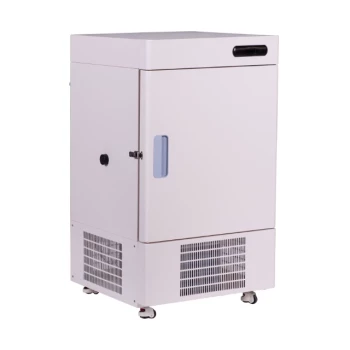
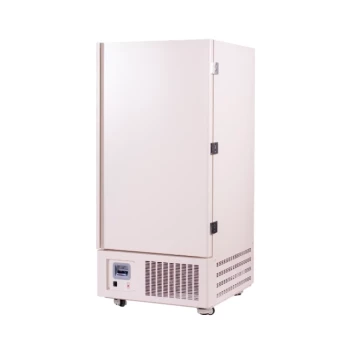
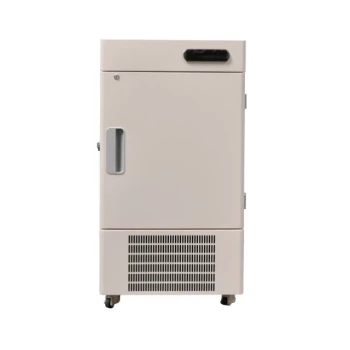
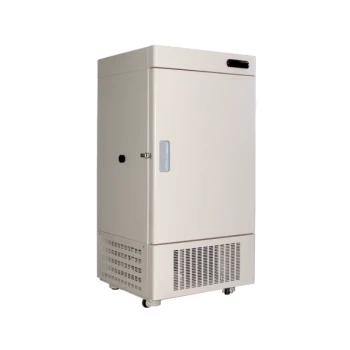
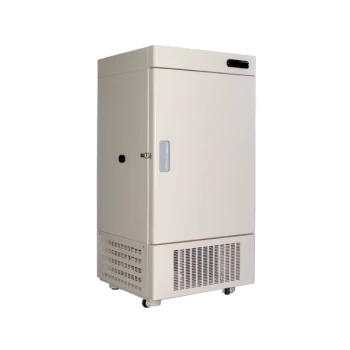
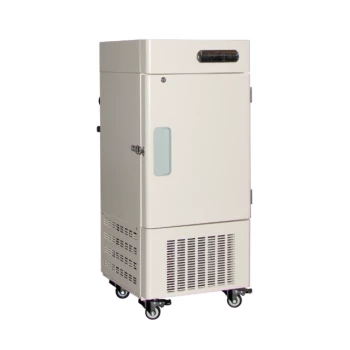
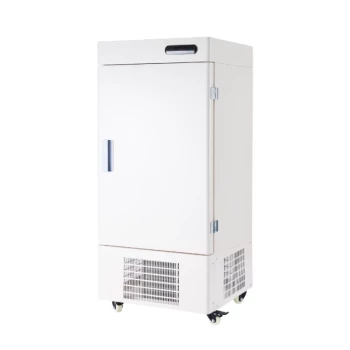
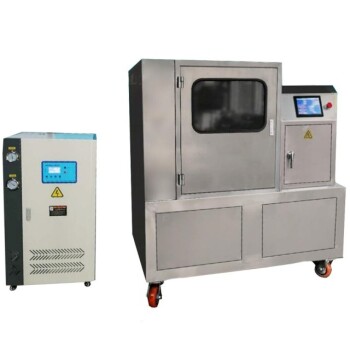
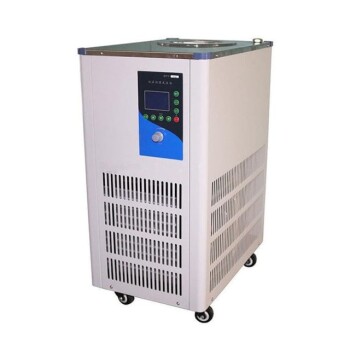
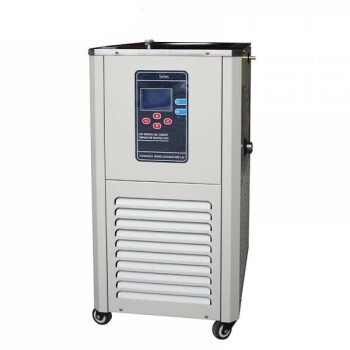
Ultra-Low Temperature (ULT) cooling equipment acts as the critical manufacturing tool for establishing the physical architecture of the hydrogel matrix. Specifically, it is used to execute precise freeze-thaw cycles, a physical cross-linking method that solidifies polymers like Polyvinyl Alcohol (PVA). This process creates a robust, porous scaffold capable of hosting gold nanoparticles without the need for toxic chemical agents.
Core Takeaway ULT cooling drives the formation of ordered microcrystalline regions within the polymer, transforming it into a stable gel with a honeycomb-like microporous structure. This specific architecture is essential for the uniform distribution of gold nanoparticles and ensures the final composite reacts rapidly to thermal or photothermal stimulation.
The Mechanism of Physical Cross-Linking
Inducing Polymer Aggregation
The primary function of ULT equipment is to control the freezing rate in an extreme low-temperature environment. As water within the mixture freezes into ice crystals, it compresses the polymer chains.
This compression forces the chains to aggregate closely, forming ordered microcrystalline regions. These regions act as "physical knots" or cross-linking points that hold the hydrogel together once thawed.
Eliminating Chemical Additives
Unlike traditional synthesis methods, this approach relies entirely on physical changes rather than chemical reactions. By using a ULT freezer, you avoid the use of chemical cross-linking agents like glutaraldehyde.
This results in a purer material with higher biocompatibility, which is often a critical requirement for hydrogel applications.
Shaping the Nanocomposite Architecture
Creating the Honeycomb Structure
The ice crystals formed inside the ULT freezer serve as a temporary template. When the material is thawed, these crystals melt away, leaving behind a honeycomb-like microporous structure.
This porosity is not accidental; it is engineered by the temperature cycles provided by the ULT equipment.
Facilitating Nanoparticle Loading
The resulting porous architecture provides the necessary internal volume to host gold nanoparticles. The interconnected voids allow for uniform loading of these particles throughout the matrix.
Without the precise cavity formation driven by ULT freezing, nanoparticle distribution would likely be uneven, compromising performance.
Enhancing Photothermal Responsiveness
The "performance" of a gold nanoparticle hydrogel often refers to its ability to swell or shrink in response to light (photothermal effect). The porous structure created by the ULT process allows water to move rapidly in and out of the gel.
This ensures the material has rapid swelling and shrinking kinetics, optimizing its use as a photo-actuator.
Understanding the Trade-offs
Process Sensitivity
While ULT freezing creates superior structures, the process is highly sensitive to the rate of cooling. If the temperature descent is not controlled precisely, the ice crystals may form irregularly.
Irregular crystal formation leads to inconsistent pore sizes, which can disrupt the mechanical strength of the gel and the uniformity of the gold nanoparticle dispersion.
Cycle Dependence
Achieving the optimal "honeycomb" structure often requires multiple freeze-thaw cycles rather than a single event. This extends the manufacturing timeline compared to instant chemical cross-linking.
Making the Right Choice for Your Goal
To maximize the effectiveness of your synthesis process, align your cooling protocol with your specific performance metrics:
- If your primary focus is Biocompatibility: Leverage the ULT freeze-thaw process to eliminate all chemical cross-linkers, ensuring the final composite is safe for biological interaction.
- If your primary focus is Response Speed: Optimize the freezing rate to maximize the regularity of the honeycomb pores, which directly correlates to faster water transport and quicker photothermal reaction times.
ULT equipment is not just a freezer; it is the tool that physically engineers the internal highway system of your nanocomposite.
Summary Table:
| Feature of ULT Process | Impact on Nanocomposite Synthesis |
|---|---|
| Physical Cross-Linking | Forms ordered microcrystalline regions without toxic chemical agents. |
| Ice Templating | Creates a honeycomb-like microporous structure for nanoparticle hosting. |
| Pore Engineering | Enables rapid swelling/shrinking kinetics for photothermal response. |
| Biocompatibility | Eliminates chemical additives, making the gel ideal for biological use. |
| Controlled Cooling | Ensures uniform pore distribution and mechanical stability of the matrix. |
Elevate Your Nanomaterial Precision with KINTEK
Unlock the full potential of your hydrogel synthesis with KINTEK’s high-performance Ultra-Low Temperature (ULT) cooling solutions. From precise freeze-thaw cycles to stable storage, our cooling equipment—including ULT freezers, cold traps, and freeze dryers—is engineered to provide the thermal accuracy required for complex polymer architectures.
Whether you are developing advanced gold nanoparticle hydrogels, medical-grade biocompatible materials, or high-response photo-actuators, KINTEK offers the specialized laboratory tools you need. Beyond cooling, our portfolio includes high-temperature furnaces, hydraulic presses, and crushing systems to support your entire material research workflow.
Ready to optimize your lab’s cooling performance? Contact our experts at KINTEK today to find the perfect equipment for your research goals!
References
- Raluca Ivan. Fabrication of hybrid nanostructures by laser technique for water decontamination. DOI: 10.21175/rad.abstr.book.2023.15.4
This article is also based on technical information from Kintek Solution Knowledge Base .
Related Products
- 108L Vertical Ultra Low Temperature ULT Freezer
- 408L Advanced Vertical Laboratory Ultra Low Temperature Freezer for Critical Research Material Preservation
- 508L Advanced Vertical Ultra Low Temperature Freezer for Critical Laboratory Storage
- 938L Vertical Ultra Low Temperature Freezer for Advanced Laboratory Storage
- 58L Precision Laboratory Ultra Low Temperature Upright Freezer for Critical Sample Storage
People Also Ask
- What are the common applications of ultra-low temperature freezers? Preserve Your Most Valuable Samples
- What are the different types of ultra-low temperature freezers available? Choose the Right ULT Freezer for Your Lab
- What are some key features of ultra-low temperature freezers? Essential Guide to Reliable Sample Storage
- Have other labs successfully stored samples at -70°C? Proven Long-Term Preservation for Biological Materials
- What features should be considered when choosing an ultra low temperature freezer? Secure Your Samples with Precision