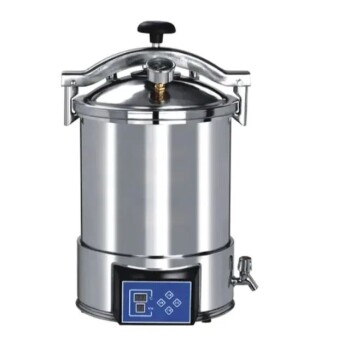
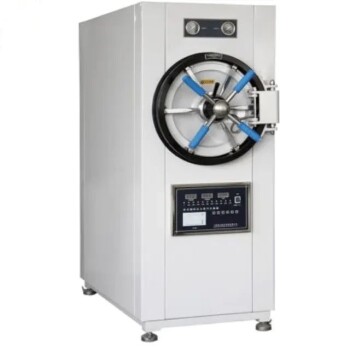
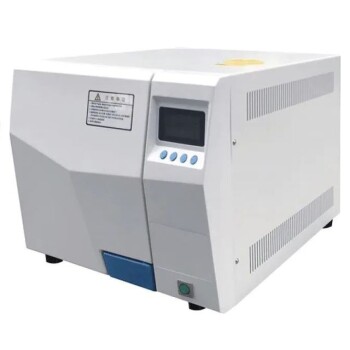
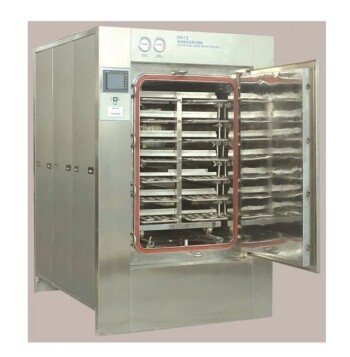
A high-pressure autoclave functions as a precision reaction vessel designed to generate a sealed environment capable of sustaining temperatures and pressures well beyond atmospheric limits. For the synthesis of complex phosphates like CdMn4(HPO4)2(PO4)2·4H2O, its primary role is to drastically increase the solubility of precursors—specifically Manganese, Cadmium Chloride, and phosphoric acid—that are otherwise difficult to dissolve. This allows for liquid-phase reactions at temperatures such as 468 K, facilitating the growth of high-quality single crystals.
Core Takeaway The autoclave does not merely heat the reactants; it utilizes a sealed volume to generate autogenous pressure, which alters the physical properties of the solvent. This transformation enables the dissolution of solid precursors and creates a supersaturated environment essential for the nucleation of defect-free, Hureaulite-type crystal structures.
The Mechanism of Hydrothermal Synthesis
Overcoming Solubility Barriers
Standard atmospheric heating is often insufficient for dissolving complex metal and phosphate precursors. The autoclave allows the solvent to reach temperatures significantly exceeding its boiling point without evaporating.
At specific temperatures, such as the 468 K referenced for this material, the dielectric constant and viscosity of the water (or solvent) change. This allows the Manganese and Cadmium Chloride to dissolve completely into the phosphoric acid solution, creating a homogeneous fluid phase necessary for reaction.
Generating Autogenous Pressure
The term "high-pressure" in this context refers to autogenous pressure—pressure self-generated by the heating of the liquid within a fixed volume.
As the temperature rises within the sealed vessel, the internal pressure increases proportionally. This pressure is critical because it drives the reaction kinetics and forces the precursors to interact at a molecular level that would be impossible in an open system.
Driving Nucleation and Growth
Once the precursors are dissolved, the stable thermal environment of the autoclave governs the transition from liquid to solid.
By maintaining high pressure and temperature, the system reaches a specific state of supersaturation. This promotes controlled nucleation, where the dissolved ions begin to organize into a solid lattice. The liquid phase environment ensures that this growth is directional and uniform.
Ensuring Crystal Quality and Integrity
Minimizing Internal Defects
For complex materials like CdMn4(HPO4)2(PO4)2·4H2O, the goal is often to produce crystals suitable for advanced diffraction analysis.
The autoclave provides a distinct advantage here: it minimizes thermal gradients and fluctuations. A stable environment reduces the likelihood of crystal defects, ensuring the internal structure is consistent and chemically pure.
Achieving the Hureaulite-Type Structure
The specific arrangement of atoms in this phosphate material is known as a Hureaulite-type structure.
Achieving this specific phase requires precise control over reaction kinetics. The autoclave ensures that the reaction proceeds at the correct rate, preventing the formation of competing, unwanted amorphous phases or irregular polymorphs.
Understanding the Trade-offs
Sensitivity to Temperature Variables
While the autoclave offers precision, it also introduces high sensitivity. Because the pressure is autogenous, it is directly coupled to temperature.
A slight deviation in temperature regulation will cause a fluctuation in internal pressure. This can disrupt the supersaturation balance, potentially leading to rapid, disordered precipitation rather than controlled single-crystal growth.
The "Black Box" Limitation
A practical challenge of high-pressure autoclaves is the inability to observe the reaction in real-time.
Unlike open-beaker chemistry, you cannot visually monitor the dissolution or nucleation stages. You must rely entirely on predictive modeling of the temperature-pressure relationship to ensure the reaction environment remains within the "growth zone" for the entire duration.
Making the Right Choice for Your Goal
To optimize the synthesis of CdMn4(HPO4)2(PO4)2·4H2O, align your autoclave parameters with your specific analytical needs:
- If your primary focus is Single Crystal Diffraction: Prioritize a slow cooling ramp within the autoclave to maintain the stable supersaturation required for large, defect-free crystal growth.
- If your primary focus is Phase Purity (Hureaulite structure): Focus on precise temperature regulation (e.g., maintaining exactly 468 K) to ensure the autogenous pressure remains constant throughout the nucleation phase.
The autoclave is not just a heating device; it is a solubility engineer that forces incompatible solids to merge into complex, ordered crystalline architectures.
Summary Table:
| Parameter | Function in Hydrothermal Synthesis |
|---|---|
| Temperature (e.g., 468 K) | Increases solvent solubility and alters dielectric constants for precursor dissolution. |
| Autogenous Pressure | Self-generated pressure that drives reaction kinetics and maintains liquid phase above boiling point. |
| Solvent Environment | Creates a supersaturated state essential for controlled nucleation and growth of single crystals. |
| Structural Control | Minimizes thermal gradients to ensure defect-free, Hureaulite-type crystal structures. |
Elevate Your Material Synthesis with KINTEK Precision
Achieving the perfect Hureaulite-type crystal structure requires uncompromising control over temperature and pressure. KINTEK specializes in high-performance laboratory equipment, offering a premium range of high-temperature high-pressure reactors and autoclaves designed specifically for complex hydrothermal synthesis.
Whether you are developing advanced phosphates or conducting cutting-edge battery research, our solutions—including muffle furnaces, vacuum systems, and specialized PTFE consumables—provide the stability your research demands.
Ready to optimize your crystal growth and eliminate phase impurities?
Contact KINTEK today to find the ideal autoclave solution for your lab!
References
- Chaymae Alami, Lahcen El. Hydrothermal Synthesis and Crystal Structure of a Novel Phosphate: CdMn4(HPO4)2(PO4)2.4H2O. DOI: 10.17756/nwj.2023-s2-065
This article is also based on technical information from Kintek Solution Knowledge Base .
Related Products
- Mini SS High Pressure Autoclave Reactor for Laboratory Use
- High Pressure Laboratory Autoclave Reactor for Hydrothermal Synthesis
- Stainless High Pressure Autoclave Reactor Laboratory Pressure Reactor
- Desktop Fast High Pressure Laboratory Autoclave Sterilizer 16L 24L for Lab Use
- Laboratory High Pressure Horizontal Autoclave Steam Sterilizer for Lab Use
People Also Ask
- Why use high-pressure reactors for molecular sieve synthesis? Unlock Superior Crystallinity and Framework Control
- What is the function of a high-pressure reactor autoclave? Enhancing Cu/N Co-Doped Carbon Catalyst Synthesis
- What are the advantages of using a high-pressure reactor like an autoclave? Maximize Liquefaction Speed & Yield
- Why are high-pressure reactors or autoclaves necessary for the synthesis of new functional materials? Unlock Precision.
- How are high-pressure reactors used to prepare metaphosphate electrocatalysts? Master In-Situ Precursor Growth