Knowledge What is the speed range of a ball mill? Find Your Optimal Grinding Efficiency
Author avatar

Tech Team · Kintek Solution

Updated 1 week ago

What is the speed range of a ball mill? Find Your Optimal Grinding Efficiency


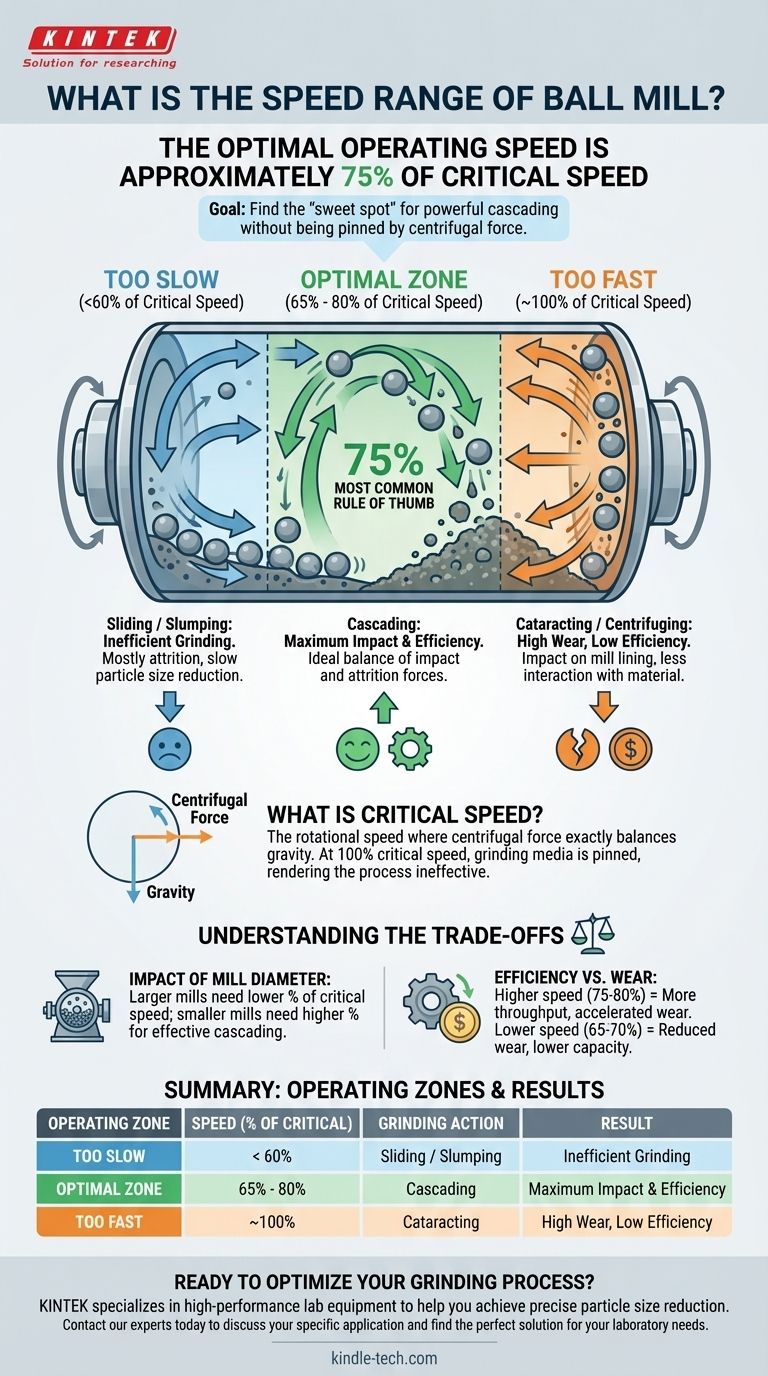
The optimal operating speed for most ball mills is approximately 75% of their "critical speed." This isn't an arbitrary number; it represents a carefully calculated balance point between the physical forces required for efficient grinding and the point where those forces become counterproductive. The ideal speed ensures the grinding media cascades effectively to crush the material.

The core challenge in setting ball mill speed is not to maximize rotation, but to optimize impact. The goal is to find the "sweet spot" where the grinding media is lifted high enough to create a powerful cascade, but not so fast that it gets pinned to the mill wall by centrifugal force.

What is the speed range of a ball mill? Find Your Optimal Grinding Efficiency

What is Critical Speed?

Critical speed is a foundational concept in ball mill operation. It defines the theoretical limit at which the mill is effective.

Defining Critical Speed

Critical speed is the rotational speed where the centrifugal force inside the mill exactly balances the force of gravity.

At this speed, the grinding media (the balls) are pinned against the inner wall of the rotating drum. Instead of tumbling and crushing the material, they simply spin with the mill, rendering the grinding process ineffective.

Think of it like the spin cycle in a washing machine. Once it reaches a high enough speed, the clothes stick to the side of the drum. This is exactly what happens to the grinding media at 100% critical speed.

The Three Operating Speed Zones

Understanding critical speed allows us to define three distinct operational zones, only one of which is effective for grinding.

Too Slow (Below ~60% of Critical Speed)

If the mill rotates too slowly, the balls are not lifted high enough along the side of the drum.

They simply roll over each other at the bottom of the charge, a motion known as "sliding" or "slumping." This results in very little impact force and primarily causes attrition, leading to extremely inefficient and slow grinding.

The Optimal Zone (65% - 80% of Critical Speed)

This is the target range for efficient grinding, with 75% being the most common rule of thumb.

In this zone, the balls are carried almost to the top of the drum before they break away and tumble down onto the material below. This "cascading" motion maximizes the impact and attrition forces needed for effective particle size reduction.

Too Fast (Approaching 100% of Critical Speed)

As the speed increases beyond the optimal zone, the balls are thrown further and with more force. This is called "cataracting."

While this creates high impact, it directs that force primarily onto the mill's inner lining rather than the material itself. This dramatically increases wear and tear on the mill and reduces grinding efficiency as the balls spend less time interacting with the material charge.

Understanding the Trade-offs

The 75% rule is a starting point, not an absolute law. The true optimum speed is a balance between productivity and operational costs.

The Impact of Mill Diameter

The ideal percentage of critical speed is influenced by the mill's diameter.

Larger diameter mills can achieve the necessary lift height at a slightly lower percentage of critical speed. Conversely, smaller mills may need to operate at a slightly higher percentage to get the same effective cascading action.

Efficiency vs. Wear

Operating at the higher end of the optimal range (e.g., 75-80%) can increase throughput but will also accelerate the wear on both the grinding media and the mill liners.

Running at the lower end (e.g., 65-70%) reduces wear and operational costs but may result in lower production capacity.

Making the Right Choice for Your Goal

Selecting the correct speed is about aligning the mill's operation with your primary business objective.

  • If your primary focus is maximum throughput: Operate toward the higher end of the optimal range (75-80% of critical speed), but plan for higher maintenance costs and more frequent replacement of liners and media.
  • If your primary focus is minimizing operational costs: Run closer to the lower end of the optimal range (65-70% of critical speed) to extend the life of your equipment and consumables.
  • If you are establishing a new process: Start with the industry standard of 75% of critical speed and carefully monitor your output quality and equipment wear to fine-tune your operation.

Ultimately, ball mill speed is the primary lever you can pull to balance productivity against long-term operational expense.

Summary Table:

Operating Zone Speed (% of Critical) Grinding Action Result
Too Slow < 60% Sliding/Slumping Inefficient Grinding
Optimal Zone 65% - 80% Cascading Maximum Impact & Efficiency
Too Fast ~100% Cataracting High Wear, Low Efficiency

Ready to optimize your grinding process? The right ball mill speed is critical for balancing productivity and operational costs. KINTEK specializes in high-performance lab equipment, including ball mills, to help you achieve precise particle size reduction and maximize your lab's efficiency. Contact our experts today to discuss your specific application and find the perfect solution for your laboratory needs.

Visual Guide
What is the speed range of a ball mill? Find Your Optimal Grinding Efficiency Visual Guide

Related Products

People Also Ask

Related Products

Laboratory Jar Ball Mill with Alumina Zirconia Grinding Jar and Balls

Laboratory Jar Ball Mill with Alumina Zirconia Grinding Jar and Balls

Grind to perfection with alumina/zirconia grinding jars and balls. Available in volume sizes from 50ml to 2500ml, compatible with various mills.

High-Energy Omnidirectional Planetary Ball Mill Milling Machine for Laboratory

High-Energy Omnidirectional Planetary Ball Mill Milling Machine for Laboratory

The KT-P4000E is a new product derived from the vertical high-energy planetary ball mill with a 360° swivel function. Experience faster, uniform, and smaller sample output results with 4 ≤1000ml ball mill jars.

High Energy Planetary Ball Mill Milling Machine for Laboratory

High Energy Planetary Ball Mill Milling Machine for Laboratory

Experience fast and effective sample processing with the F-P2000 high-energy planetary ball mill. This versatile equipment offers precise control and excellent grinding capabilities. Perfect for laboratories, it features multiple grinding bowls for simultaneous testing and high output. Achieve optimal results with its ergonomic design, compact structure, and advanced features. Ideal for a wide range of materials, it ensures consistent particle size reduction and low maintenance.

High-Energy Omnidirectional Planetary Ball Mill Machine for Laboratory

High-Energy Omnidirectional Planetary Ball Mill Machine for Laboratory

The KT-P2000E is a new product derived from the vertical high-energy planetary ball mill with a 360°rotation function. The product not only has the characteristics of the vertical high-energy ball mill, but also has a unique 360°rotation function for the planetary body.

High Energy Planetary Ball Mill Milling Machine for Laboratory

High Energy Planetary Ball Mill Milling Machine for Laboratory

The biggest feature is that the high energy planetary ball mill can not only perform fast and effective grinding, but also has good crushing ability

Hybrid High Energy Vibratory Ball Mill for Lab Use

Hybrid High Energy Vibratory Ball Mill for Lab Use

KT-BM400 is used for rapid grinding or mixing of dry, wet and frozen small amount of samples in the laboratory. It can be configured with two 50ml ball mill jars

Laboratory High Throughput Tissue Grinding Mill Grinder

Laboratory High Throughput Tissue Grinding Mill Grinder

KT-MT is a high-quality, small, and versatile tissue grinder used for crushing, grinding, mixing, and cell wall breaking in various fields, including food, medical, and environmental protection. It is equipped with 24 or 48 2ml adapters and ball grinding tanks and is widely employed for DNA, RNA, and protein extraction.

Laboratory Hybrid Tissue Grinding Mill

Laboratory Hybrid Tissue Grinding Mill

KT-MT20 is a versatile laboratory device used for rapid grinding or mixing of small samples, whether dry, wet, or frozen. It comes with two 50ml ball mill jars and various cell wall breaking adapters for biological applications such as DNA/RNA and protein extraction.

High Energy Vibratory Laboratory Ball Mill Grinding Mill Single Tank Type

High Energy Vibratory Laboratory Ball Mill Grinding Mill Single Tank Type

High-energy vibration ball mill is a small desktop laboratory grinding instrument.It can be ball-milled or mixed with different particle sizes and materials by dry and wet methods.

Lab Vibration Mill

Lab Vibration Mill

Vibration Mill for Efficient Sample Preparation, Suitable for Crushing and Grinding a Variety of Materials with Analytical Precision. Supports Dry / Wet / Cryogenic Grinding and Vacuum/Inert Gas Protection.

Laboratory Disc Cup Vibratory Mill for Sample Grinding

Laboratory Disc Cup Vibratory Mill for Sample Grinding

The vibrating disc mill is suitable for non-destructive crushing and fine grinding of samples with large particle sizes, and can quickly prepare samples with analytical fineness and purity.

Liquid Nitrogen Cryogenic Grinder Mill Cryomill with Screw Feeder

Liquid Nitrogen Cryogenic Grinder Mill Cryomill with Screw Feeder

Discover the Liquid Nitrogen Cryogenic Pulverizer with Screw Feeder, perfect for fine material processing. Ideal for plastics, rubber, and more. Boost your lab efficiency now!

lab cryogenic grinding use liquid-nitrogen for pulverizing plastic raw materials and heat sensitive materials

lab cryogenic grinding use liquid-nitrogen for pulverizing plastic raw materials and heat sensitive materials

Discover the KT-CG01 Liquid Nitrogen Cryogenic Pulverizer, Ideal for Plastic and Heat-Sensitive Material Pulverization, Preserving Material Integrity and Delivering Ultra-Fine Results.

Laboratory Test Sieves and Sieving Machines

Laboratory Test Sieves and Sieving Machines

Precision lab test sieves & sieving machines for accurate particle analysis. Stainless steel, ISO-compliant, 20μm-125mm range. Request specs now!

Anti-Cracking Press Mold for Lab Use

Anti-Cracking Press Mold for Lab Use

The anti-cracking press mold is a specialized equipment designed for molding various shapes and sizes of film using high pressure and electric heating.

HFCVD Machine System Equipment for Drawing Die Nano-Diamond Coating

HFCVD Machine System Equipment for Drawing Die Nano-Diamond Coating

The nano-diamond composite coating drawing die uses cemented carbide (WC-Co) as the substrate, and uses the chemical vapor phase method ( CVD method for short ) to coat the conventional diamond and nano-diamond composite coating on the surface of the inner hole of the mold.

Benchtop Laboratory Vacuum Freeze Dryer

Benchtop Laboratory Vacuum Freeze Dryer

Benchtop laboratory freeze dryer for efficient lyophilization of biological, pharmaceutical, and food samples. Features intuitive touchscreen, high-performance refrigeration, and durable design. Preserve sample integrity—consult now!

Laboratory Sterilizer Lab Autoclave Vertical Pressure Steam Sterilizer for Liquid Crystal Display Automatic Type

Laboratory Sterilizer Lab Autoclave Vertical Pressure Steam Sterilizer for Liquid Crystal Display Automatic Type

Liquid crystal display automatic vertical sterilizer is a safe, reliable and automatic control sterilization equipment, which is composed of heating system, microcomputer control system and overheating and overvoltage protection system.

Laboratory Vibratory Sieve Shaker Machine Slap Vibrating Sieve

Laboratory Vibratory Sieve Shaker Machine Slap Vibrating Sieve

KT-T200TAP is a slapping and oscillating sieving instrument for laboratory desktop use, with 300 rpm horizontal circular motion and 300 vertical slapping motions to simulate manual sieving to help sample particles pass through better.

Benchtop Laboratory Freeze Dryer for Lab Use

Benchtop Laboratory Freeze Dryer for Lab Use

Premium benchtop laboratory freeze dryer for lyophilization, preserving samples with ≤ -60°C cooling. Ideal for pharmaceuticals & research.


Leave Your Message