Knowledge engineering ceramics What is the temperature limit for alumina? It's not a single number—here's why.
Author avatar

Tech Team · Kintek Solution

Updated 2 months ago

What is the temperature limit for alumina? It's not a single number—here's why.


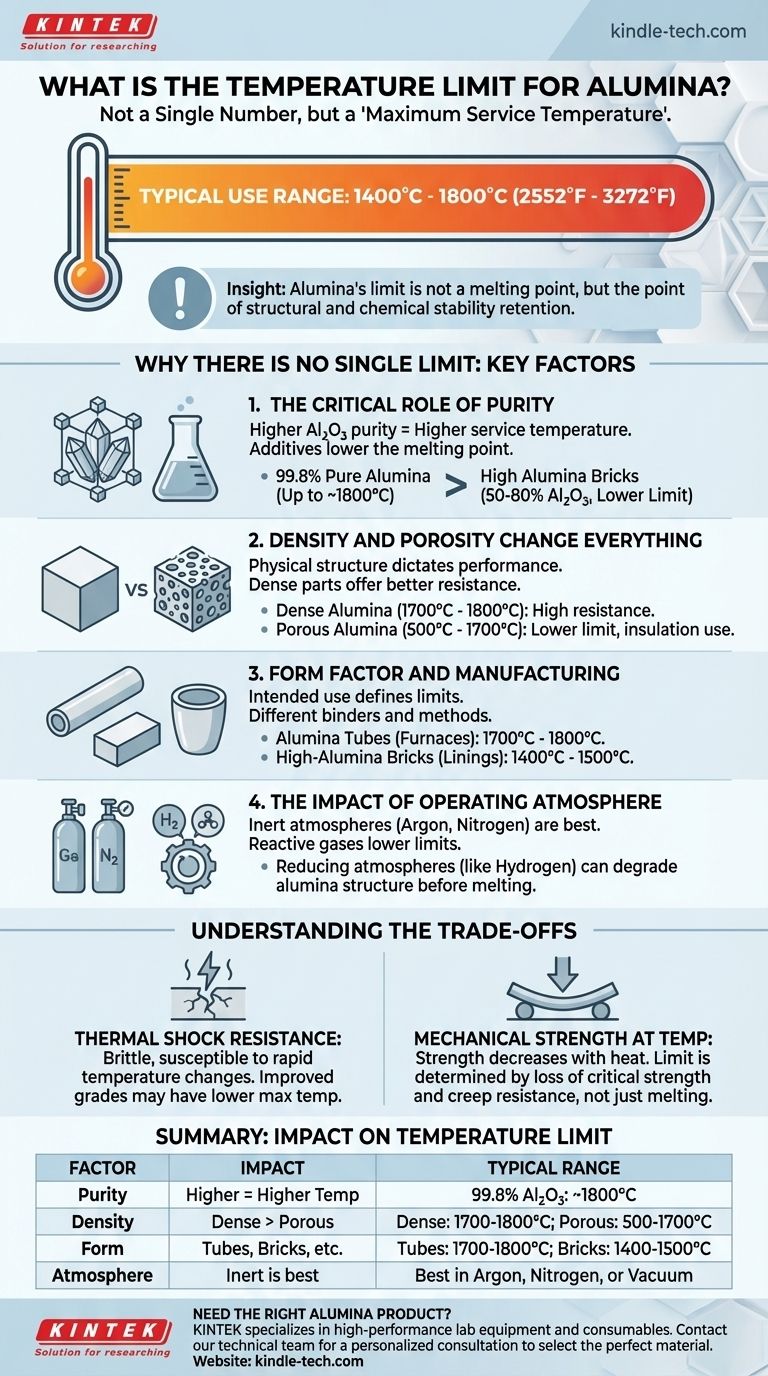
For practical applications, the maximum use temperature of alumina ceramic typically falls between 1400°C and 1800°C (2552°F to 3272°F). However, this is not a single, fixed number. The precise temperature limit is highly dependent on the alumina's purity, density, and the specific form of the final product.

The term "temperature limit" for alumina is misleading. Instead of a single melting point, you must consider the Maximum Service Temperature, which is the highest temperature at which the material retains its structural integrity and chemical stability for a specific application. This limit is determined by the product's purity, density, and operating environment.
What is the temperature limit for alumina? It's not a single number—here's why.

Why There Is No Single Temperature Limit for Alumina

Alumina (Aluminum Oxide, Al₂O₃) is not one monolithic material but a category of ceramics. The manufacturing process and final composition dictate its performance under heat.

The Critical Role of Purity

The percentage of Al₂O₃ is the single most important factor. Additives and impurities, even in small amounts, can create lower-melting-point phases within the ceramic structure.

A higher purity level almost always corresponds to a higher maximum service temperature. For example, a 99.8% pure alumina component will have a significantly higher limit than a "high alumina brick" which may be only 50-80% alumina.

Density and Porosity Change Everything

The physical structure of the ceramic is just as important as its chemical makeup. A dense, fully sintered part behaves very differently from a porous one.

Dense alumina, with minimal voids, offers the highest temperature resistance, typically in the 1700°C to 1800°C range.

Porous alumina, designed for applications like insulation or filtration, has a much wider and generally lower service temperature range, from 500°C to 1700°C, because its structure is less robust.

Form Factor and Manufacturing

The final shape and intended use define the product's limits. Different binders and manufacturing methods are used for different forms.

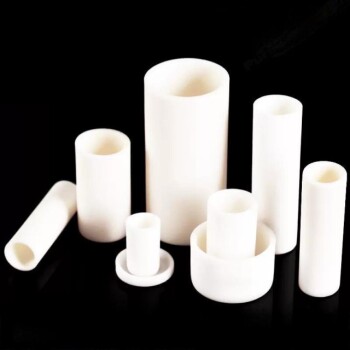
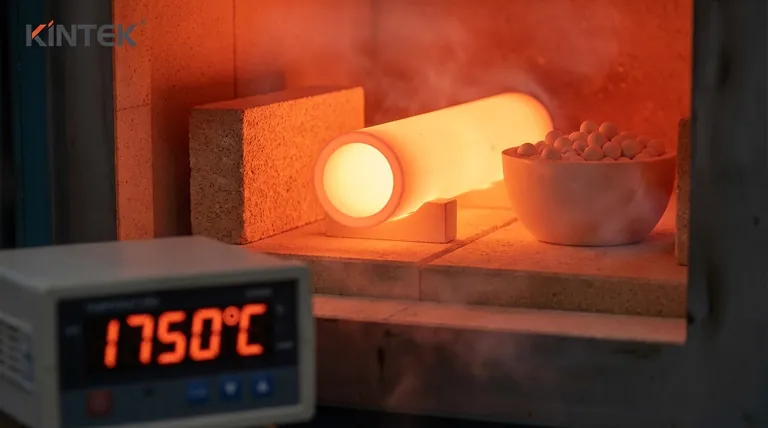
Alumina tubes, often used in furnaces, are engineered for high density and thermal stability, commonly rated for 1700°C to 1800°C.

High-alumina bricks, used for furnace linings, are designed for a balance of insulation and structural strength, often placing their limit lower, around 1400°C to 1500°C.

The Impact of Operating Atmosphere

The maximum temperature is almost always specified for use in an inert atmosphere (like argon or nitrogen) or a vacuum.

Reactive atmospheres can significantly lower the effective temperature limit. For example, strong reducing atmospheres (like hydrogen) can begin to react with the alumina at high temperatures, degrading its structure long before it would melt.

Understanding the Trade-offs

Selecting an alumina product is not just about finding the highest temperature rating. You must consider the practical limitations and balances.

Thermal Shock Resistance

While excellent at handling sustained high heat, alumina can be brittle and susceptible to thermal shock. Rapid heating or cooling can cause it to crack.

Specialized grades are formulated to improve thermal shock resistance, but this may come at the cost of a slightly lower maximum service temperature.

Mechanical Strength at Temperature

A material's strength decreases as it gets hotter. The maximum service temperature is not its melting point (which is over 2000°C), but the point where it begins to lose a critical amount of its mechanical strength and resistance to creep (slow deformation under load).

Cost vs. Performance

There is a direct and steep correlation between performance and cost. A 99.8% pure, fully dense, custom-machined alumina component will be orders of magnitude more expensive than a standard high-alumina firebrick.

Making the Right Choice for Your Application

To select the correct material, you must match the product's specifications to your primary goal.

  • If your primary focus is absolute maximum temperature resistance: You need a high-purity (99.5%+) and high-density (low porosity) alumina product, operated in an inert atmosphere.
  • If your primary focus is furnace lining and insulation: High-alumina bricks or porous alumina plates offer the best balance of thermal insulation and structural integrity for their rated temperature.
  • If your primary focus is for labware or process tubes: Standard dense alumina tubes offer excellent performance, but you must implement controlled heating and cooling cycles to avoid thermal shock.

Ultimately, understanding these key factors empowers you to look beyond a single number and choose the material truly suited to your needs.

Summary Table:

Factor Impact on Temperature Limit Typical Range
Purity Higher purity = higher temperature resistance 99.8% Al₂O₃: ~1800°C
Density Dense parts resist heat better than porous ones Dense: 1700-1800°C; Porous: 500-1700°C
Form/Product Tubes, bricks, and labware have different ratings Tubes: 1700-1800°C; Bricks: 1400-1500°C
Atmosphere Inert atmospheres preserve integrity; reactive gases lower the limit Best in argon, nitrogen, or vacuum

Need the right alumina product for your high-temperature application?

At KINTEK, we specialize in high-performance lab equipment and consumables. Our experts understand that the 'right' alumina depends on your specific needs—whether it's for maximum temperature resistance, thermal insulation, or resistance to thermal shock. We provide high-purity, dense alumina tubes, bricks, and custom components designed for reliability in demanding laboratory environments.

Let us help you select the perfect material to ensure your process runs safely and efficiently. Contact our technical team today for a personalized consultation!

Visual Guide
What is the temperature limit for alumina? It's not a single number—here's why. Visual Guide

Related Products

People Also Ask

Related Products

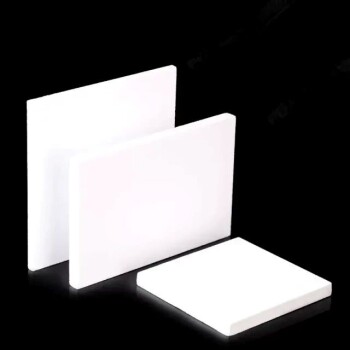
High Temperature Wear-Resistant Alumina Al2O3 Plate for Engineering Advanced Fine Ceramics

High Temperature Wear-Resistant Alumina Al2O3 Plate for Engineering Advanced Fine Ceramics

High temperature wear-resistant insulating alumina plate has excellent insulation performance and high temperature resistance.

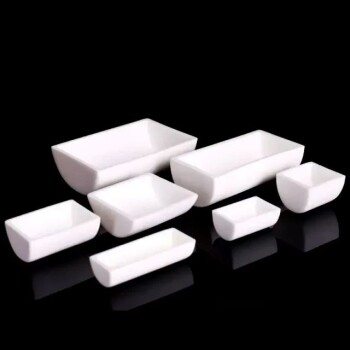
Alumina Al2O3 Ceramic Crucible Semicircle Boat with Lid for Engineering Advanced Fine Ceramics

Alumina Al2O3 Ceramic Crucible Semicircle Boat with Lid for Engineering Advanced Fine Ceramics

Crucibles are containers widely used for melting and processing various materials, and semicircular boat-shaped crucibles are suitable for special smelting and processing requirements. Their types and uses vary by material and shape.

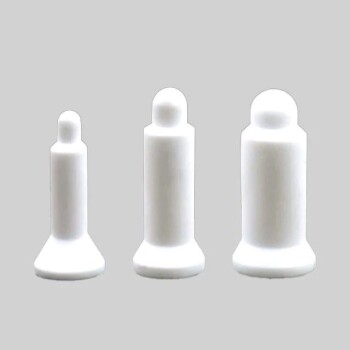
Engineering Advanced Fine Alumina (Al₂O₃) Ceramic Positioning Pin Straight Bevel for Precision Applications

Engineering Advanced Fine Alumina (Al₂O₃) Ceramic Positioning Pin Straight Bevel for Precision Applications

Alumina ceramic positioning pin has the characteristics of high hardness, wear resistance and high temperature resistance.

Advanced Engineering Fine Ceramics Low Temperature Alumina Granulation Powder

Advanced Engineering Fine Ceramics Low Temperature Alumina Granulation Powder

Low temperature alumina granulation powder is a kind of alumina particles produced by a special low temperature process, designed to meet the needs of temperature sensitive applications. This material has excellent low temperature performance and good processing characteristics, suitable for a variety of industries that require low temperature processing and treatment.

High Purity Alumina Granulated Powder for Engineering Advanced Fine Ceramics

High Purity Alumina Granulated Powder for Engineering Advanced Fine Ceramics

Ordinary alumina granulated powder is alumina particles prepared by traditional processes, with a wide range of applications and good market adaptability. This material is known for its high purity, excellent thermal stability and chemical stability, and is suitable for a variety of high-temperature and conventional applications.

High Quality Alumina Ceramic Screw for Engineering Advanced Fine Ceramics with High Temperature Resistance and Insulation

High Quality Alumina Ceramic Screw for Engineering Advanced Fine Ceramics with High Temperature Resistance and Insulation

Alumina ceramic screws are fastening components made of 99.5% alumina, ideal for extreme applications requiring excellent thermal resistance, electrical insulation and chemical resistance.

Custom-Made Alumina Zirconia Special-Shaped Ceramic Plates for Engineering Advanced Fine Ceramics Processing

Custom-Made Alumina Zirconia Special-Shaped Ceramic Plates for Engineering Advanced Fine Ceramics Processing

Alumina ceramics have good electrical conductivity, mechanical strength and high temperature resistance, while zirconia ceramics are known for their high strength and high toughness and are widely used.

Engineering Advanced Fine Alumina Al2O3 Ceramic Rod Insulated for Industrial Applications

Engineering Advanced Fine Alumina Al2O3 Ceramic Rod Insulated for Industrial Applications

Insulated alumina rod is a fine ceramic material. Alumina rods have excellent electrical insulating properties, high chemical resistance and low thermal expansion.

Engineering Advanced Fine Alumina Al2O3 Ceramic Crucible for Laboratory Muffle Furnace

Engineering Advanced Fine Alumina Al2O3 Ceramic Crucible for Laboratory Muffle Furnace

Alumina ceramic crucibles are used in some materials and metal melting tools, and flat-bottomed crucibles are suitable for melting and processing larger batches of materials with better stability and uniformity.

Engineering Advanced Fine Ceramics Alumina Al2O3 Crucible With Lid Cylindrical Laboratory Crucible

Engineering Advanced Fine Ceramics Alumina Al2O3 Crucible With Lid Cylindrical Laboratory Crucible

Cylindrical Crucibles Cylindrical crucibles are one of the most common crucible shapes, suitable for melting and processing a wide variety of materials, and are easy to handle and clean.

Engineering Advanced Fine Ceramics Aluminium Oxide Al2O3 Ceramic Washer for Wear-Resistant Applications

Engineering Advanced Fine Ceramics Aluminium Oxide Al2O3 Ceramic Washer for Wear-Resistant Applications

Alumina wear-resistant ceramic washer are used for heat dissipation, which can replace aluminum heat sinks, with high temperature resistance and high thermal conductivity.

Arc-Shaped Alumina Ceramic Crucible High Temperature Resistant for Engineering Advanced Fine Ceramics

Arc-Shaped Alumina Ceramic Crucible High Temperature Resistant for Engineering Advanced Fine Ceramics

In the journey of scientific exploration and industrial production, every detail is crucial. Our arc-shaped alumina ceramic crucibles, with their excellent high temperature resistance and stable chemical properties, have become a powerful assistant in laboratories and industrial fields. They are made of high-purity alumina materials and manufactured through precision processes to ensure excellent performance in extreme environments.

High Temperature Alumina (Al2O3) Furnace Tube for Engineering Advanced Fine Ceramics

High Temperature Alumina (Al2O3) Furnace Tube for Engineering Advanced Fine Ceramics

High temperature alumina furnace tube combines the advantages of high hardness of alumina, good chemical inertness and steel, and has excellent wear resistance, thermal shock resistance and mechanical shock resistance.

Advanced Engineering Fine Ceramics Alumina Ceramic Saggar for Fine Corundum

Advanced Engineering Fine Ceramics Alumina Ceramic Saggar for Fine Corundum

Alumina sagger products have the characteristics of high temperature resistance, good thermal shock stability, small expansion coefficient, anti-stripping, and good anti-powdering performance.

Engineering Advanced Fine Ceramics Alumina Crucibles (Al2O3) for Thermal Analysis TGA DTA

Engineering Advanced Fine Ceramics Alumina Crucibles (Al2O3) for Thermal Analysis TGA DTA

TGA/DTA thermal analysis vessels are made of aluminum oxide (corundum or aluminum oxide). It can withstand high temperature and is suitable for analyzing materials that require high temperature testing.

High Temperature Aluminum Oxide (Al2O3) Protective Tube for Engineering Advanced Fine Ceramics

High Temperature Aluminum Oxide (Al2O3) Protective Tube for Engineering Advanced Fine Ceramics

Alumina oxide protective tube, also known as high temperature resistant corundum tube or thermocouple protection tube, is a ceramic tube mainly made of alumina (aluminum oxide).

Ceramic Evaporation Boat Set Alumina Crucible for Laboratory Use

Ceramic Evaporation Boat Set Alumina Crucible for Laboratory Use

It can be used for vapor deposition of various metals and alloys. Most metals can be evaporated completely without loss. Evaporation baskets are reusable.1

Aluminized Ceramic Evaporation Boat for Thin Film Deposition

Aluminized Ceramic Evaporation Boat for Thin Film Deposition

Vessel for depositing thin films; has an aluminum-coated ceramic body for improved thermal efficiency and chemical resistance. making it suitable for various applications.

Engineering Advanced Fine Ceramics Aluminum Oxide Al2O3 Heat Sink for Insulation

Engineering Advanced Fine Ceramics Aluminum Oxide Al2O3 Heat Sink for Insulation

The hole structure of the ceramic heat sink increases the heat dissipation area in contact with the air, which greatly enhances the heat dissipation effect, and the heat dissipation effect is better than that of super copper and aluminum.

Advanced Engineering Fine Ceramics Aluminum Nitride (AlN) Ceramic Sheet

Advanced Engineering Fine Ceramics Aluminum Nitride (AlN) Ceramic Sheet

Aluminum nitride (AlN) has the characteristics of good compatibility with silicon. It is not only used as a sintering aid or reinforcing phase for structural ceramics, but its performance far exceeds that of alumina.


Leave Your Message