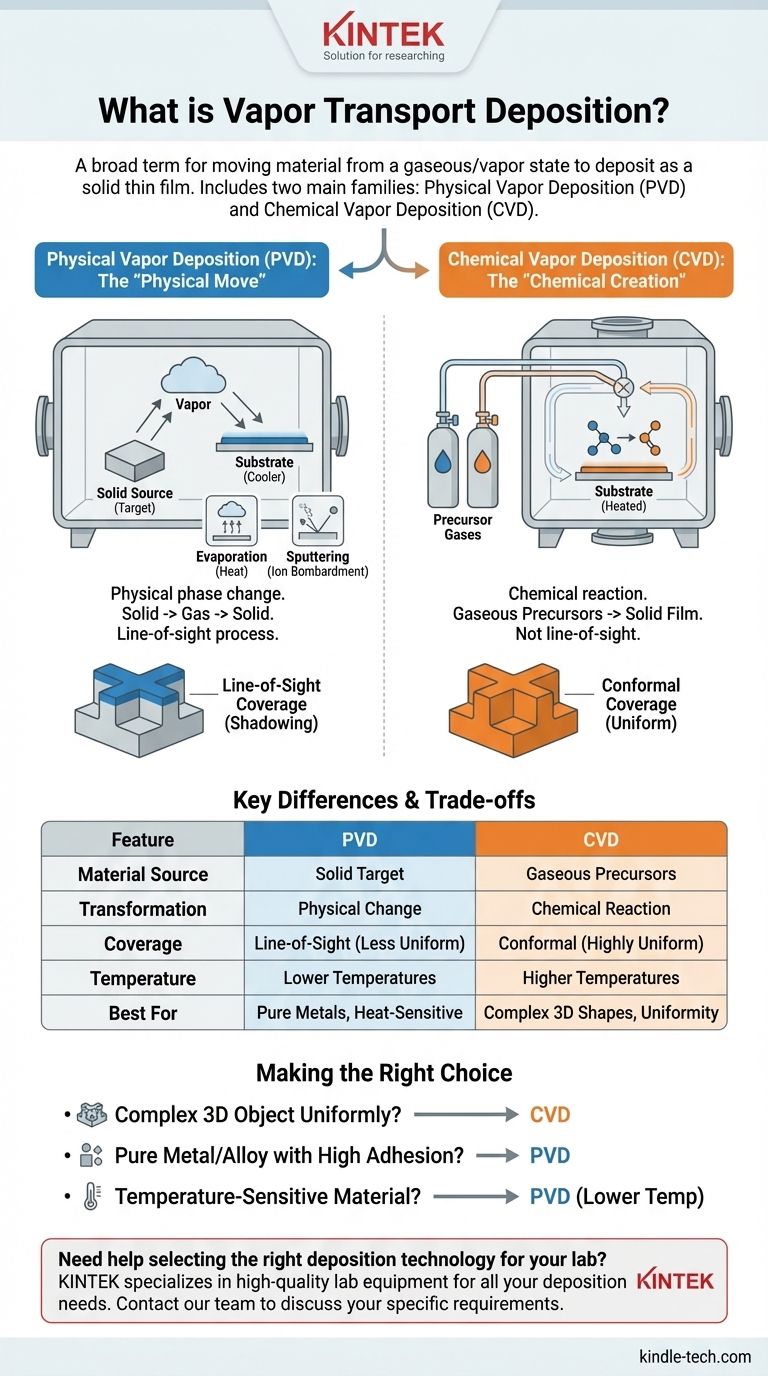
In short, vapor transport deposition is not a single process but a broad term describing methods that move a material in a gaseous or vapor state to deposit it as a solid thin film onto a surface. This category primarily encompasses two distinct families of technology: Physical Vapor Deposition (PVD), where the material is physically moved, and Chemical Vapor Deposition (CVD), where a new material is created at the surface through a chemical reaction.
The critical distinction is how the material travels. In PVD, you are essentially spray-painting with atoms that are physically vaporized from a solid source. In CVD, you are introducing precursor gases that react and "bake" a new solid layer directly onto the target surface.
Physical Vapor Deposition (PVD): The "Physical Move"
Physical Vapor Deposition, sometimes called Physical Vapor Transport (PVT), is a process that involves a purely physical state change. The material being deposited starts as a solid, becomes a gas, and finishes as a solid again, without changing its chemical identity.
The Mechanism: From Solid to Vapor
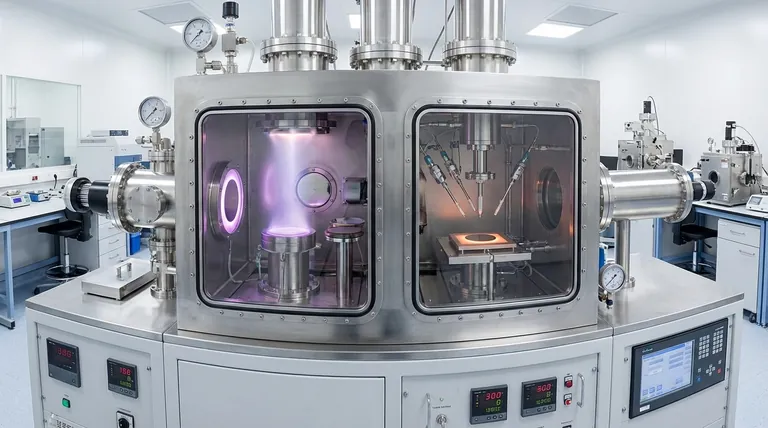
The process takes place in a vacuum chamber and begins by turning a solid source material (known as the "target") into a vapor.
This is typically achieved through one of two methods: evaporation, where the material is heated until it vaporizes, or spraying (sputtering), where the target is bombarded with high-energy ions, knocking atoms loose.
Condensation on the Substrate
Once in a vapor state, these atoms or molecules travel through the vacuum and condense onto the cooler substrate (the part being coated).
This direct, line-of-sight transfer forms a thin, solid film. This process is excellent for depositing materials with very high melting points.
Chemical Vapor Deposition (CVD): The "Chemical Creation"
Chemical Vapor Deposition relies on a chemical reaction to form the coating. Instead of starting with the final material in solid form, you begin with one or more volatile precursor gases.
The Mechanism: Precursor Gas to Solid Film
The substrate is placed inside a reaction chamber, and precursor gases—which contain the atoms needed for the final film—are introduced.
The chamber is heated to a specific reaction temperature, providing the energy needed to trigger a chemical change.
The Reaction at the Surface
The precursor gases react or decompose on the hot substrate surface, leaving behind the desired solid material as a coating.
Other gaseous byproducts from the reaction are simply transported away. This process allows the coating to "grow" on the surface, molecule by molecule.
Understanding the Key Differences and Trade-offs
Choosing between PVD and CVD requires understanding their fundamental differences, as each has distinct advantages.
The Material Source
PVD uses a solid source of the exact material you want to deposit.
CVD uses volatile precursor gases that chemically combine or break down to form the desired material on the surface.
The Transformation Process
The core of PVD is a physical phase change: solid to gas and back to solid.
The core of CVD is a chemical reaction that creates an entirely new solid product from gaseous reactants.
Coverage and Conformality
Because PVD is a line-of-sight process, it can struggle to coat complex, three-dimensional shapes uniformly. Areas not in the direct path of the vapor source receive little to no coating.
CVD is not a line-of-sight process. The precursor gases can flow around and react on all exposed surfaces, resulting in an exceptionally uniform (conformal) coating, even on intricate parts.
Operating Conditions
CVD often requires high substrate temperatures to drive the necessary chemical reactions.
PVD processes can frequently be performed at lower temperatures, making them suitable for coating materials that cannot withstand high heat.
Making the Right Choice for Your Application
Your final goal dictates which method is more appropriate.
- If your primary focus is coating a complex, 3D object uniformly: CVD is often the superior choice because the chemical reaction can occur on all surfaces simultaneously.
- If your primary focus is depositing a pure metal or alloy with high adhesion: PVD is a direct and powerful method well-suited for this, especially for high-performance metallic coatings.
- If your primary focus is coating a temperature-sensitive material: A lower-temperature PVD process is likely the more viable option to avoid damaging the substrate.
Ultimately, understanding whether your material needs to be physically moved or chemically created is the key to selecting the right deposition technology for your project.
Summary Table:
| Feature | PVD (Physical Vapor Deposition) | CVD (Chemical Vapor Deposition) |
|---|---|---|
| Material Source | Solid target material | Gaseous precursor chemicals |
| Transformation | Physical phase change | Chemical reaction |
| Coverage | Line-of-sight (less uniform) | Conformal (highly uniform) |
| Temperature | Lower temperatures | Higher temperatures |
| Best For | Pure metals, heat-sensitive substrates | Complex 3D shapes, uniform coatings |
Need help selecting the right deposition technology for your lab? The choice between PVD and CVD is critical for your thin film application's success. At KINTEK, we specialize in providing high-quality lab equipment and consumables for all your deposition needs. Our experts can help you choose the perfect solution for coating complex shapes, temperature-sensitive materials, or achieving high-purity metallic layers. Contact our team today to discuss your specific requirements and discover how KINTEK can enhance your laboratory's capabilities!
Visual Guide
Related Products
- RF PECVD System Radio Frequency Plasma-Enhanced Chemical Vapor Deposition RF PECVD
- Chemical Vapor Deposition CVD Equipment System Chamber Slide PECVD Tube Furnace with Liquid Gasifier PECVD Machine
- Customer Made Versatile CVD Tube Furnace Chemical Vapor Deposition Chamber System Equipment
- Inclined Rotary Plasma Enhanced Chemical Vapor Deposition PECVD Equipment Tube Furnace Machine
- Inclined Rotary Plasma Enhanced Chemical Vapor Deposition PECVD Equipment Tube Furnace Machine
People Also Ask
- What is plasma enhanced chemical Vapour deposition process used for fabrication of? A Guide to Low-Temperature Thin Films
- What is plasma enhanced chemical vapour deposition process? Unlock Low-Temperature, High-Quality Thin Films
- What is plasma CVD? Unlock Low-Temperature Thin Film Deposition for Sensitive Materials
- What is plasma enhanced chemical vapour deposition PECVD used for? Enable Low-Temp Thin Films for Electronics & Solar
- How does plasma enhance CVD? Unlock Low-Temperature, High-Quality Film Deposition