Knowledge Electric Rotary Kiln What is thermal regeneration? Restore Spent Materials Like Activated Carbon with High Heat
Author avatar

Tech Team · Kintek Solution

Updated 2 months ago

What is thermal regeneration? Restore Spent Materials Like Activated Carbon with High Heat


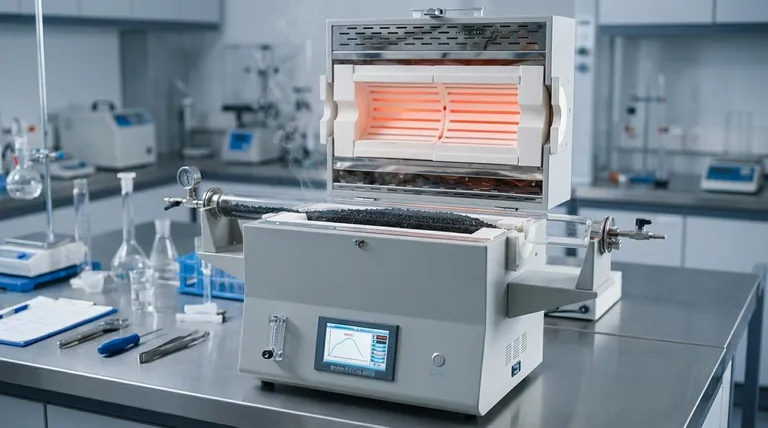
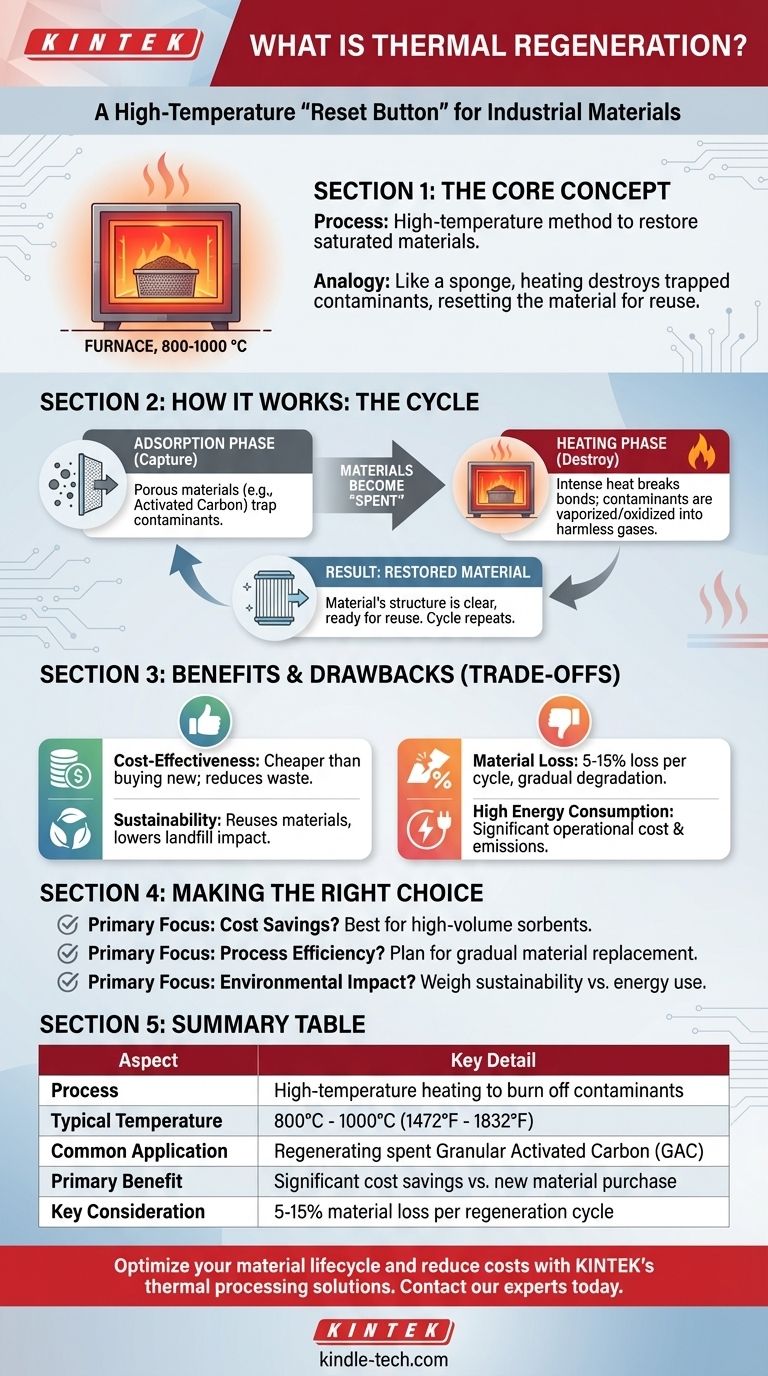
In short, thermal regeneration is a high-temperature process used to restore a material to its original, effective state after it has become saturated or "spent." It is most commonly used to clean industrial materials like activated carbon by using extreme heat (often 800-1000 °C) in a furnace to burn off or vaporize the contaminants that the material has adsorbed.

Thermal regeneration acts as a high-temperature "reset button" for materials that function like sponges. By heating the spent material, you effectively destroy and remove the trapped contaminants, restoring the material’s capacity to be used again.
What is thermal regeneration? Restore Spent Materials Like Activated Carbon with High Heat

How Thermal Regeneration Works: The Core Mechanism

To understand thermal regeneration, you must first understand the job the material was doing. The process is a cycle of capture and release, driven by changes in temperature.

The Adsorption Phase: Capturing Contaminants

Many industrial processes use porous materials, like Granular Activated Carbon (GAC), to purify liquids or gases. These materials have a vast internal surface area with active sites that trap and hold onto unwanted organic substances—a process called adsorption.

Over time, these active sites become filled, and the material is considered "spent" or saturated, losing its effectiveness.

The Heating Phase: Destroying the Contaminants

This is where thermal regeneration comes in. The spent material is removed from service and placed into a high-temperature furnace, often in a low-oxygen environment.

The intense heat, typically between 800°C and 1000°C (1472°F to 1832°F), provides the energy needed to break the bonds holding the adsorbed contaminants. These organic substances are either vaporized or, more commonly, oxidized (chemically destroyed) and converted into harmless gases.

The Result: A Restored Material

After the heating and cool-down cycle, the contaminants are gone. The material's porous structure and active sites are now clear and available again.

This "regenerated" material is ready to be put back into service, capable of adsorbing new contaminants. This cycle of use and regeneration can be repeated multiple times.

Understanding the Trade-offs

While highly effective, thermal regeneration is not a perfect process. It involves a clear set of benefits and drawbacks that are critical to consider.

Pro: Cost-Effectiveness and Sustainability

The primary driver for thermal regeneration is economics. Regenerating and reusing an expensive material like activated carbon is significantly cheaper than continuously disposing of spent material and purchasing new supplies. It also reduces landfill waste, offering a clear environmental benefit.

Con: Material Loss and Degradation

The process is not 100% efficient. Each high-temperature cycle inevitably causes some physical degradation and burnout of the host material itself. Typically, there is a 5-15% loss of carbon with each regeneration cycle, which gradually reduces its performance and lifespan.

Con: High Energy Consumption

Heating industrial-scale furnaces to 1000°C requires a massive amount of energy. This represents a significant operational cost and has its own environmental footprint, which must be weighed against the benefits of material reuse.

Making the Right Choice for Your Process

Deciding whether to implement thermal regeneration depends on balancing economic, operational, and environmental goals.

  • If your primary focus is cost savings on high-volume materials: Thermal regeneration is often the most economically viable method for sorbents like activated carbon used in large-scale purification.
  • If your primary focus is process efficiency: Account for the 5-15% material loss per cycle in your operational planning and budget for gradual replacement of the media over time.
  • If your primary focus is environmental impact: Carefully weigh the sustainability benefit of reusing materials against the significant energy consumption and emissions of the regeneration furnace.

Ultimately, thermal regeneration is a powerful tool for extending the life of critical materials and reducing operational costs.

Summary Table:

Aspect Key Detail
Process High-temperature heating to burn off contaminants
Typical Temperature 800°C - 1000°C (1472°F - 1832°F)
Common Application Regenerating spent Granular Activated Carbon (GAC)
Primary Benefit Significant cost savings vs. new material purchase
Key Consideration 5-15% material loss per regeneration cycle

Optimize your material lifecycle and reduce costs with KINTEK's thermal processing solutions.

Thermal regeneration is a powerful strategy for laboratories and industrial facilities using sorbents like activated carbon. By restoring spent materials, you can dramatically cut operational expenses and minimize waste. KINTEK specializes in the high-temperature lab equipment and consumables needed to implement this process efficiently and reliably.

Contact our experts today to discuss how our furnaces and thermal systems can help you achieve sustainable, cost-effective material regeneration for your specific application.

Visual Guide
What is thermal regeneration? Restore Spent Materials Like Activated Carbon with High Heat Visual Guide

Related Products

People Also Ask

Related Products

Vacuum Heat Treat and Pressure Sintering Furnace for High Temperature Applications

Vacuum Heat Treat and Pressure Sintering Furnace for High Temperature Applications

Vacuum pressure sintering furnaces are designed for high temperature hot pressing applications in metal and ceramic sintering. Its advanced features ensure precise temperature control, reliable pressure maintenance, and a robust design for seamless operation.

1700℃ Laboratory High Temperature Tube Furnace with Alumina Tube

1700℃ Laboratory High Temperature Tube Furnace with Alumina Tube

Looking for a high-temperature tube furnace? Check out our 1700℃ Tube Furnace with Alumina Tube. Perfect for research and industrial applications up to 1700C.

1400℃ Laboratory High Temperature Tube Furnace with Alumina Tube

1400℃ Laboratory High Temperature Tube Furnace with Alumina Tube

Looking for a tube furnace for high-temperature applications? Our 1400℃ Tube Furnace with Alumina Tube is perfect for research and industrial use.

1700℃ Controlled Atmosphere Furnace Nitrogen Inert Atmosphere Furnace

1700℃ Controlled Atmosphere Furnace Nitrogen Inert Atmosphere Furnace

KT-17A Controlled atmosphere furnace: 1700℃ heating, vacuum sealing technology, PID temperature control, and versatile TFT smart touch screen controller for laboratory and industrial use.

1400℃ Controlled Atmosphere Furnace with Nitrogen and Inert Atmosphere

1400℃ Controlled Atmosphere Furnace with Nitrogen and Inert Atmosphere

Achieve precise heat treatment with KT-14A controlled atmosphere furnace. Vacuum sealed with a smart controller, it's ideal for lab and industrial use up to 1400℃.

High Temperature Muffle Oven Furnace for Laboratory Debinding and Pre Sintering

High Temperature Muffle Oven Furnace for Laboratory Debinding and Pre Sintering

KT-MD High temperature debinding and pre-sintering furnace for ceramic materials with various molding processes. Ideal for electronic components such as MLCC and NFC.

1200℃ Muffle Furnace Oven for Laboratory

1200℃ Muffle Furnace Oven for Laboratory

Upgrade your lab with our 1200℃ Muffle Furnace. Achieve fast, precise heating with Japan alumina fibers and Molybdenum coils. Features TFT touch screen controller for easy programming and data analysis. Order now!

1700℃ Muffle Oven Furnace for Laboratory

1700℃ Muffle Oven Furnace for Laboratory

Get superior heat control with our 1700℃ Muffle Furnace. Equipped with intelligent temperature microprocessor, TFT touch screen controller & advanced insulation materials for precise heating up to 1700C. Order now!

Ultra-High Temperature Graphite Vacuum Graphitization Furnace

Ultra-High Temperature Graphite Vacuum Graphitization Furnace

The ultra-high temperature graphitization furnace utilizes medium frequency induction heating in a vacuum or inert gas environment. The induction coil generates an alternating magnetic field, inducing eddy currents in the graphite crucible, which heats up and radiates heat to the workpiece, bringing it to the desired temperature. This furnace is primarily used for graphitization and sintering of carbon materials, carbon fiber materials, and other composite materials.

1200℃ Split Tube Furnace with Quartz Tube Laboratory Tubular Furnace

1200℃ Split Tube Furnace with Quartz Tube Laboratory Tubular Furnace

KT-TF12 split tube furnace: high-purity insulation, embedded heating wire coils, and max. 1200C. Widely used for new materials and chemical vapour deposition.

Vertical High Temperature Graphite Vacuum Graphitization Furnace

Vertical High Temperature Graphite Vacuum Graphitization Furnace

Vertical high temperature graphitization furnace for carbonization and graphitization of carbon materials up to 3100℃.Suitable for shaped graphitization of carbon fiber filaments and other materials sintered in a carbon environment.Applications in metallurgy, electronics, and aerospace for producing high-quality graphite products like electrodes and crucibles.

Horizontal High Temperature Graphite Vacuum Graphitization Furnace

Horizontal High Temperature Graphite Vacuum Graphitization Furnace

Horizontal Graphitization Furnace: This type of furnace is designed with the heating elements placed horizontally, allowing for uniform heating of the sample. It's well-suited for graphitizing large or bulky samples that require precise temperature control and uniformity.

2200 ℃ Tungsten Vacuum Heat Treat and Sintering Furnace

2200 ℃ Tungsten Vacuum Heat Treat and Sintering Furnace

Experience the ultimate refractory metal furnace with our Tungsten vacuum furnace. Capable of reaching 2200℃, perfect for sintering advanced ceramics and refractory metals. Order now for high-quality results.

2200 ℃ Graphite Vacuum Heat Treat Furnace

2200 ℃ Graphite Vacuum Heat Treat Furnace

Discover the power of the KT-VG Graphite Vacuum Furnace - with a maximum working temperature of 2200℃, it's perfect for vacuum sintering of various materials. Learn more now.

Graphite Vacuum Furnace High Thermal Conductivity Film Graphitization Furnace

Graphite Vacuum Furnace High Thermal Conductivity Film Graphitization Furnace

The high thermal conductivity film graphitization furnace has uniform temperature, low energy consumption and can operate continuously.

Laboratory High Pressure Vacuum Tube Furnace

Laboratory High Pressure Vacuum Tube Furnace

KT-PTF High Pressure Tube Furnace: Compact split tube furnace with strong positive pressure resistance. Working temp up to 1100°C and pressure up to 15Mpa. Also works under controller atmosphere or high vacuum.

Laboratory Muffle Oven Furnace Bottom Lifting Muffle Furnace

Laboratory Muffle Oven Furnace Bottom Lifting Muffle Furnace

Efficiently produce batches with excellent temperature uniformity using our Bottom Lifting Furnace. Features two electric lifting stages and advanced temperature control up to 1600℃.

Graphite Vacuum Furnace Bottom Discharge Graphitization Furnace for Carbon Materials

Graphite Vacuum Furnace Bottom Discharge Graphitization Furnace for Carbon Materials

Bottom-out graphitization furnace for carbon materials, ultra-high temperature furnace up to 3100°C, suitable for graphitization and sintering of carbon rods and carbon blocks. Vertical design, bottom discharging, convenient feeding and discharging, high temperature uniformity, low energy consumption, good stability, hydraulic lifting system, convenient loading and unloading.

Large Vertical Graphite Vacuum Graphitization Furnace

Large Vertical Graphite Vacuum Graphitization Furnace

A large vertical high-temperature graphitization furnace is a type of industrial furnace used for the graphitization of carbon materials, such as carbon fiber and carbon black. It is a high-temperature furnace that can reach temperatures of up to 3100°C.

1200℃ Controlled Atmosphere Furnace Nitrogen Inert Atmosphere Furnace

1200℃ Controlled Atmosphere Furnace Nitrogen Inert Atmosphere Furnace

Discover our KT-12A Pro Controlled atmosphere furnace - high precision, heavy duty vacuum chamber, versatile smart touch screen controller, and excellent temperature uniformity up to 1200C. Ideal for both laboratory and industrial application.


Leave Your Message



















