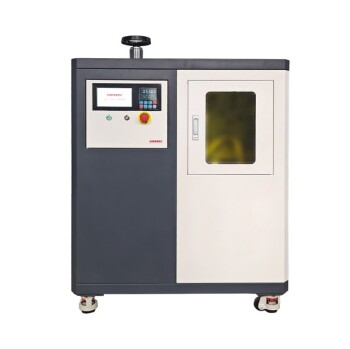
The Hot Press Technique subjects Thallium Bromide (TlBr) to a rigorous, coupled thermal-mechanical environment designed to alter its physical state. Specifically, the process applies a high temperature range of approximately 455 to 465 degrees Celsius alongside a continuous mechanical pressure of roughly 30 kN. These conditions are maintained to compress zone-refined raw materials within specific molds, transforming them into bulk crystal blocks.
The core function of these physical conditions is thermal-mechanical coupling: using heat and pressure simultaneously to densify powder materials and precisely adjust crystal orientation for high-performance radiation detection.
The Mechanics of the Environment
To achieve the necessary material properties for semiconductor use, the Hot Press Technique relies on the synergy between heat and physical force.
High-Temperature Regulation
The process requires a strictly controlled thermal environment, specifically maintaining temperatures between 455°C and 465°C.
This elevated temperature creates the necessary thermodynamic state for the material to become malleable without losing its essential chemical characteristics.
High-Pressure Application
Simultaneous to the heating, the system applies a substantial axial force of approximately 30 kN.
This pressure is not momentary; it is a continuous load applied to the raw materials inside the mold.
Duration of Exposure
While temperature and pressure are the primary variables, the duration is the stabilizing factor.
Supplementary data indicates this environment is typically maintained for a period of 2 hours to ensure complete consolidation.
Material Transformation Goals
The physical conditions described above are not arbitrary; they are engineered to solve specific material challenges found in raw TlBr powder.
Densification and Porosity Elimination
The primary goal of applying 30 kN of pressure is to eliminate internal micro-porosity.
The process compresses loose, zone-refined powder into a solid, high-density block.
This densification is critical for maximizing the material's gamma-ray attenuation coefficient.
Control of Crystal Orientation
Heat alone cannot achieve the desired structural properties; the mechanical stress field is required to guide growth.
The thermal-mechanical coupling induces specific lattice orientations within the crystal.
This alignment improves charge collection efficiency, a vital metric for photon-counting detectors.
Defect Suppression
By controlling the stress field during the high-temperature phase, the technique minimizes the formation of internal defects.
This results in a uniform structure that supports better energy resolution in the final device.
Understanding the Trade-offs
While the Hot Press Technique is effective, it relies on the precise balance of its physical variables.
The Necessity of Synergy
One physical condition cannot succeed without the other.
Pressure without sufficient heat would likely fracture the material or fail to bond the granules.
Conversely, heat without pressure would result in sintering but fail to achieve the specific crystal orientation and high density required for detector-grade performance.
Sensitivity to Parameters
The window for success is narrow (a 10-degree temperature range).
Deviating from the 455-465°C range or the 30 kN pressure standard risks producing crystals with poor structural integrity or inconsistent detection capabilities.
Making the Right Choice for Your Goal
The physical conditions of the Hot Press Technique are specifically optimized for producing high-efficiency radiation detectors.
- If your primary focus is Detection Efficiency: Ensure the combination of pressure and heat achieves maximum density, as this directly correlates to a superior gamma-ray attenuation coefficient.
- If your primary focus is Energy Resolution: Prioritize the consistency of the thermal-mechanical coupling to ensure specific crystal orientation and minimize internal defects.
By strictly adhering to these temperature and pressure benchmarks, you ensure the production of TlBr crystals capable of high-performance gamma-ray photon counting.
Summary Table:
| Parameter | Operating Range / Value | Primary Function in TlBr Development |
|---|---|---|
| Temperature | 455°C – 465°C | Creates thermodynamic state for malleability and bonding. |
| Mechanical Pressure | ~30 kN (Continuous) | Eliminates micro-porosity and drives densification. |
| Process Duration | Approx. 2 Hours | Ensures complete material consolidation and stability. |
| Core Mechanism | Thermal-Mechanical Coupling | Adjusts crystal orientation for charge collection efficiency. |
| Material Goal | High-Density Bulk Block | Maximizes gamma-ray attenuation for radiation detection. |
Elevate Your Semiconductor Research with KINTEK
Precision is the difference between a defect and a discovery. At KINTEK, we specialize in the advanced laboratory equipment required to master thermal-mechanical coupling. Whether you are developing Thallium Bromide crystals or advanced ceramics, our high-performance hydraulic hot presses, vacuum furnaces, and crushing and milling systems provide the stable environments needed for high-stakes material science.
From high-temperature reactors to specialized consumables like PTFE products and crucibles, KINTEK supports every stage of your workflow—from raw material preparation to final densification.
Ready to optimize your crystal growth parameters? Contact our technical specialists today to find the perfect hydraulic press and high-temperature solution for your lab.
References
- Petronela Gheorghe, Adina Mirela Anton. Optical limiting properties of a new class of DNA-based materials functionalized with natural chromophores. DOI: 10.21175/rad.abstr.book.2023.5.7
This article is also based on technical information from Kintek Solution Knowledge Base .
Related Products
- Automatic Heated Hydraulic Press Machine with Heated Plates for Laboratory Hot Press 25T 30T 50T
- Manual High Temperature Heated Hydraulic Press Machine with Heated Plates for Lab
- Touchscreen Automatic Vacuum Heat Press
- 30T 40T Split Automatic Heated Hydraulic Press Machine with Heated Plates for Laboratory Hot Press
- Vacuum Hot Press Furnace Machine Heated Vacuum Press
People Also Ask
- Why is the heating function of a laboratory hydraulic press essential for MEA assembly in DEFC? Optimize Cell Bonding
- What technical conditions does a heated hydraulic press provide for PEO batteries? Optimize Solid-State Interfaces
- How is a heated hydraulic press used for Li-LLZO batteries? Optimize Interfacial Bonding with Thermal-Pressure
- What role does a heated hydraulic press play in Cold Sintering (CSP)? Enhancing LATP-Halide Densification
- What are heated hydraulic presses used for? Molding Composites, Vulcanizing Rubber, and More