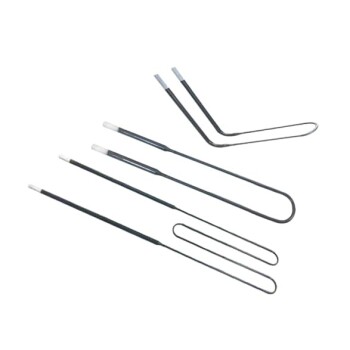
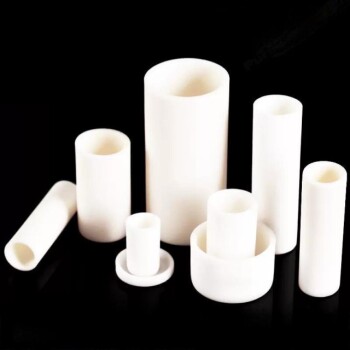
Ceramic heaters function as the high-efficiency thermal core of the physical evaporation-condensation method. Their primary role is to generate a strictly controlled thermal environment, which is the decisive factor in synthesizing silver nanoparticles that are consistent in shape and free from unwanted clumping.
In nanoparticle synthesis, temperature fluctuations are the enemy of quality. Ceramic heaters provide the precise stability required to prevent agglomeration and ensure specific distribution characteristics during the physical preparation process.
The Physics of Particle Formation
Achieving High-Efficiency Heating
The fundamental role of the ceramic heater in this process is to act as a high-efficiency heat source.
This efficiency is required to drive the evaporation-condensation mechanism effectively, ensuring the silver is processed at the necessary rate for nanoparticle formation.
The Criticality of Thermal Stability
Beyond generating raw heat, the ceramic heater is prized for providing a highly stable thermal environment.
This stability is not merely a feature but a requirement; without a constant temperature output, the physical conditions for uniform particle growth cannot be maintained.
Impact on Nanoparticle Quality
Preventing Agglomeration
One of the most significant challenges in preparing silver nanoparticles is preventing them from sticking together, or agglomerating.
The stable heat provided by ceramic heaters is the key mechanism that allows for the production of non-agglomerated particles, ensuring the material remains dispersed.
Ensuring Morphological Consistency
To be useful in technical applications, nanoparticles must look and behave consistently.
Ceramic heaters ensure the consistency of particle morphology, meaning the shape and structure of the silver nanoparticles remain uniform throughout the batch.
Controlling Distribution
The quality of the thermal environment dictates the final spread of the particles.
Using ceramic heaters allows researchers to achieve specific distribution characteristics, tailoring the output to meet precise physical requirements.
The Consequence of Thermal Instability
The Risk of Inconsistent Heat
While ceramic heaters are effective, it is important to understand the pitfall they solve: thermal instability.
If a heat source fails to provide the high stability of a ceramic unit, the synthesis environment becomes unpredictable.
This lack of control inevitably leads to irregular particle shapes and the loss of specific distribution traits, rendering the silver nanoparticles less effective for high-precision applications.
Making the Right Choice for Your Goal
To maximize the quality of your silver nanoparticles, align your equipment choice with your specific technical needs:
- If your primary focus is Monodispersity: Rely on the stability of ceramic heaters to produce non-agglomerated particles that remain distinct and separate.
- If your primary focus is Uniformity: Leverage the consistent thermal output to ensure strict control over particle morphology and distribution.
The right thermal environment is not just about heating the material; it is about sculpting it with precision.
Summary Table:
| Key Feature | Role in Nanoparticle Synthesis | Benefit for Silver Nanoparticles |
|---|---|---|
| High-Efficiency Heating | Drives evaporation-condensation | Ensures consistent formation rates |
| Thermal Stability | Maintains constant temperature | Prevents particle agglomeration |
| Precision Control | Sculpting at the molecular level | Uniform morphology and distribution |
| Stable Environment | Eliminates thermal fluctuations | High-quality, non-clumping output |
Elevate Your Nanomaterial Research with KINTEK
Precision is the heartbeat of nanoparticle synthesis. At KINTEK, we specialize in the high-performance laboratory equipment you need to maintain absolute control over your thermal environments. Whether you are producing silver nanoparticles or developing advanced materials, our comprehensive range of high-temperature furnaces (muffle, vacuum, CVD, tube) and precision crushing and milling systems ensure your results are consistent and repeatable.
From high-pressure reactors and autoclaves to essential ceramics, crucibles, and PTFE consumables, KINTEK provides the tools to prevent agglomeration and achieve perfect morphology. Contact us today to discover how our specialized laboratory solutions can enhance your lab's efficiency and product quality.
References
- Kamal Prasad Kamal. Silver Nanoparticles: Synthesis, Characterization, and Emerging Applications in Agriculture and Biomedicine for Enhancing Crop Production and Human Health. DOI: 10.56556/jase.v4i1.1140
This article is also based on technical information from Kintek Solution Knowledge Base .
Related Products
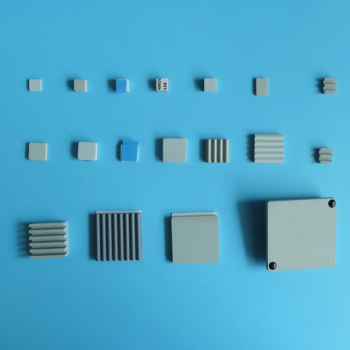
- Silicon Carbide (SIC) Ceramic Sheet Flat Corrugated Heat Sink for Engineering Advanced Fine Ceramics
- Engineering Advanced Fine Ceramics Aluminum Oxide Al2O3 Heat Sink for Insulation
- Hexagonal Boron Nitride HBN Ceramic Ring
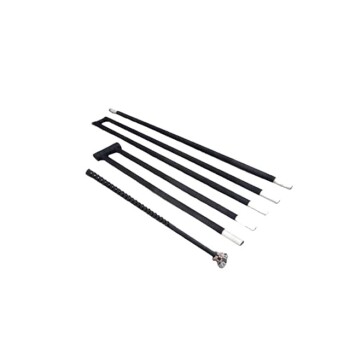
- Silicon Carbide SiC Thermal Heating Elements for Electric Furnace
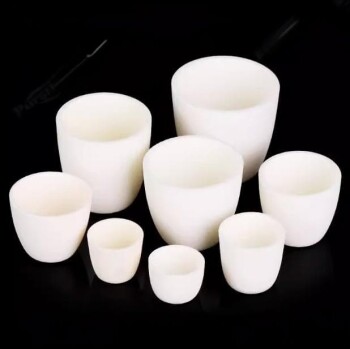
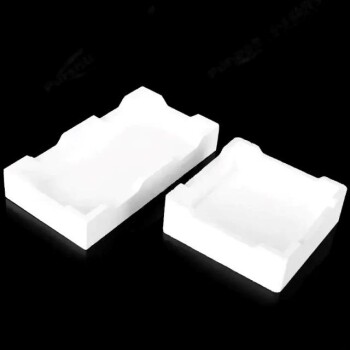
- Arc-Shaped Alumina Ceramic Crucible High Temperature Resistant for Engineering Advanced Fine Ceramics
People Also Ask
- What are the properties and applications of silicon carbide ceramics? Solve Extreme Engineering Challenges
- What is the strongest ceramics? Silicon Carbide Leads in Hardness & Thermal Strength
- What are the uses of silicon carbide ceramics in different industries? Master Extreme Performance in Aerospace, Semiconductors & More
- What are the properties of SiC? Unlock High-Temperature, High-Frequency Performance
- Why is silicon carbide more efficient? Unlock Higher Power Density with SiC's Superior Material Properties