Electrochemical workstations serve as the definitive tool for quantifying the protective capabilities of carbon coatings. By applying controlled polarization potentials to samples within simulated environments—such as artificial saliva—these systems measure the resulting current-voltage characteristics. This process allows researchers to determine critical failure points, specifically the breakdown potential ($E_b$) and corrosion potential ($E_{corr}$), to rigorously assess the barrier protection a coating provides to substrates like Ni-Cr alloys.
The core value of an electrochemical workstation lies in its ability to translate physical durability into precise electrical data. It objectively determines not just if a coating protects a metal, but exactly how much stress it can withstand before failing.
Quantifying Barrier Protection
Controlled Polarization
The primary function of the workstation is to apply a specific electrical stress—known as polarization potential—to the coated sample.
This acts as an accelerated stress test, forcing the material to interact with the corrosive environment more aggressively than it would under passive conditions.
Determining Breakdown Metrics
By analyzing the current flow in response to the applied voltage, the workstation identifies the breakdown potential ($E_b$).
This metric pinpoints the exact voltage at which the carbon coating fails and allows corrosive elements to penetrate to the substrate.
Simultaneously, it measures the corrosion potential ($E_{corr}$), which indicates the thermodynamic tendency of the coated material to corrode.
Simulated Clinical Environments
These tests are often conducted in fluid mediums that mimic real-world applications, such as artificial saliva.
This is critical for evaluating coatings on Ni-Cr alloys used in dental or medical implants, ensuring the data reflects performance in complex, biological environments.
Advanced Analysis via Impedance
The Standardized Three-Electrode System
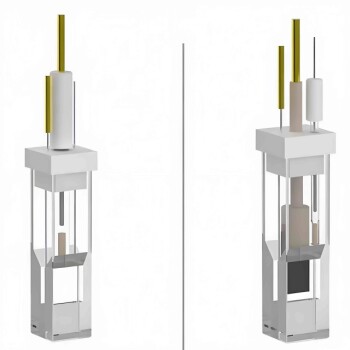
To ensure accuracy, the workstation typically employs a three-electrode cell configuration.
This setup includes the sample (working electrode), a reference electrode, and a counter electrode to create a stable, standardized testing loop.
Electrochemical Impedance Spectroscopy (EIS)
Beyond simple voltage stress, these workstations utilize EIS to measure the coating's resistance to electron flow.
This technique isolates specific properties, such as charge transfer resistance and pore resistance.
Assessing Active Protection
EIS data is particularly valuable for determining if the coating offers active protection mechanisms.
For example, it can reveal the effectiveness of corrosion inhibitors released onto the metal surface, distinguishing between simple physical blocking and active chemical defense.
Understanding the Constraints
Simulation vs. Reality
While workstations provide precise data, they rely on simulated environments like artificial saliva.
These electrochemical tests are accelerated approximations and may not fully replicate the mechanical wear or biological complexity of the human body over years of use.
The Importance of Sample Preparation
The accuracy of the three-electrode system depends heavily on the integrity of the working electrode (the sample).
Defects in the sample preparation, rather than the coating itself, can lead to false readings regarding pore resistance and breakdown potential.
Making the Right Choice for Your Goal
## How to Apply This to Your Project
- If your primary focus is determining the maximum durability limit: Prioritize Potentiodynamic Polarization tests to identify the specific breakdown potential ($E_b$) where the coating fails.
- If your primary focus is analyzing coating porosity and seal quality: Prioritize Electrochemical Impedance Spectroscopy (EIS) to measure pore resistance and charge transfer capabilities.
- If your primary focus is biological application: Ensure your testing environment utilizes artificial saliva or a relevant simulated body fluid to match the chemical context of the Ni-Cr alloy's intended use.
By leveraging these workstations, you transform corrosion resistance from a qualitative observation into a measurable, engineering-grade metric.
Summary Table:
| Metric/Method | Function in Corrosion Research | Key Data Provided |
|---|---|---|
| Potentiodynamic Polarization | Applies electrical stress to simulate accelerated corrosion. | Breakdown Potential ($E_b$) & Corrosion Potential ($E_{corr}$) |
| EIS (Impedance Spectroscopy) | Measures resistance to electron flow and coating porosity. | Charge transfer resistance and pore quality |
| Three-Electrode System | Provides a standardized electrochemical cell configuration. | High-precision, repeatable electrical measurements |
| Simulated Environments | Uses artificial saliva or body fluids to mimic real usage. | Application-specific durability and clinical relevance |
Elevate Your Material Analysis with KINTEK Precision
Unlock the full potential of your corrosion research with KINTEK’s advanced laboratory solutions. Whether you are testing the durability of carbon coatings on Ni-Cr alloys or exploring the frontiers of battery research, our comprehensive range of electrochemical workstations, high-temperature furnaces, and specialized electrolytic cells provides the precision your data demands.
From high-pressure reactors to precision-engineered ceramics and crucibles, KINTEK specializes in equipping researchers with the tools needed to translate physical durability into engineering-grade metrics. Contact us today to optimize your laboratory workflow and achieve superior material performance!
References
- Zofia Kula, L. Klimek. Carbon Coatings Deposited on Prosthodontic Ni-Cr Alloy. DOI: 10.3390/app11104551
This article is also based on technical information from Kintek Solution Knowledge Base .
Related Products
- Lab Electrochemical Workstation Potentiostat for Laboratory Use
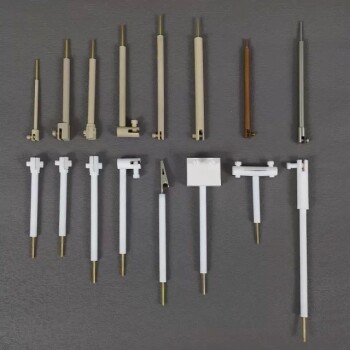
- Electrode Fixture for Electrochemical Experiments
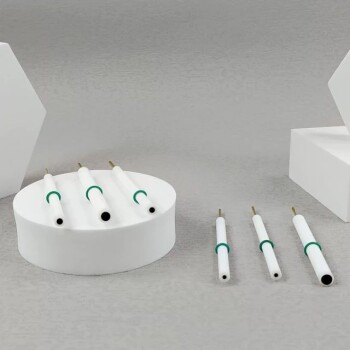
- Glassy Carbon Electrochemical Electrode
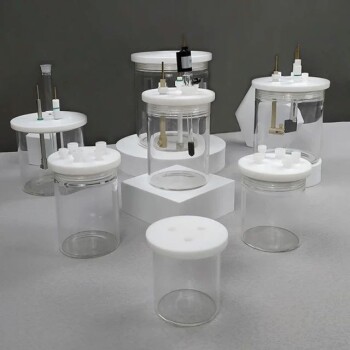
- Electrolytic Electrochemical Cell with Five-Port
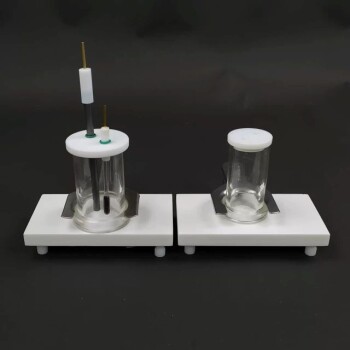
- Sample Support Body for Electrochemical Tests
People Also Ask
- How does an electrochemical workstation assist in assessing corrosion resistance? Quantify Laser-Remelted Steel Performance
- How does an electrochemical testing system evaluate mesoporous oxide electrodes? Precision Analysis for Battery Research
- What are the primary functions of an electrochemical workstation (Potentiostat)? Expert Titanium Alloy Corrosion Analysis
- What is the primary function of a high-precision electrochemical workstation? Optimize Your Reactor Performance
- What characteristics are analyzed using an electrochemical workstation during EIS testing of solid-state batteries?