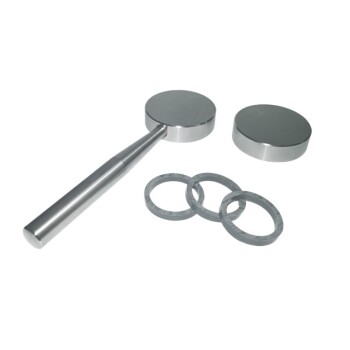
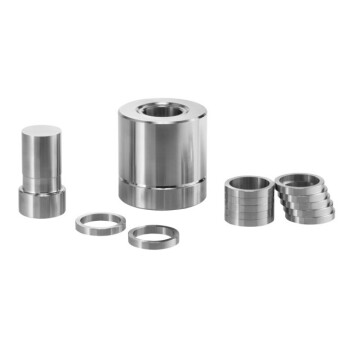
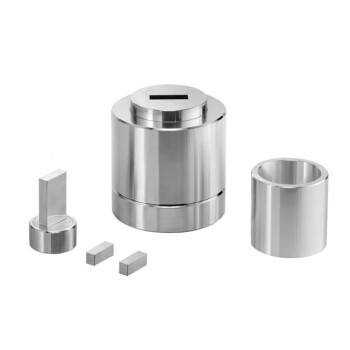
Graphite molds function as the critical structural interface in the vacuum hot pressing sintering of Ni-Co-Al superalloys, serving as both the container that defines the product's shape and the medium that enables consolidation. They are specifically tasked with confining the alloy powder and transmitting the necessary thermal and mechanical energy to transform loose particles into a solid, dense material.
Core Insight: The selection of graphite is not merely for containment; it is chosen for its ability to maintain high strength and thermal conductivity under extreme conditions. By ensuring uniform pressure transmission at temperatures up to 1260°C, graphite molds are the key enabler for achieving the high material densification required in superalloy production.
The Functional Mechanics of Graphite Molds
Defining Component Geometry
The primary role of the graphite mold is to act as a precision constraint.
During the sintering process, the mold confines the loose Ni-Co-Al powder. As the material consolidates, the mold forces it to adopt a specific cylindrical geometry, ensuring the final sample meets the required dimensional specifications.
Facilitating Material Densification
Beyond simple containment, the mold plays an active role in the densification of the alloy.
It acts as a transmission vessel for mechanical force, subjecting the powder to pressures of 20 MPa. The mold ensures this pressure is transmitted uniformly throughout the powder volume, which is essential for eliminating voids and creating a solid, cohesive superalloy.
Why Graphite is the Material of Choice
High-Temperature Strength
The vacuum hot pressing process for Ni-Co-Al superalloys requires an intense thermal environment, specifically ranging from 1100°C to 1260°C.
Graphite is utilized because it possesses excellent high-temperature strength. Unlike many other materials that might soften or deform, graphite maintains its structural integrity within this window, ensuring the mold does not fail under load.
Efficient Thermal Conductivity
Uniform heating is just as critical as uniform pressure.
Graphite offers excellent thermal conductivity, allowing heat to pass efficiently from the furnace environment through the mold walls to the alloy powder. This ensures the material reaches the sintering temperature evenly, promoting consistent material properties.
Operational Limits and Considerations
Adhering to Pressure Thresholds
While graphite is robust, the process relies on the mold's ability to withstand specific mechanical loads.
The reference cites a pressure parameter of 20 MPa. It is critical to understand that the mold's ability to transmit uniform pressure is calibrated to this operational standard; exceeding design limits could compromise the mold structure or the uniformity of the resulting alloy.
Respecting the Thermal Window
The material benefits of graphite are highlighted within the 1100°C to 1260°C range.
Successful sintering depends on staying within this thermal envelope. Operating outside these boundaries could impact the graphite's performance or fail to trigger the necessary densification mechanisms in the Ni-Co-Al powder.
Making the Right Choice for Your Goal
To maximize the quality of your Ni-Co-Al superalloys, consider how the mold influences your specific objectives:
- If your primary focus is Geometric Accuracy: Ensure your graphite tooling is machined precisely, as the mold's rigidity directly dictates the final cylindrical shape of the sample.
- If your primary focus is Material Density: Strictly maintain process parameters between 1100°C–1260°C and 20 MPa to fully leverage the graphite's ability to transmit uniform pressure and heat.
The success of vacuum hot pressing relies on the graphite mold acting as a stable, conductive bridge between the furnace forces and the alloy powder.
Summary Table:
| Feature | Function in Sintering Process | Impact on Ni-Co-Al Superalloys |
|---|---|---|
| Geometry Constraint | Defines the cylindrical shape | Ensures high dimensional accuracy |
| Pressure Transmission | Evenly applies 20 MPa mechanical load | Eliminates voids for maximum densification |
| Thermal Conductivity | Rapid, uniform heat transfer | Consistent material properties across the sample |
| High-Temp Strength | Maintains integrity at 1100°C–1260°C | Prevents mold deformation under high thermal stress |
Elevate Your Material Research with KINTEK
Achieve precision in every sintering cycle. KINTEK specializes in advanced laboratory equipment, providing high-performance vacuum hot presses, graphite molds, and crushing systems tailored for superalloy development. From high-temperature furnaces and isostatic presses to specialized consumables like ceramics and crucibles, we deliver the tools necessary for superior densification and material integrity.
Ready to optimize your lab's performance? Contact our technical experts today to find the perfect solution for your research needs.
Related Products
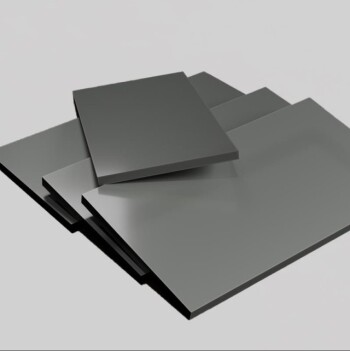
- Carbon Graphite Plate Manufactured by Isostatic Pressing Method
- High Purity Pure Graphite Crucible for Evaporation
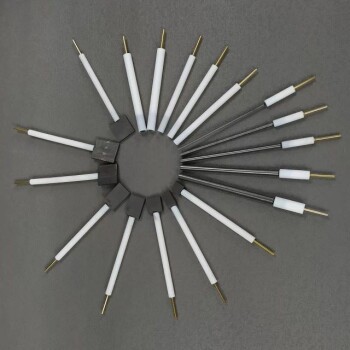
- Graphite Disc Rod and Sheet Electrode Electrochemical Graphite Electrode
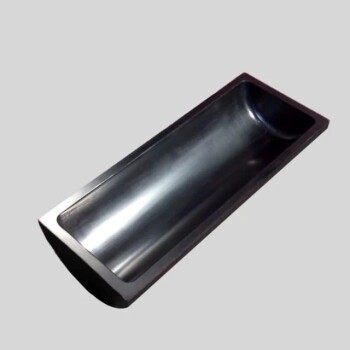
- Carbon Graphite Boat -Laboratory Tube Furnace with Cover
- High Purity Pure Graphite Crucible for Electron Beam Evaporation
People Also Ask
- What is the process of isostatic graphite manufacturing? Achieve Unmatched Material Uniformity and Performance
- What is isostatic graphite? The Ultimate Material for High-Tech and High-Temperature Applications
- What is the density of isostatic graphite? Unlock Superior Performance for Demanding Applications
- How big is the isostatic pressing market? A Deep Dive into the $1.2B+ Advanced Manufacturing Enabler
- Why Use an Isostatic or High-Precision Hydraulic Press for Li/LLZO/Li Batteries? Master Solid-State Interfaces