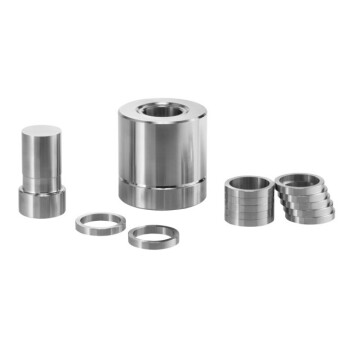
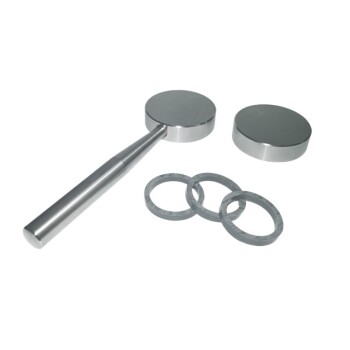
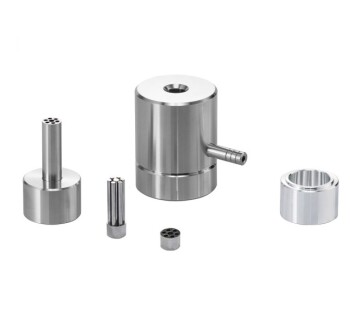
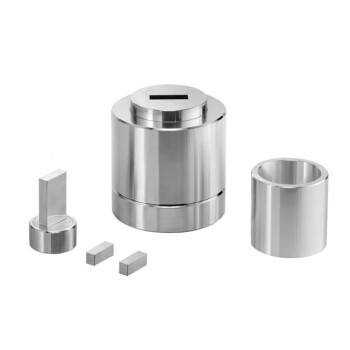
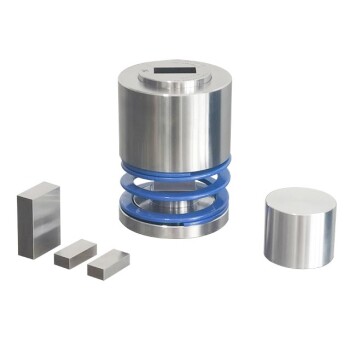
High-strength molds act as the critical constraint mechanism that defines the structural integrity of LLZTO ceramic pellets during fabrication. Their primary function is to rigidly restrict the lateral displacement of loose powder, forcing the vertical pressure from a hydraulic press to translate entirely into internal compaction force rather than outward expansion.
Core Takeaway High-strength molds are not merely shaping tools; they are essential for densification control. By resisting elastic deformation under extreme loads, they ensure uniform pressure distribution, which is the only way to prevent density gradients that cause delamination, cracking, and poor ion conductivity in solid-state electrolytes.
Transforming Pressure into Structural Integrity
Restricting Lateral Displacement
When hydraulic pressure is applied to a powder sample, the natural tendency of the particles is to spread outwards.
A high-strength mold blocks this lateral movement completely.
This confinement forces the loose LLZTO powder to consolidate on itself, converting the applied vertical load into effective compaction force.
Ensuring Geometric Precision
The mold is responsible for giving the electrolyte pellet a regular, repeatable geometric shape and size.
For battery applications, this geometric consistency is vital for stack assembly and interface contact.
The mold ensures the final pellet has a flat surface and precise dimensions, free from irregular bulging.
Preventing Critical Defects
Eliminating Density Gradients
One of the most common failure modes in ceramic pressing is uneven density within the "green" (un-sintered) pellet.
If pressure is not distributed evenly, some areas become dense while others remain porous.
High-strength molds facilitate even pressure distribution, which minimizes these density gradients.
Avoiding Delamination and Deformation
Density gradients create internal stress points.
When pressure is released, or during subsequent handling, these stresses can cause the pellet to delaminate (separate into layers) or deform.
By ensuring uniform compaction, the mold acts as a preventative measure against these structural failures.
The Critical Role in LLZTO Performance
Enabling High-Tonnage Densification
Fabricating dense LLZTO pellets often requires significant pressure, sometimes reaching several hundred megapascals or multiple tons (e.g., 8 tons in laboratory settings).
The mold facilitates this densification, forcing particles into tight contact.
In polymer-coated LLZTO composites, this pressure forces the polymer to fill voids between particles.
Establishing Ion Transport Networks
The ultimate goal of pressing LLZTO is to create a conductive pathway for ions.
The mold drives the microstructural arrangement required for this.
By forcing tight inter-particle contact, the mold helps establish a continuous ion transport network, which is a prerequisite for high-performance solid-state batteries.
Understanding the Trade-offs: The Elastic Limit
The Danger of Mold Deformation
The term "high-strength" is not a suggestion; it is a requirement.
If the mold material is too weak, it will undergo elastic deformation (bulging) under high pressure.
This absorbs the energy meant for the powder, resulting in lower pellet density and potential cracking.
Material Selection Matters
The mold must be significantly harder and stiffer than the pressures applied.
While graphite is often used for high-temperature applications due to thermal conductivity, steel or carbide molds are often required for cold pressing to withstand the sheer mechanical load without flexing.
Making the Right Choice for Your Goal
To maximize the effectiveness of your molding process, align your tooling with your specific processing conditions:
- If your primary focus is Ion Conductivity: Prioritize molds with zero elastic deformation to ensure maximum particle-to-particle contact and density.
- If your primary focus is Geometric Consistency: Ensure the mold tolerance is tight to prevent lateral "flashing" or edge defects during compression.
High-strength molds are the gatekeepers of density, ensuring that raw powder transforms into a uniform, defect-free electrolyte capable of supporting solid-state battery function.
Summary Table:
| Function | Impact on LLZTO Pellets | Benefit |
|---|---|---|
| Lateral Restriction | Converts vertical pressure into compaction force | Prevents outward expansion and ensures high density |
| Geometric Precision | Defines flat surfaces and exact dimensions | Ensures optimal interface contact in battery stacks |
| Pressure Distribution | Eliminates internal density gradients | Prevents delamination, cracking, and structural failure |
| Elastic Resistance | Resists bulging under high-tonnage (e.g., 8 tons) | Maximizes energy transfer for particle-to-particle contact |
| Network Formation | Drives microstructural arrangement | Establishes efficient ion transport pathways |
Elevate Your Solid-State Battery Research with KINTEK
Achieving the perfect LLZTO electrolyte requires more than just pressure—it requires precision engineering. KINTEK specializes in high-performance laboratory equipment designed for the most demanding ceramic processing workflows.
Our premium hydraulic presses (pellet, hot, isostatic) and custom-engineered high-strength molds ensure your materials reach their theoretical density without structural defects. Whether you are working with LLZTO, advanced ceramics, or battery composites, our portfolio offers the reliability you need:
- Precision Pressing: High-tonnage hydraulic systems for uniform densification.
- Advanced Thermal Solutions: Muffle, tube, and vacuum furnaces for perfect sintering.
- Processing Excellence: Crushing, milling, and high-quality crucibles for material purity.
Ready to eliminate delamination and boost ion conductivity? Contact our technical experts today to find the ideal molding and pressing solution for your lab.
Related Products
- XRF & KBR steel ring lab Powder Pellet Pressing Mold for FTIR
- XRF Boric Acid Lab Powder Pellet Pressing Mold for Laboratory Use
- XRF & KBR plastic ring lab Powder Pellet Pressing Mold for FTIR
- Ring Press Mold for Lab Applications
- Special Shape Press Mold for Lab
People Also Ask
- What is the purpose of using a mold for pellet pressing when preparing catalyst test samples? Ensure Data Consistency
- What are the advantages of using the pressed pellet method for XRF sample preparation? Optimize Your XRF Analysis
- What is the pressed powder pellet method? A Guide to Accurate FTIR Sample Preparation
- How does the selection of a pressure mold affect the performance of all-solid-state batteries? Expert Pelletizing Guide
- What are the different types of XRF samples? A Guide to Solid, Powder, and Liquid Prep