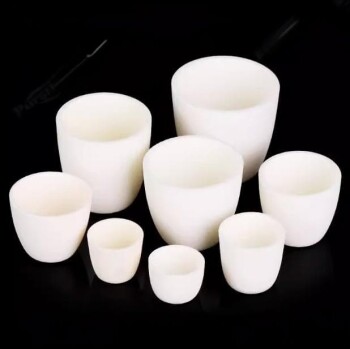
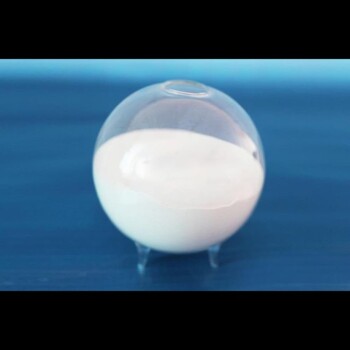
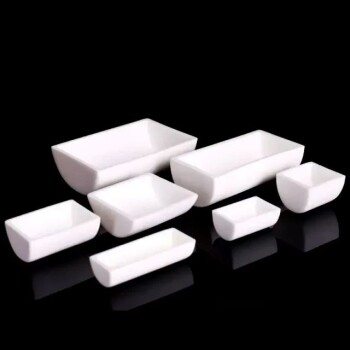
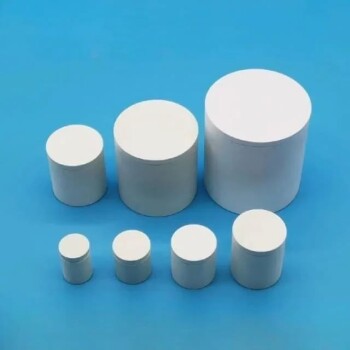
High-purity alumina crucibles function as critical high-temperature reaction vessels that provide a stable, inert environment for solid-state synthesis. In the production of double-doped silicon oxynitride phosphors (such as SrSi2O2N2:Eu2+,Yb2+), these crucibles maintain structural integrity at temperatures up to 1400°C while preventing chemical contamination that would otherwise degrade the material's luminescence.
The high-purity alumina crucible acts as a passive but vital safeguard, ensuring that the host lattice forms correctly and that rare-earth activators are incorporated into their intended sites without interference from impurities or vessel deformation.
Structural Support in Extreme Thermal Environments
Withstanding High Sintering Temperatures
The synthesis of silicon oxynitride phosphors requires prolonged sintering, often reaching 1400°C. At these temperatures, many standard materials would soften or melt, but high-purity alumina possesses superior thermal resistance.
The crucible remains dimensionally stable throughout the heating cycle. This prevents the raw material powders from leaking or reacting with the furnace heating elements, providing a reliable physical support environment for the solid-state reaction.
Resistance to Thermal Deformation
Maintaining a consistent shape at extreme heat is necessary for uniform heat distribution within the precursor mix. Because the alumina does not deform, it ensures the precursor powder is heated uniformly, which is essential for achieving a homogenous crystal phase.
Preservation of Chemical and Phase Purity
Preventing Cross-Contamination
High-purity alumina is characterized by its chemical inertness. At high temperatures, nitride and oxide materials can become highly reactive, potentially leaching elements from the container walls.
The use of high-purity alumina prevents the introduction of extraneous impurities into the phosphor. This is critical because even trace amounts of foreign ions can quench luminescence or create competing non-radiative pathways.
Ensuring Host Lattice Integrity
For double-doped phosphors to function, the host crystal lattice (SrSi2O2N2) must form precisely. The crucible's stability ensures that no unintended chemical reactions occur between the vessel and the raw materials.
This isolation allows the Eu2+ and Yb2+ activators to be correctly incorporated into the host crystal lattice sites. This precise positioning is what determines the specific emission wavelengths and efficiency of the phosphor.
Facilitating the Reaction Environment
Interaction with the Atmosphere
In a muffle or tube furnace, the crucible allows the controlled atmosphere (such as nitrogen or a reducing gas) to interact with the powder. It holds the sample securely while permitting the gas-solid interactions necessary for oxynitride formation.
Protection from Furnace Elements
The crucible serves as a barrier between the raw materials and the furnace chamber. This protects the sample from scale or debris falling from the furnace lining and simultaneously protects the furnace from potentially corrosive vapors emitted by the precursors.
Understanding the Trade-offs
Sensitivity to Thermal Shock
While alumina is highly heat-resistant, it is susceptible to thermal shock. Rapid heating or cooling can cause the crucible to crack, which could lead to sample loss or contamination during the synthesis process.
Chemical Limitations with Certain Fluxes
Although alumina is generally inert, it can be eroded by certain molten alkali metal salt fluxes over time. If the synthesis process requires heavy use of aggressive fluxes at temperatures exceeding 1250°C, the crucible may eventually contribute trace aluminum to the reaction.
Porosity and Reusability
Depending on the manufacturing method, some alumina crucibles have slight porosity. This can lead to "memory effects" where trace amounts of previous dopants remain trapped in the crucible walls, potentially contaminating subsequent batches of different phosphor compositions.
How to Apply This to Your Project
Making the Right Choice for Your Goal
To achieve the best results in phosphor synthesis, select your crucible based on your specific purity and thermal requirements.
- If your primary focus is Maximum Luminescence Efficiency: Utilize the highest purity alumina (99.9%+) to ensure no metallic impurities interfere with the activator ions.
- If your primary focus is Large-Scale Batch Consistency: Prioritize crucibles with low porosity and high density to minimize the absorption of precursors into the vessel walls.
- If your primary focus is Reducing Operational Costs: Implement gradual heating and cooling ramps (typically 5°C/min or less) to extend the lifespan of the alumina crucibles and prevent thermal shock.
Selecting the appropriate high-purity vessel is not merely a logistical choice, but a fundamental technical requirement for achieving high-performance optical materials.
Summary Table:
| Feature | Benefit in Synthesis | Impact on Phosphor Quality |
|---|---|---|
| High Thermal Resistance | Withstands up to 1400°C without melting | Maintains structural integrity for uniform sintering |
| Chemical Inertness | Prevents leaching of vessel elements | Ensures host lattice purity and prevents quenching |
| Dimensional Stability | Resists deformation at extreme heat | Promotes uniform heat distribution and phase homogeneity |
| Atmosphere Support | Facilitates gas-solid interactions | Allows precise control of oxynitride formation environments |
Elevate Your Material Synthesis with KINTEK Precision
Achieving the perfect luminescent phase requires more than just a recipe; it requires the right environment. KINTEK specializes in providing high-performance laboratory equipment designed for the most demanding research. Whether you are synthesizing advanced phosphors or developing next-generation ceramics, our high-purity alumina crucibles and comprehensive range of high-temperature furnaces (muffle, tube, vacuum, and CVD) provide the thermal precision and chemical isolation your work demands.
Beyond crucibles, KINTEK offers a full suite of solutions, including:
- Crushing, milling, and sieving equipment for precursor preparation.
- Hydraulic presses (pellet, hot, isostatic) for dense material formation.
- High-temperature high-pressure reactors and autoclaves for specialized synthesis.
- Essential consumables like PTFE products, ceramics, and high-purity crucibles.
Ready to optimize your laboratory's output? Contact us today to discuss how our high-purity solutions can improve your material purity and batch consistency.
References
- Hà Thanh Tùng, Dieu An Nguyen Thi. Utilizing SrSi<sub>2</sub>O<sub>2</sub>N<sub>2</sub>:Eu<sup>2+</sup>,Yb<sup>2+</sup> phosphor to achieve high hue rendering index and high hue stability. DOI: 10.11591/eei.v13i1.4724
This article is also based on technical information from Kintek Solution Knowledge Base .
Related Products
- Arc-Shaped Alumina Ceramic Crucible High Temperature Resistant for Engineering Advanced Fine Ceramics
- High Purity Alumina Granulated Powder for Engineering Advanced Fine Ceramics
- High Purity Pure Graphite Crucible for Evaporation
- Engineering Advanced Fine Alumina Al2O3 Ceramic Crucible for Laboratory Muffle Furnace
- High Purity Pure Graphite Crucible for Electron Beam Evaporation
People Also Ask
- Why Use Alumina Crucibles & Powder Burial for NaSICON? Ensure Phase Purity and Prevent Elemental Volatilization
- What is the primary purpose of using alumina crucibles for LLTO ceramics? Optimize Your High-Temperature Sintering
- Why are alumina crucibles and mother powder essential for LATP sintering? Optimize Your Solid Electrolyte Performance
- Why are high-purity alumina crucibles used for liquid lead corrosion experiments? Ensure Data Accuracy at 550°C
- Primary considerations for choosing alumina crucibles and quartz tubes in indium intercalation: Ensure Material Purity