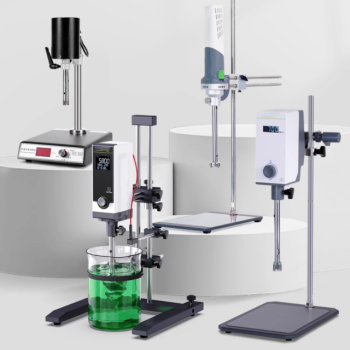
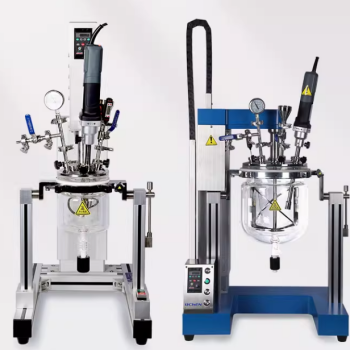
The high-shear dispersion emulsifier acts as the critical mechanical driver in the synthesis of ionic liquid-based Pickering emulsions. By utilizing high-speed rotation to generate intense kinetic energy and hydraulic shear, this device fractures the aqueous phase containing ionic liquids into micron-sized droplets. Crucially, this mechanical force drives surface-modified silica nanoparticles to the oil-water interface, establishing the robust film necessary for emulsion stability.
The device does more than simply mix fluids; it provides the specific kinetic energy required to force solid nanoparticles to the droplet interface. This creates a physical barrier that stabilizes the ionic liquid, a result that standard low-energy mixing cannot achieve.
The Mechanics of Droplet Formation
Generating Kinetic Energy
The process begins with the high-speed rotation of the emulsifier's rotor. This rotation converts mechanical energy into significant kinetic energy within the fluid mixture.
Hydraulic Shear
This energy creates powerful hydraulic shear forces. These forces act directly on the aqueous phase containing the ionic liquids.
Micron-Sized Dispersion
The shear forces physically tear the aqueous phase apart. This results in the formation of micron-sized droplets that are dispersed throughout the continuous oil phase.
Facilitating Nanoparticle Stabilization
Transporting Solid Particles
The role of the emulsifier extends beyond droplet creation; it is essential for particle transport. The high kinetic energy efficiently moves surface-modified silica nanoparticles through the medium.
Constructing the Interfacial Film
The mechanical agitation forces these nanoparticles to adsorb at the oil-water interface.
Ensuring Long-Term Stability
Once at the interface, the nanoparticles form a stable interfacial film. This "armor" prevents the droplets from coalescing, which is the defining characteristic of a stable Pickering emulsion.
Critical Process Considerations
Dependence on Mechanical Force
The formation of the stabilizing film is not purely spontaneous; it is mechanically driven. Without sufficient hydraulic shear, the nanoparticles may not reach the interface in sufficient quantities to form a complete barrier.
The Micron-Scale Limit
It is important to note the scale defined by this equipment. The primary reference specifies the creation of micron-sized droplets, indicating that this specific mechanical setup targets micro-emulsions rather than nano-emulsions.
Making the Right Choice for Your Goal
To optimize the preparation of your ionic liquid-based emulsions, align your process parameters with your specific objectives.
- If your primary focus is Maximum Stability: Ensure the rotation speed is sufficient to generate the hydraulic shear needed to fully transport silica nanoparticles to the interface.
- If your primary focus is Droplet Size Control: Regulate the kinetic energy input to consistently fracture the aqueous phase into your target micron-range diameter.
Success in this process relies on using high shear not just to mix, but to mechanically construct a barrier at the microscopic level.
Summary Table:
| Feature | Role in Pickering Emulsion Preparation |
|---|---|
| Mechanism | Converts mechanical energy into high hydraulic shear and kinetic energy |
| Droplet Size | Fractures aqueous phases into micron-sized droplets (Micro-emulsions) |
| Particle Transport | Forces surface-modified silica nanoparticles to the oil-water interface |
| Stability Result | Creates a robust interfacial film to prevent droplet coalescence |
| Energy Requirement | High kinetic energy needed to overcome spontaneous mixing limits |
Elevate Your Emulsion Research with KINTEK Precision
Optimize your Pickering emulsion stability and droplet morphology with KINTEK’s high-performance high-shear dispersion emulsifiers. As specialists in laboratory equipment, KINTEK provides the mechanical reliability required to drive nanoparticles to the interface and ensure long-term stability in your ionic liquid formulations.
Beyond emulsification, our portfolio supports every stage of your material science and battery research, featuring:
- High-Temperature & High-Pressure Reactors & Autoclaves
- Advanced Crushing, Milling, and Sieving Systems
- Precision Hydraulic Presses (Pellet, Hot, Isostatic)
- Comprehensive Battery Research Tools and Electrolytic Cells
Ready to achieve superior dispersion results? Contact our technical experts today to find the perfect equipment solution for your laboratory needs.
References
- Hong Zhang, Yuanhai Su. Process Intensification of 2,2′-(4-Nitrophenyl) Dipyrromethane Synthesis with a SO3H-Functionalized Ionic Liquid Catalyst in Pickering-Emulsion-Based Packed-Bed Microreactors. DOI: 10.3390/mi12070796
This article is also based on technical information from Kintek Solution Knowledge Base .
Related Products
- High Shear Homogenizer for Pharmaceutical and Cosmetic Applications
- High Performance Lab Homogenizer for Pharma Cosmetics and Food R&D
- Lab Sterile Slapping Type Homogenizer for Tissue Mashing and Dispersing
People Also Ask
- Why Use a High Shear Homogenizer for Cathode Slurries? Optimize Double-Layer Solid-State Battery Production
- What is the function of high-shear dispersion equipment in corona-resistant nanocomposites? Elevate Your Insulation
- What is the necessity of using an industrial-grade high-shear homogenizer for biomass washing? Ensure Process Efficiency
- What are the advantages of using a high-shear homogenizer for BED/GMA coatings? Achieve Superior Nano-Dispersion
- What role does a high-shear homogenizer play in ODC catalyst suspensions? Unlock Superior Electrochemical Efficiency