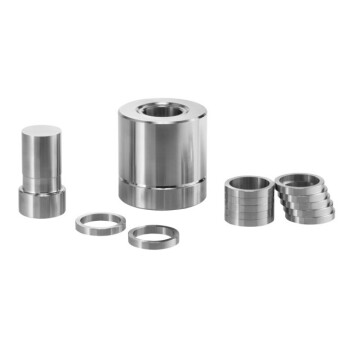
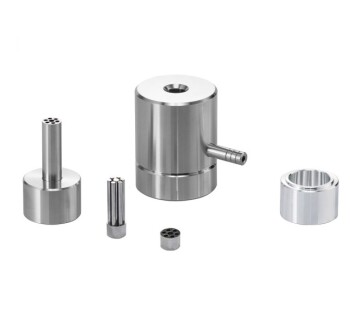
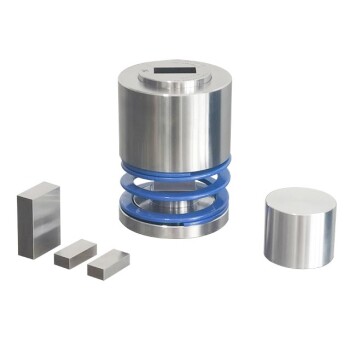
The primary function of a high-strength steel mold is to serve as a robust containment vessel capable of withstanding extreme uniaxial pressures during fabrication. In the context of LLTO (Lithium Lanthanum Titanium Oxide) composite electrolytes, this mold is essential for applying pressures as high as 600 MPa without deformation. By restricting lateral movement, it ensures that the applied force is directed entirely toward densifying the powder into a solid pellet.
The mold is not merely a container; it is a critical mechanical constraint that enables the high-pressure environment required for cold sintering. Its ability to resist deformation ensures precise geometry and effective densification of the electrolyte material.
The Mechanics of Containment
Withstanding Extreme Forces
The cold sintering process relies on heavy mechanical force to facilitate densification at low temperatures. A high-strength steel mold is specifically chosen to handle uniaxial pressures up to 600 MPa. Standard materials would yield or deform under such stress, compromising the process.
Directing Energy for Densification
The efficiency of the sintering process depends on the efficient transfer of force. Because the steel mold does not deform, the energy applied is transferred directly into the mixed powder. This forces the particles together, reducing porosity and creating a dense composite structure.
Ensuring Structural Precision
Restricting Lateral Movement
For uniaxial pressure to be effective, the powder must be prevented from spreading outward. The mold acts as a rigid barrier that restricts lateral movement of the LLTO powder. This confinement forces the material to compact vertically rather than displacing horizontally.
Achieving Precise Dimensions
The rigidity of the mold guarantees that the final product maintains a consistent shape. By preventing expansion, the mold ensures the resulting composite electrolyte pellets have precise geometric dimensions. This uniformity is vital for consistent electrochemical performance and subsequent battery assembly.
Operational Considerations and Limitations
The Risk of Mold Deformation
While high-strength steel is robust, it is not infinitely rigid. If the pressure applied exceeds the specific yield strength of the steel alloy used, the mold will expand. This expansion creates a "pressure leak," reducing the effective force on the powder and leading to poor densification.
Importance of Material Hardness
The choice of steel grade is critical to the success of the process. Using a mold made from softer metals would result in lateral bulging. This distortion would not only ruin the geometric tolerance of the pellet but also prevent the LLTO composite from reaching the necessary density for optimal conductivity.
Optimizing the Cold Sintering Setup
To ensure successful fabrication of LLTO electrolytes, consider the following regarding your tooling:
- If your primary focus is achieving maximum density: Ensure your mold is rated for pressures significantly higher than your target (e.g., >600 MPa) to eliminate any risk of elastic deformation.
- If your primary focus is geometric repeatability: Regularly inspect the inner walls of the mold for wear or expansion, as even microscopic deformations can affect the lateral constraint of the powder.
Ultimately, the steel mold acts as the foundational anvil that transforms loose powder into a dense, functional electrolyte.
Summary Table:
| Feature | Role in LLTO Cold Sintering | Impact on Electrolyte |
|---|---|---|
| Pressure Tolerance | Withstands up to 600 MPa uniaxial force | Enables high-density material structure |
| Lateral Constraint | Restricts outward powder movement | Directs energy toward vertical densification |
| Material Rigidity | Prevents mold expansion/bulging | Ensures precise geometric dimensions |
| Yield Strength | Resists deformation under stress | Maintains consistent electrochemical performance |
Elevate Your Battery Research with KINTEK Precision
At KINTEK, we understand that high-performance LLTO composite electrolytes require more than just quality powders—they require superior mechanical constraints. Our high-strength steel molds and hydraulic pellet presses are engineered to withstand the extreme 600 MPa pressures necessary for cold sintering without deformation.
Whether you are developing next-generation solid-state batteries or advanced ceramics, KINTEK provides the specialized laboratory equipment you need to succeed:
- Hydraulic Presses: Precision pellet, hot, and isostatic presses for maximum densification.
- High-Pressure Tooling: Specialized molds and crushing systems for material processing.
- Advanced Thermal Solutions: A full range of muffle, vacuum, and CVD furnaces for post-sintering treatments.
Achieve superior densification and geometric precision in your lab. Contact KINTEK today to find the perfect tooling for your research!
Related Products
- XRF & KBR steel ring lab Powder Pellet Pressing Mold for FTIR
- Anti-Cracking Press Mold for Lab Use
- Special Shape Press Mold for Lab
- Isostatic Molding Pressing Molds for Lab
- Round Bidirectional Press Mold for Lab
People Also Ask
- What is the purpose of using a mold for pellet pressing when preparing catalyst test samples? Ensure Data Consistency
- What are the advantages of using the pressed pellet method for XRF sample preparation? Optimize Your XRF Analysis
- What is the pressed powder pellet method? A Guide to Accurate FTIR Sample Preparation
- How does the selection of a pressure mold affect the performance of all-solid-state batteries? Expert Pelletizing Guide
- What are the different types of XRF samples? A Guide to Solid, Powder, and Liquid Prep