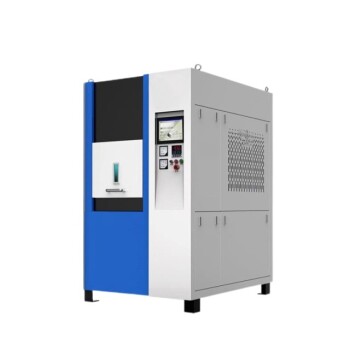
The primary role of the high-temperature sintering furnace is structural restoration and integration. specifically for ball-milled L*LS cathode precursors, this furnace creates a thermal environment, often around 750°C, that reverses the mechanical damage caused by high-energy milling. Its main functions are to eliminate lattice stress, remove amorphous regions, and drive the recrystallization necessary for stable electrochemical performance.
High-energy ball milling is a destructive process that leaves materials mechanically stressed and structurally disordered. The sintering furnace provides the critical thermal energy required to heal these defects, inducing recrystallization and element diffusion to ensure the final cathode material is stable and highly crystalline.
Repairing Mechanical Damage
The ball milling process is essential for mixing, but it introduces significant defects into the precursor material. The secondary heat treatment is the corrective step.
Eliminating Lattice Stress
High-energy ball milling imparts immense kinetic energy into the powder, twisting and distorting the atomic lattice.
This results in high levels of internal lattice stress. The sintering furnace provides the thermal energy needed to relax these atomic bonds, returning the material to a low-energy, stable state.
Erasing Amorphous Regions
The impact forces during milling often destroy the long-range order of atoms, creating amorphous (non-crystalline) regions.
Without heat treatment, these regions would lead to poor battery performance. The furnace heats the material to a point where atoms can rearrange, eliminating these disordered zones.
Enhancing Structural Integrity
Beyond simple repair, the furnace actively promotes the formation of the final, functional crystal structure.
Promoting Recrystallization
The thermal energy provided at temperatures like 750°C acts as a catalyst for material recrystallization.
This process significantly increases the crystallinity of the L*LS precursors. High crystallinity is directly correlated with better ion transport and structural durability in battery cathodes.
Inducing Element Diffusion
For the cathode to function correctly, the various chemical components must be perfectly integrated.
The furnace induces appropriate element diffusion, allowing atoms to migrate and settle into their correct lattice positions. This leads to strong structural integration between components, ensuring the material acts as a cohesive unit rather than a mixture of separate phases.
Understanding the Trade-offs
While the sintering furnace is vital for synthesis, the process requires precise control to avoid diminishing returns.
The Balance of Temperature
The target temperature (e.g., 750°C) is specific to the material's needs.
If the temperature is too low, the lattice stress will not be fully eliminated, leading to rapid degradation during battery cycling. If the temperature is too high, you risk excessive grain growth, which can extend diffusion paths and hinder performance.
Structural Integration vs. Phase Purity
The goal is structural integration, but this relies on a stable thermal environment.
Inconsistent heating can lead to incomplete diffusion or phase separation. As seen in other complex oxide syntheses, a continuous and stable heat input is required to ensure the reaction completes fully without leaving unreacted raw materials.
Making the Right Choice for Your Goal
To optimize your secondary heat treatment process, consider your specific performance targets:
- If your primary focus is Electrochemical Cycling Stability: Prioritize a heat treatment protocol that guarantees the complete elimination of lattice stress, as residual stress is a primary cause of degradation.
- If your primary focus is High Crystallinity: Focus on maintaining a stable temperature plateau (around 750°C) to maximize the reduction of amorphous regions introduced by milling.
Ultimately, the sintering furnace transforms a chaotic, mechanically stressed powder into a unified, crystalline cathode capable of enduring the rigors of electrochemical cycling.
Summary Table:
| Function | Description | Impact on Performance |
|---|---|---|
| Lattice Stress Relief | Relaxes atomic bonds distorted by high-energy milling. | Enhances long-term cycling stability. |
| Recrystallization | Converts amorphous regions into ordered crystal structures. | Improves ion transport and structural durability. |
| Element Diffusion | Facilitates migration of atoms into correct lattice positions. | Ensures chemical homogeneity and phase purity. |
| Temperature Control | Maintains precise thermal plateaus (e.g., 750°C). | Prevents excessive grain growth and unreacted phases. |
Elevate Your Battery Research with KINTEK
Precision is paramount when transforming mechanically stressed precursors into high-performance cathode materials. KINTEK specializes in advanced laboratory solutions designed for the rigorous demands of battery material synthesis.
Our comprehensive range of high-temperature sintering furnaces (muffle, tube, and vacuum) and crushing/milling systems provides the stable thermal environments and mechanical control necessary to achieve superior crystallinity and structural integration. Whether you are optimizing L*LS precursors or developing next-generation solid-state batteries, our expertise in thermal processing and material preparation ensures your lab achieves repeatable, high-quality results.
Ready to optimize your secondary heat treatment process? Contact our technical experts today to find the perfect furnace or milling solution for your research goals.
Related Products
- High Temperature Muffle Oven Furnace for Laboratory Debinding and Pre Sintering
- Vacuum Heat Treat and Pressure Sintering Furnace for High Temperature Applications
- 2200 ℃ Tungsten Vacuum Heat Treat and Sintering Furnace
- Ultra-High Temperature Graphite Vacuum Graphitization Furnace
- 2200 ℃ Graphite Vacuum Heat Treat Furnace
People Also Ask
- Why is the annealing treatment in a high-temperature muffle furnace critical for the preparation of an Sb-SnO2 interlayer?
- What role does a high-temperature muffle furnace play in the synthesis of manganese/cobalt-modified ceramic catalysts?
- What are the main components of a high-temperature muffle furnace? A Guide to the Core Systems
- What is the significance of integrating a high-temperature muffle furnace into an impact wear testing system?
- What is the role of a high-temperature muffle furnace in preparing Cs-aluminosilicate waste? Key Simulation Insights