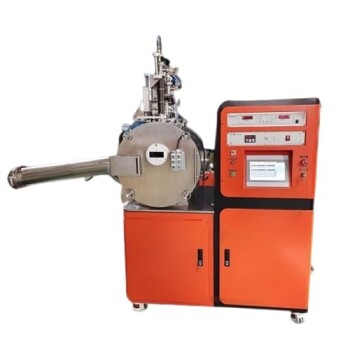
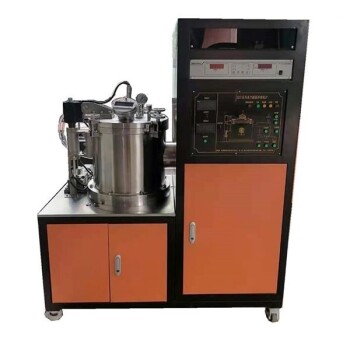
The high-vacuum or high-purity atmosphere arc melting furnace serves as the critical first line of defense against material degradation. In the synthesis of NiCoFeCr and NiCoFeCrMn high-entropy alloys, this equipment plays a dual role: it provides a sterile environment to prevent oxidation and generates the intense thermal energy required to fuse diverse elements. By melting high-purity metal powders under protective argon gas, the furnace ensures the resulting ingot retains the precise chemical composition intended by the researcher.
This equipment bridges the gap between raw powder and usable alloy by eliminating oxygen contamination and ensuring complete elemental homogenization through high-intensity arc heating.
Ensuring Chemical Integrity
Preventing High-Temperature Oxidation
The primary challenge in synthesizing high-entropy alloys (HEAs) containing reactive elements like Chromium (Cr) and Manganese (Mn) is their affinity for oxygen.
At melting temperatures, these elements oxidize rapidly if exposed to air. This contamination compromises the mechanical properties of the final alloy.
The arc melting furnace solves this by evacuating air and replacing it with high-purity argon gas. This inert atmosphere effectively acts as a shield, preserving the metallic state of the raw powders during the intense heating process.
Precise Composition Control
Success in HEA research depends on hitting exact atomic ratios (e.g., equiatomic NiCoFeCr).
If elements oxidize or evaporate during melting, the final stoichiometry changes, leading to unpredictable material behavior.
By maintaining a "clean" melting environment, the furnace ensures that the input mass matches the output mass. This results in as-cast alloys with high purity levels and chemical compositions that strictly adhere to the theoretical design.
Achieving Homogeneity Through Heat
Full Component Fusion
NiCoFeCr and NiCoFeCrMn alloys consist of elements with varying melting points and densities.
The electric arc generates extremely high temperatures, far exceeding the melting point of the most refractory element in the mix.
This intense heat ensures that all components, regardless of their individual thermal properties, are fully melted. This creates a uniform liquid melt, which is essential for mixing the elements thoroughly before solidification.
The Role of Copper Molds
While the arc provides the heat, the vessel matters equally.
These furnaces typically utilize water-cooled copper molds or hearths. As noted in supplementary processing contexts, copper offers superior thermal conductivity.
This allows for the rapid cooling and solidification of the molten metal once the arc is extinguished. This rapid solidification helps achieve a fine, uniform initial grain structure, setting a stable foundation for any future mechanical work.
Understanding the Limitations
The "As-Cast" Condition
While the arc melting furnace creates a chemically pure alloy, the resulting material is in an "as-cast" state.
It is important to recognize that arc melting alone does not guarantee perfect microstructural equilibrium. Rapid cooling can sometimes lead to dendritic segregation (micro-scale chemical variation).
The Necessity of Post-Processing
The arc melter is the synthesis tool, not necessarily the final processing tool.
To achieve optimal mechanical properties, the ingots produced often require subsequent heat treatment.
As indicated by standard protocols for these alloys, homogenization annealing (e.g., at 1050°C) is often required after arc melting to eliminate casting stresses and ensure the elements are chemically uniform at the micro-level.
Making the Right Choice for Your Goal
To maximize the quality of your NiCoFeCr or NiCoFeCrMn alloys, consider how the arc melting stage dictates downstream success:
- If your primary focus is Chemical Purity: Prioritize a furnace with a robust vacuum system and high-purity argon backfill to eliminate any risk of oxide formation during the initial melt.
- If your primary focus is Microstructural Homogeneity: Understand that while the arc melter fuses the elements, you must plan for subsequent homogenization heat treatments to remove dendritic segregation found in the as-cast ingot.
The arc melting furnace is the foundational tool that transforms loose powder into a coherent, high-purity metallic solid, enabling all subsequent material science investigations.
Summary Table:
| Feature | Role in HEA Synthesis | Benefit for NiCoFeCr/Mn Alloys |
|---|---|---|
| High-Vacuum/Argon Shield | Prevents high-temperature oxidation | Preserves reactive elements like Cr and Mn |
| High-Intensity Electric Arc | Generates extreme thermal energy | Ensures full fusion of elements with diverse melting points |
| Water-Cooled Copper Mold | Rapidly solidifies molten metal | Creates a stable as-cast ingot with fine grain structure |
| Atmosphere Control | Maintains stoichiometry | Guarantees precise atomic ratios and chemical purity |
Elevate Your Materials Research with KINTEK Precision
High-entropy alloy synthesis requires uncompromising purity and thermal control. KINTEK specializes in advanced laboratory equipment, providing researchers with high-performance high-vacuum arc melting furnaces, induction melting systems, and high-temperature muffle and tube furnaces designed for precise atmosphere control.
Whether you are synthesizing NiCoFeCrMn ingots or developing next-generation battery materials, our comprehensive portfolio—including crushing systems, hydraulic presses, and high-pressure reactors—ensures your workflow is seamless and your results are reproducible.
Ready to achieve superior homogenization and chemical integrity in your alloys? Contact our technical experts today to find the perfect equipment solution for your laboratory.
References
- Bauyrzhan Amanzhulov, Maxim V. Zdorovets. Composition and Structure of NiCoFeCr and NiCoFeCrMn High-Entropy Alloys Irradiated by Helium Ions. DOI: 10.3390/ma16103695
This article is also based on technical information from Kintek Solution Knowledge Base .
Related Products
- Vacuum Arc Induction Melting Furnace
- Vacuum Induction Melting Spinning System Arc Melting Furnace
- Non Consumable Vacuum Arc Induction Melting Furnace
- Vacuum Heat Treat Furnace and Levitation Induction Melting Furnace
- Lab-Scale Vacuum Induction Melting Furnace
People Also Ask
- How do vacuum induction or arc melting furnaces facilitate the synthesis of U-Al-C MAX phases? Precision Heat & Purity
- What core role does a Vacuum Induction Melting furnace play in nickel-free steel production? Achieve High-Purity Alloys
- What is the function of vacuum arc melting equipment? Creating High-Purity Ferrochrome (CrFe) Alloys
- What is the primary function of a vacuum arc melting furnace in RHEA preparation? Achieving Extreme Thermal Fusion
- What is the function of a vacuum arc melting furnace? Master Homogeneity for Amorphous Alloy Ribbons