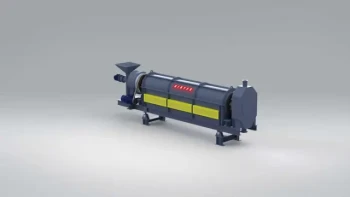
A horizontal tube furnace serves as the controlled thermal reactor necessary to transform raw bio-waste into a structured carbon precursor through anaerobic pyrolysis. By maintaining temperatures typically ranging from 400°C to 600°C under a continuous flow of inert gas like nitrogen, the furnace ensures that organic materials—such as citrus peels, walnut shells, or cellulose fibers—decompose thermally without burning into ash. This process establishes the initial carbon framework and pore structure required for subsequent activation.
The horizontal tube furnace is the critical tool for decoupling thermal decomposition from oxidation, allowing for the precise creation of a stable, porous carbon skeleton from biomass. It provides the dual-control of atmosphere and temperature gradient necessary to turn waste into a high-value adsorbent.
The Foundation of Controlled Pyrolysis
Establishing an Anaerobic Environment
The primary role of the furnace is to provide a sealed environment that excludes oxygen. By introducing a constant flow of nitrogen or argon, the furnace facilitates pyrolysis in an anaerobic state.
This prevents the bio-waste from undergoing combustion. Without this atmospheric control, the material would simply burn, leaving behind useless mineral ash rather than a functional carbon framework.
Precision Temperature Management
The furnace allows for programmed heating rates and stable "soak" times at specific temperatures. For example, pre-carbonization often occurs at 400°C to 550°C to induce dehydration and the removal of volatile organic compounds.
Uniform heat distribution within the tube ensures that the entire batch of biomass reaches the same state of carbonization. This thermal stability is vital for producing a consistent biochar base with predictable chemical characteristics.
Driving Chemical and Structural Activation
Volatile Removal and Pore Development
During the heating process, the furnace facilitates the thermochemical decomposition of the precursor. As volatile components are driven off, the furnace helps establish an initial pore structure within the amorphous carbon framework.
This initial porosity is the "blueprint" for the final product. The furnace's ability to maintain a steady environment allows these pores to form without the structural collapse of the biomass skeleton.
Facilitating High-Temperature Reagents
In more advanced production stages, the tube furnace supplies the energy for chemical activation. When biomass is impregnated with agents like potassium hydroxide (KOH) or phosphoric acid, the furnace is pushed to higher temperatures, sometimes reaching 850°C.
At these extremes, the furnace drives specific reactions, such as the generation of metallic potassium vapor. This vapor penetrates the carbon matrix, creating a dense network of micropores that significantly increases the material's specific surface area.
Understanding the Trade-offs
Batch Processing Limitations
The most significant limitation of a horizontal tube furnace is its batch-based nature. Because the material is contained within a fixed-volume tube, it is difficult to achieve the continuous high-volume throughput found in rotary kilns.
This makes it an exceptional tool for research and high-purity specialized production, but less efficient for low-grade, mass-market carbon manufacturing.
Thermal Stress and Material Integrity
The quartz or ceramic tubes used in these furnaces are susceptible to thermal shock if heating or cooling rates are too aggressive. Rapid changes can lead to tube cracking, which compromises the inert atmosphere.
Furthermore, certain activating agents, particularly strong alkalis like KOH, can chemically attack the tube material at high temperatures. This necessitates frequent maintenance and the use of protective crucibles or liners to extend the life of the equipment.
How to Apply This to Your Project
Selecting the Right Approach
Choosing the correct furnace parameters depends entirely on your specific biomass precursor and the intended application of the activated carbon.
- If your primary focus is Research and Development: Utilize the programmable logic controllers (PLCs) to test various heating rates (e.g., 5°C/min vs. 20°C/min) to optimize the pore size distribution for specific adsorbates.
- If your primary focus is High-Surface Area Activation: Ensure your furnace is rated for at least 900°C and utilize a dual-stage process—initial carbonization followed by chemical activation—to maximize the development of the carbon matrix.
- If your primary focus is Scalable Prototyping: Focus on optimizing the gas flow rate and sample thickness within the furnace to ensure uniform heat penetration, which will make the transition to larger reactors more predictable.
The horizontal tube furnace remains the definitive standard for transforming raw bio-waste into sophisticated carbon structures through total environmental control.
Summary Table:
| Process Phase | Furnace Function | Impact on Carbon Quality |
|---|---|---|
| Anaerobic Pyrolysis | Provides inert atmosphere (N2/Ar) | Prevents ash formation; creates carbon skeleton. |
| Thermal Control | Precise heating rates (400-600°C) | Ensures uniform volatile removal and pore initiation. |
| Chemical Activation | High-temp stability (up to 900°C) | Drives reagent reactions to maximize surface area. |
| Research Testing | Programmable logic control (PLC) | Allows optimization of heating cycles for specific waste. |
Elevate Your Carbon Research with KINTEK Precision
Ready to transform bio-waste into high-performance activated carbon? KINTEK specializes in advanced thermal solutions, offering a comprehensive range of horizontal tube furnaces, vacuum furnaces, and high-temperature reactors designed for precise atmospheric and temperature control.
From initial sample preparation with our crushing and milling systems to final material characterization, our portfolio supports your entire workflow with premium crucibles, ceramics, and cooling solutions.
Contact our technical experts today to find the ideal equipment for your carbonization projects and experience the KINTEK advantage in material science!
References
- K. Kiran Kumar, G. Krishnaveni. Defluoridation of Water by Biowaste Material – A Study of Adsorption Kinetics and Isotherms. DOI: 10.46488/nept.2023.v22i04.031
This article is also based on technical information from Kintek Solution Knowledge Base .
Related Products
- Vertical Laboratory Tube Furnace
- Horizontal High Temperature Graphite Vacuum Graphitization Furnace
- Graphite Vacuum Furnace Bottom Discharge Graphitization Furnace for Carbon Materials
- Large Vertical Graphite Vacuum Graphitization Furnace
- Laboratory Vacuum Tilt Rotary Tube Furnace Rotating Tube Furnace
People Also Ask
- What is the function of a laboratory vertical tube furnace in microalgae catalytic pyrolysis? Optimize Your Bio-Fuel.
- How does a laboratory tube furnace provide atmospheric control during the sintering of glass-ceramics? Achieve Precision
- Why is a laboratory tube furnace required for LMTP0.1/CA materials? Achieve Precise Carbon Coating & Crystal Growth
- How does a laboratory tube furnace provide precise temperature control? Expert Simulation for Steam Cracking
- How does the temperature control precision of a laboratory tube furnace affect the quality of grown single crystals?