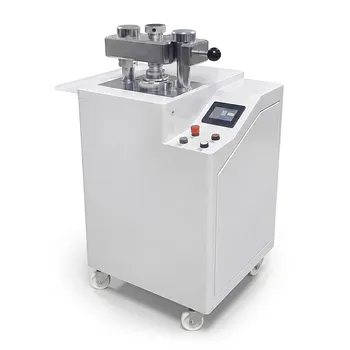
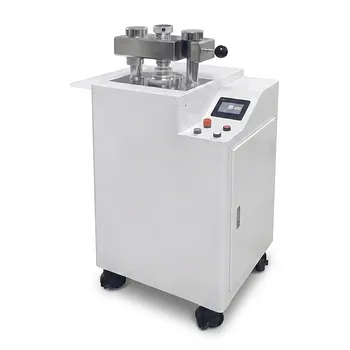
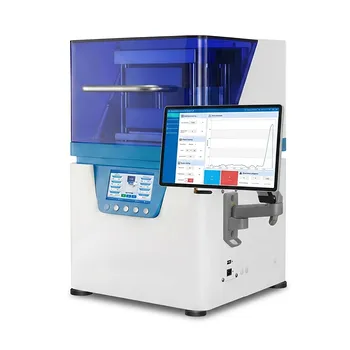
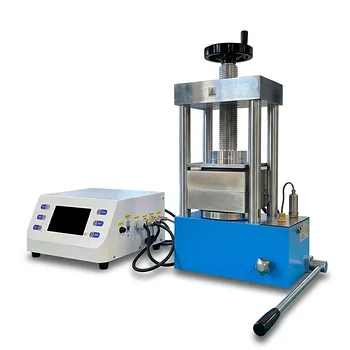
The laboratory hydraulic press is the foundational tool for transforming loose $UO_2$ and $Gd_2O_3$ powder into a stable "green pellet" through high-pressure axial compaction. This mechanical process compresses the mixed powders into a precise geometric shape, ensuring the intimate particle-to-particle contact required for successful solid-state reactions and densification during the subsequent high-temperature sintering stage.
The primary role of the hydraulic press is to establish the initial density and structural integrity of the fuel pellet, creating a "green body" that can withstand handling and provide the necessary pathways for diffusion. By applying uniform pressure, the press directly dictates the final product's microstructure, porosity, and dimensional stability.
The Mechanics of Green Pellet Compaction
Transformation from Powder to Green Body
The hydraulic press applies high axial pressure—typically ranging from 200 MPa to 700 MPa—to the blended uranium and gadolinium oxides within a specialized die. This force overcomes the internal friction of the powder, reducing the volume and creating a cohesive, handleable pellet known as a green body.
Particle Rearrangement and Mechanical Bonding
Under high pressure, the individual $UO_2$ and $Gd_2O_3$ particles undergo rearrangement and plastic deformation, filling the voids between them. This eliminates large pores and increases the contact density, which is essential for the mechanical strength of the unsintered pellet.
Ensuring Geometric Precision
The use of a hydraulic press allows for the production of pellets with consistent diameters and heights. Maintaining these geometric tolerances is critical because any irregularities in the green stage will be magnified during the shrinkage that occurs during sintering.
Impact on Solid-State Reactions and Sintering
Facilitating Solid-Phase Diffusion
For $Gd_2O_3$ to effectively dope the $UO_2$ matrix, atoms must migrate across particle boundaries at high temperatures. The hydraulic press ensures the particles are in intimate contact, which provides the necessary interfaces for rapid solid-phase diffusion and uniform grain growth.
Controlling Porosity and Final Density
By eliminating air pockets and reducing the initial distance between particles, the press establishes the "initial state" for densification. Proper compaction is the only way to achieve a final relative density that often exceeds 90% to 95% of the theoretical maximum.
Minimizing Microstructural Defects
A high-precision hydraulic press provides uniform pressure distribution, which is vital for a homogeneous microstructure. If the pressure is inconsistent, the resulting variation in grain boundaries can lead to localized stress and uneven material properties in the finished nuclear fuel.
Understanding the Trade-offs and Pitfalls
Internal Density Gradients
One of the most significant challenges in hydraulic pressing is the formation of density gradients, where the center of the pellet is less dense than the ends. If these gradients are too steep, the pellet may warp, "hour-glass," or develop internal cracks during the sintering process as different areas shrink at different rates.
The Risk of Laminar Cracking (Capping)
Applying excessive pressure can lead to a phenomenon known as capping or laminar cracking, where the pellet delaminates upon being ejected from the die. This occurs when the stored elastic energy in the compressed powder exceeds the strength of the mechanical bonds formed during pressing.
Binder and Lubricant Management
To facilitate pressing and protect the die, binders or lubricants are often added to the powder mix. However, these must be carefully managed; if they are not fully removed (de-bound) before the pellet reaches peak sintering temperatures, they can leave behind residual porosity or carbon contaminants.
Making the Right Choice for Your Goal
How to Apply This to Your Project
- If your primary focus is maximizing final density: Utilize higher compaction pressures (approaching 600–700 MPa) to minimize initial void space, ensuring the die is well-lubricated to prevent friction-induced heating.
- If your primary focus is preventing deformation and warping: Prioritize high-precision pressure control and slow decompression cycles to minimize internal density gradients and elastic spring-back.
- If your primary focus is microstructural uniformity: Ensure the $UO_2$ and $Gd_2O_3$ powders are thoroughly ball-milled before pressing to guarantee that the hydraulic force is acting on a truly homogeneous mixture.
By mastering the precision and mechanics of the hydraulic press, you ensure that the complex chemical and physical transitions of the sintering process result in a high-performance, defect-free nuclear fuel pellet.
Summary Table:
Role of Hydraulic Press in Pellet Fabrication
| Process Phase | Pressing Function | Key Outcome |
|---|---|---|
| Compaction | High-pressure axial force (200-700 MPa) | Creates stable, handleable "green bodies" |
| Particle Contact | Rearrangement and plastic deformation | Facilitates rapid solid-phase diffusion |
| Dimensional Control | Specialized die-based compression | Ensures precise geometric tolerances |
| Densification | Elimination of internal air pockets | Enables final relative density >95% |
| Quality Control | Uniform pressure distribution | Minimizes microstructural defects and warping |
Elevate Your Material Synthesis with KINTEK Precision
Achieving the perfect green pellet density is critical for high-performance nuclear fuel research and advanced ceramics. At KINTEK, we understand that uniform pressure and mechanical stability are the foundations of successful sintering.
Our specialized range of laboratory hydraulic presses (manual, pellet, hot, and isostatic) is engineered to provide the precise axial force required to eliminate laminar cracking and minimize density gradients. To ensure a complete and seamless workflow, we also offer:
- Crushing & Milling Systems: For the homogeneous blending of $UO_2$ and $Gd_2O_3$ powders.
- High-Temperature Furnaces: Including vacuum and atmosphere-controlled models for optimal sintering.
- Essential Consumables: High-precision dies, ceramic crucibles, and PTFE products.
Ready to enhance your lab's efficiency and achieve superior microstructural uniformity? Contact our technical experts today to find the perfect solution for your research!
References
- Sonia García-Gómez, Joan de Pablo. Gd2O3 Doped UO2(s) Corrosion in the Presence of Silicate and Calcium under Alkaline Conditions. DOI: 10.3390/inorganics11120469
This article is also based on technical information from Kintek Solution Knowledge Base .
Related Products
- Automatic XRF Pellet Press 40 Ton Hydraulic Sample Preparation Press for Fluorescent Spectroscopy Analysis
- Automatic Laboratory Hydraulic Pellet Press Machine for Lab Use
- kbr pellet press 2t
- Laboratory Manual Hydraulic Pellet Press for Lab Use
- Laboratory Hydraulic Press Lab Pellet Press Machine for Glove Box
People Also Ask
- How does a laboratory hydraulic press assist in the quantitative analysis of slag powder using XRF? Boost Precision
- Why is a laboratory hydraulic pellet press essential for the FTIR characterization of lignite and its pyrolysis products?
- How does a manual hydraulic pellet press contribute to the formation of biomass fuels? Optimize Your Fuel Densification
- What is the purpose of using a laboratory hydraulic press to form pellets? Maximize Weberite Na2Fe2F7 Phase Purity
- What is the necessity of using a laboratory hydraulic pellet press in the preparation of biomass fuel pellets? Guide