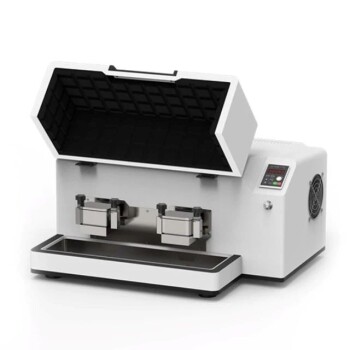
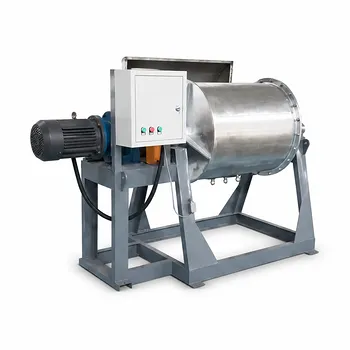
The planetary ball mill serves as the critical mechanical activation step in the solid-state synthesis of perovskite oxides. It utilizes intense mechanical forces to thoroughly grind and mix metal oxide precursors, effectively bridging the gap between raw powder and a reactive mixture ready for crystallization.
The device acts as more than a simple mixer; it reduces particle sizes to the micron level and maximizes the contact area between solids. This mechanical preparation significantly lowers the energy barrier for ion diffusion, facilitating the formation of high-purity perovskite structures during subsequent high-temperature annealing.
The Mechanics of Precursor Preparation
Achieving Atomic-Level Homogeneity
In solid-state synthesis, the reaction rate is limited by how well the different starting materials (precursors) are mixed. A planetary ball mill uses high-hardness grinding media, such as stabilized zirconia beads, to subject the raw materials—typically high-purity oxides, carbonates, or salts—to intense centrifugal and shear forces.
Particle Size Reduction
The primary physical change induced by the mill is the drastic reduction of precursor particle size. By grinding materials down to micron-level dimensions, the mill increases the specific surface area of the reactants. This is a fundamental requirement for efficient solid-state reactions, which rely entirely on surface-to-surface contact.
Facilitating the Chemical Reaction
Enhancing Interfacial Contact
Solid-state reactions occur at the interfaces where different solid particles touch. The planetary ball mill ensures thorough physical contact by forcing distinct precursor particles together. This "tight" packing creates the necessary physical conditions for ions to move from one particle to another.
Lowering Diffusion Energy Barriers
For a perovskite structure to form, ions must diffuse through solid phases, a process that typically requires immense thermal energy. By reducing the diffusion path length (via smaller particles) and increasing contact points, the ball mill lowers the activation energy required. This allows the subsequent high-temperature calcination or annealing steps to proceed more efficiently and often at lower temperatures.
Promoting High Phase Purity
Inadequate mixing often leads to secondary phases or incomplete reactions. The uniform distribution achieved by planetary milling ensures that the stoichiometric ratio of reactants is consistent throughout the mixture. This homogeneity is directly responsible for synthesizing high-purity perovskite phases free from unreacted raw materials.
Understanding the Trade-offs
Risk of Contamination
While high-energy milling is effective, the grinding media itself (balls and jars) faces significant wear. If the milling duration is excessive or the wrong media is chosen, material from the grinding balls (e.g., zirconia) can contaminate the sample, potentially altering the electrical or magnetic properties of the final perovskite.
Mechanical Amorphization
The impact forces in a planetary ball mill can be high enough to induce mechanochemical reactions or amorphization (loss of crystal structure) before heating. While sometimes desired for specific electrolytes, in standard oxide synthesis, uncontrolled amorphization might complicate the crystallization process during the annealing phase if not properly managed.
Making the Right Choice for Your Goal
To optimize your synthesis strategy, consider the following recommendations based on your specific project requirements:
- If your primary focus is Phase Purity: Use high-density, wear-resistant media like yttria-stabilized zirconia (YSZ) to minimize contamination while ensuring thorough homogenization.
- If your primary focus is Reaction Efficiency: optimize the milling time to achieve the smallest possible particle size without over-milling, thereby reducing the time and temperature required for the final calcination step.
Ultimately, the planetary ball mill transforms a mixture of passive powders into a highly reactive system, ensuring your thermal treatment yields a consistent, high-quality perovskite.
Summary Table:
| Key Role | Impact on Synthesis | Benefit to Final Perovskite |
|---|---|---|
| Particle Size Reduction | Decreases ion diffusion path length | Faster reaction kinetics at lower temperatures |
| Homogenization | Ensures stoichiometric consistency | High phase purity with minimal secondary phases |
| Mechanical Activation | Increases specific surface area and contact | Lower activation energy for solid-state reactions |
| Precursor Prep | Intense shear and centrifugal forces | Enhanced interfacial contact for efficient calcination |
Elevate Your Material Research with KINTEK Precision
Achieving high-purity perovskites requires the perfect balance of mechanical energy and contamination control. KINTEK specializes in advanced laboratory solutions, providing high-performance planetary ball mills, crushing and milling systems, and high-purity grinding media designed for the rigorous demands of solid-state synthesis.
Beyond milling, our comprehensive portfolio supports your entire workflow—from high-temperature furnaces (muffle, vacuum, and CVD) for calcination to hydraulic presses and pellet dies for sample preparation. Whether you are optimizing battery research, developing catalysts, or synthesizing advanced ceramics, KINTEK delivers the reliability and precision your lab deserves.
Ready to optimize your synthesis process? Contact KINTEK today to discuss your equipment needs!
References
- Lin‐Bo Liu, Subiao Liu. Perovskite Oxides Toward Oxygen Evolution Reaction: Intellectual Design Strategies, Properties and Perspectives. DOI: 10.1007/s41918-023-00209-2
This article is also based on technical information from Kintek Solution Knowledge Base .
Related Products
- Mini Planetary Ball Mill Machine for Laboratory Milling
- High Energy Planetary Ball Mill for Laboratory Horizontal Tank Type Milling Machine
- Laboratory Planetary Ball Mill Cabinet Planetary Ball Milling Machine
- Laboratory Horizontal Planetary Ball Mill Milling Machine
- High-Energy Omnidirectional Planetary Ball Mill Milling Machine for Laboratory
People Also Ask
- How does a laboratory ball mill ensure the mixing quality of Mn3Zn0.8Sn0.2N and Ti? Achieve Perfect Homogeneity
- Why is a laboratory ball mill required for ultra-fine fly ash? Unlock Nano-Scale Adsorption Power
- Why is a laboratory ball mill used in Co-Ni catalyst research? Optimize CO2 Conversion with Precise Milling
- What is the function of a laboratory ball mill in the pretreatment of waste tire char (WTC)? Optimize Material Reactivity
- What is the primary function of a laboratory ball mill in the modification of sulfide-based solid electrolytes with LiPO2F2?