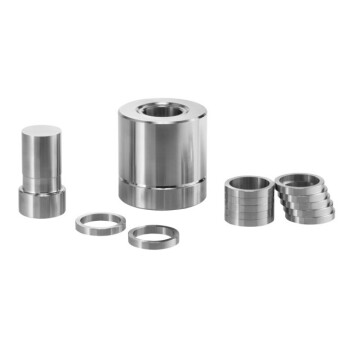
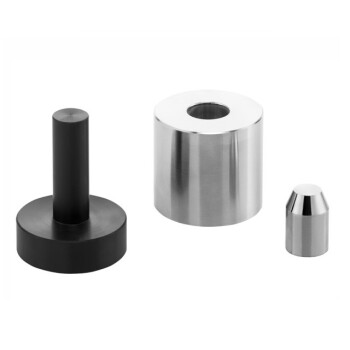
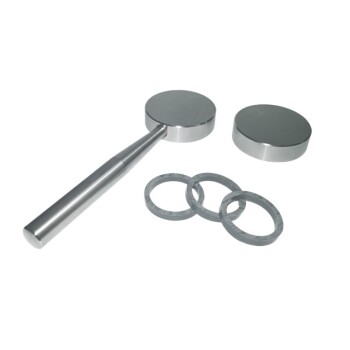
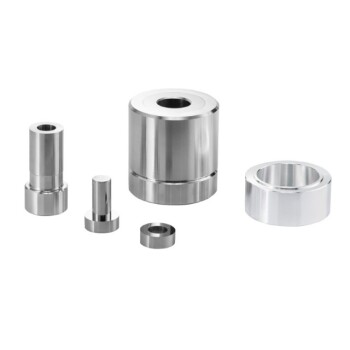
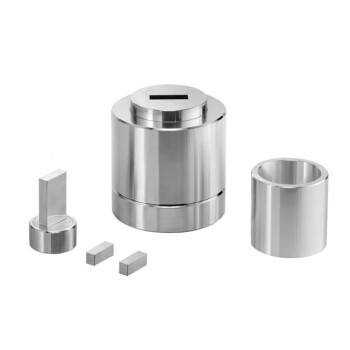
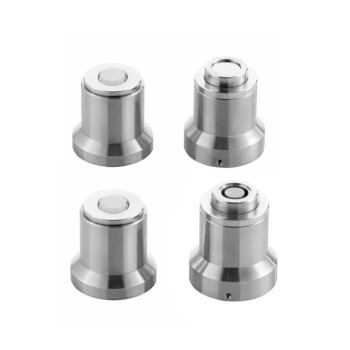
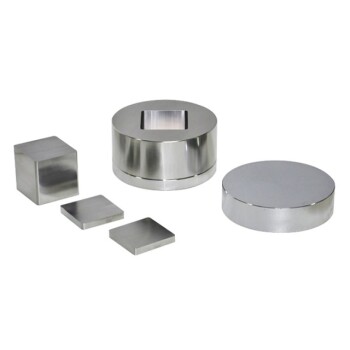
The primary function of a pressure mold is to serve as the high-strength containment vessel that defines the geometry of solid-state battery components. It allows a hydraulic press to apply immense force to loose powders, transforming them into dense, dimensionally precise electrolyte and electrode pellets while preventing material leakage or structural failure.
The mold acts as the bridge between raw force and precision engineering. By maintaining rigidity under pressure, it ensures the resulting pellets achieve the surface flatness and structural integrity required for effective solid-solid contact within the battery.
The Mechanics of Pellet Formation
Defining Physical Geometry
The most immediate role of the pressure mold is containing the powder shape. Before pressure is applied, the mold confines the loose electrolyte or electrode powders into the specific form required for the battery cell.
Withstanding Hydraulic Force
During the pressing process, the mold must endure extreme stress. It is the component that withstands the pressure applied by a hydraulic press, which acts as the external force generator.
Enabling High-Pressure Densification
The mold provides the resistance necessary for the press to do its job. This containment allows the system to achieve the high pressures needed to eliminate gaps between powder particles and create a dense material.
Ensuring Precision and Integrity
Achieving Precise Dimensions
A high-quality pressure mold guarantees that the resulting pellets have precise dimensions. This accuracy is critical for ensuring the components fit perfectly within the final battery assembly.
Guaranteeing Surface Flatness
The internal finish of the mold directly dictates the surface quality of the pellet. High-quality molds ensure excellent surface flatness, which is vital for minimizing resistance between battery layers.
Preventing Material Loss
The mold must fit together with tight tolerances. This precision is essential for preventing powder leakage during the compression phase, ensuring that the exact amount of material intended for the layer remains in the pellet.
Avoiding Structural Defects
By providing uniform support, the mold plays a key role in preventing structural defects. It ensures the pellet does not crack or deform unevenly as the powder is compacted into a solid state.
The Risks of Inferior Tooling
Compromised Structural Integrity
If a mold cannot withstand the applied pressure or has poor tolerances, the battery components will suffer. Structural integrity is the first casualty, leading to pellets that are brittle or prone to crumbling.
Poor Interfacial Contact
A mold with surface imperfections transfers those defects to the pellet. In solid-state batteries, this results in poor contact between layers, which can impede ion transport and degrade performance.
Making the Right Choice for Your Goal
When selecting or designing pressure molds for solid-state battery fabrication, consider your specific experimental needs:
- If your primary focus is fabrication consistency: Prioritize molds made from high-tensile materials that can withstand repeated high-pressure cycles without deforming, ensuring every pellet has identical dimensions.
- If your primary focus is electrochemical performance: Prioritize molds with ultra-high precision finishes to ensure maximum surface flatness, which directly reduces grain boundary resistance and improves ion transport.
Ultimately, the quality of your pressure mold dictates the baseline quality of your battery's physical structure.
Summary Table:
| Function | Benefit | Impact on Battery Quality |
|---|---|---|
| Powder Containment | Defines physical geometry | Ensures precise dimensional accuracy and fit |
| Force Resistance | Enables high-pressure densification | Eliminates gaps to create high-density pellets |
| Surface Finishing | Guarantees surface flatness | Minimizes resistance and improves ion transport |
| Precision Tolerance | Prevents material leakage | Maintains exact material composition and weight |
| Structural Support | Prevents defects/cracking | Ensures long-term durability and integrity |
Elevate Your Solid-State Battery Research with KINTEK
Precision is the foundation of energy innovation. KINTEK specializes in high-performance laboratory equipment designed to meet the rigorous demands of battery fabrication. Our premium pressure molds and hydraulic pellet presses are engineered to provide the extreme force and surface flatness required for superior electrolyte and electrode pellets.
Beyond pelletizing, KINTEK offers a comprehensive suite of solutions for advanced material science, including:
- High-Temperature Furnaces: Muffle, vacuum, and CVD systems for sintering and material synthesis.
- Advanced Reactors: High-temperature high-pressure reactors and autoclaves.
- Processing Equipment: Crushing, milling, and sieving systems for powder preparation.
- Lab Essentials: ULT freezers, electrolytic cells, and high-quality ceramic crucibles.
Ready to achieve superior structural integrity in your solid-state components? Contact our technical experts today to find the perfect equipment tailored to your research goals.
Related Products
- XRF Boric Acid Lab Powder Pellet Pressing Mold for Laboratory Use
- XRF & KBR steel ring lab Powder Pellet Pressing Mold for FTIR
- Button Battery Tablet Press Sealing Mold for Lab Use
- XRF & KBR plastic ring lab Powder Pellet Pressing Mold for FTIR
- Ring Press Mold for Lab Applications
People Also Ask
- What is the purpose of using a mold for pellet pressing when preparing catalyst test samples? Ensure Data Consistency
- What is the XRF method of sampling? Achieve Accurate Elemental Analysis with Proper Sample Prep
- What is the XRF pressed pellet method? A Fast, Cost-Effective Sample Prep Guide
- How are samples prepared for XRF analysis? Achieve Accurate and Reliable Results
- How do you make XRF pellets? A 4-Step Guide to Flawless Sample Preparation