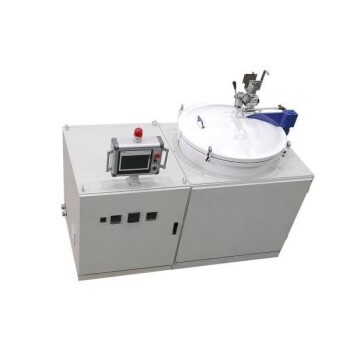
The primary role of a Vacuum Induction Melting (VIM) Furnace in preparing 1.25Cr-0.5Mo steel is to ensure absolute compositional precision. By operating in a highly controlled vacuum environment, the furnace effectively prevents the oxidation loss of critical alloying elements—specifically chromium, molybdenum, and manganese—while simultaneously inhibiting the absorption of impurity gases. This process guarantees that the final ingot strictly adheres to alloy design targets, which is essential for obtaining reliable data in subsequent testing.
The VIM furnace serves as a "compositional lock," ensuring that the chemistry you design is exactly what you produce. By isolating the melt from atmospheric interference, it creates the standardized, high-purity substrate required for accurate heat treatment and mechanical property analysis.
Preservation of Critical Elements
Preventing Oxidation Loss
The 1.25Cr-0.5Mo steel relies heavily on the specific ratios of Chromium (Cr) and Molybdenum (Mo). In a standard open-air melt, these active elements are prone to oxidation, which would alter the final composition unpredictably.
Ensuring Target Retention
The VIM furnace mitigates this by eliminating oxygen from the melting environment. This ensures that the amounts of Cr, Mo, and Manganese added to the melt remain in the final ingot, rather than being lost as slag or oxide inclusions.
Eliminating Gas Absorption
Beyond preserving solids, the vacuum environment inhibits the absorption of atmospheric impurity gases. This is critical for preventing defects that could skew experimental results or weaken the material's structural integrity.
Achieving Homogeneity and Reliability
Electromagnetic Stirring
While the vacuum protects the chemistry, the induction mechanism actively improves the physical structure. The induction heating process generates an electromagnetic stirring effect within the molten pool.
Uniform Composition
This stirring action ensures the thorough fusion of the alloy components. It eliminates segregation, ensuring that the 1.25Cr-0.5Mo distribution is uniform throughout the entire ingot, from the core to the surface.
Data Reliability for Research
The primary reference highlights that this process is frequently used for experimental ingots, such as 100 kg samples. The high purity and precise composition provided by VIM are prerequisites for generating valid data during subsequent heat treatment trials and mechanical property testing.
Critical Process Considerations
Dependency on Vacuum Integrity
The quality of the ingot is entirely dependent on the maintenance of the vacuum environment. Any breach or fluctuation in vacuum pressure during the melt can lead to immediate contamination, rendering the protection of reactive elements like Chromium and Molybdenum ineffective.
Scale and Complexity
VIM is a sophisticated batch process often used for high-value or experimental alloys. It provides superior quality but requires strict adherence to operational parameters compared to less controlled melting methods.
Making the Right Choice for Your Goal
To determine if VIM is the necessary route for your 1.25Cr-0.5Mo production, consider your specific end-goals:
- If your primary focus is Experimental Data Integrity: The VIM furnace is mandatory to ensure your test results reflect the alloy design and not process inconsistencies.
- If your primary focus is Mechanical Performance: Use VIM to guarantee the precise retention of Chromium and Molybdenum, which directly dictate the steel's strength and heat resistance.
Ultimate control over the melting environment is the only way to guarantee the reliability of your alloy's performance data.
Summary Table:
| Feature | VIM Furnace Role in 1.25Cr-0.5Mo Steel Preparation | Benefit |
|---|---|---|
| Environment | High-vacuum isolation | Prevents oxidation of Cr, Mo, and Mn and gas absorption. |
| Chemistry | Compositional Lock | Ensures final ingot strictly adheres to precise alloy design targets. |
| Mechanism | Electromagnetic Stirring | Eliminates segregation for uniform alloy distribution throughout. |
| Application | High-purity Substrate | Provides a standardized material for accurate mechanical property analysis. |
Elevate Your Material Research with KINTEK Precision
Achieving perfect compositional integrity for high-value alloys like 1.25Cr-0.5Mo steel requires superior thermal processing. KINTEK specializes in advanced laboratory equipment, offering high-performance vacuum induction melting (VIM) furnaces designed for absolute chemical precision and homogeneity.
Whether you are producing experimental ingots for mechanical testing or high-purity substrates for heat treatment trials, our comprehensive portfolio—including vacuum, muffle, and tube furnaces, as well as high-pressure reactors and crushing systems—is engineered to meet the rigorous demands of material science.
Ready to ensure your experimental data integrity? Contact our laboratory specialists today to find the ideal furnace solution for your research and production goals.
References
- Hye-Sung Na, Chung-Yun Kang. Thermodynamic Alloy Design of High Strength and Toughness in 300 mm Thick Pressure Vessel Wall of 1.25Cr-0.5Mo Steel. DOI: 10.3390/met8010070
This article is also based on technical information from Kintek Solution Knowledge Base .
Related Products
- Lab-Scale Vacuum Induction Melting Furnace
- Vacuum Induction Melting Spinning System Arc Melting Furnace
- Vacuum Heat Treat Furnace and Levitation Induction Melting Furnace
- Vacuum Arc Induction Melting Furnace
- Non Consumable Vacuum Arc Induction Melting Furnace
People Also Ask
- How do vacuum induction or arc melting furnaces facilitate the synthesis of U-Al-C MAX phases? Precision Heat & Purity
- What is the primary function of a vacuum induction melting furnace in Ni-Mo-Cr-Fe master alloy prep? Ensure High Purity
- Why use VIM for rare earth steel? Essential Precision for Melting Reactive Lanthanum and Cerium
- What types of metals are typically processed in a vacuum induction melting furnace? High-Purity Alloys for Critical Applications
- What are the key components inside the vacuum chamber of a vacuum induction melting furnace? A Guide to the Core Melting Assembly