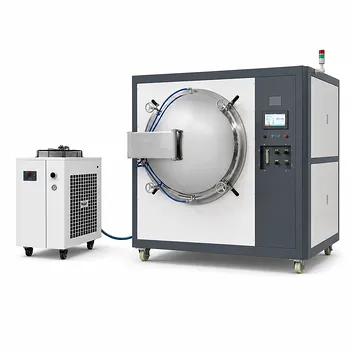
The vacuum resistance furnace serves as the primary reaction chamber for the diffusion chromizing of steel billets, acting as the critical enabler for deep metallurgical bonding. It provides a stable, high-temperature environment around 1400°C while simultaneously maintaining a vacuum to control the chemical atmosphere. This dual function allows chromium to penetrate the steel matrix deeply—reaching depths of 1.7 to 2.8 mm—over a prolonged processing cycle of up to 20 hours.
The core value of this technology lies in its ability to combine extreme heat with a contaminant-free atmosphere. By eliminating oxygen while maintaining high thermal energy, the furnace transforms surface treatment from a superficial coating into a deep, integral modification of the steel's molecular structure.
Creating the Conditions for Diffusion
To alter the chemical composition of a steel billet, specific physical conditions must be met. The vacuum resistance furnace is designed to sustain these extreme parameters reliably.
Achieving High Thermal Energy
The furnace operates at approximately 1400°C. At this temperature, the atomic structure of the steel becomes receptive to change, allowing foreign elements like chromium to migrate into the lattice.
Sustaining the Reaction
Diffusion is not instantaneous; it requires time. The furnace maintains this high heat for an isothermal aging process that lasts up to 20 hours. This duration is essential for driving the chromium atoms deep into the material rather than just coating the top layer.
Deep Matrix Penetration
Because of the sustained heat and time provided by the furnace, chromium elements can diffuse deeply into the material matrix. The result is a substantial modified layer ranging from 1.7 to 2.8 mm in thickness.
Ensuring Surface Integrity and Purity
Beyond temperature, the atmospheric control provided by the vacuum resistance furnace is vital for the quality of the final product.
Prevention of Oxidation
The vacuum environment is the primary defense against atmospheric contamination. It effectively prevents the oxidation of metal surfaces that would naturally occur if steel were heated to 1400°C in open air.
Ensuring Layer Purity
By removing oxygen and other reactive gases, the furnace ensures the diffusion layer remains pure. This leads to a consistent chemical composition throughout the chromized depth.
Maximizing Bonding Strength
The absence of oxides and impurities at the interface ensures superior bonding strength. The chromium-enriched layer becomes an integral part of the steel billet, reducing the risk of delamination or surface failure under stress.
Operational Considerations and Trade-offs
While the vacuum resistance furnace offers superior quality, it presents specific operational characteristics that must be factored into production planning.
High Energy Consumption
maintaining a temperature of 1400°C requires significant energy input. The cost of operation is higher than low-temperature surface treatments, making it a premium process reserved for critical components.
Long Processing Cycles
With a cycle time extending up to 20 hours, this is a low-throughput batch process. It is not suitable for high-speed, continuous manufacturing lines where rapid turnover is required.
Making the Right Choice for Your Goal
When deciding if this specific furnace process is right for your steel treatment needs, consider your performance requirements.
- If your primary focus is extreme durability: Rely on this process to achieve a diffusion depth of 1.7–2.8 mm, which offers significantly more protection than standard plating.
- If your primary focus is surface integrity: Use the vacuum capability to ensure a pristine, oxide-free surface finish that is chemically bonded to the core.
- If your primary focus is structural integration: Choose this method to ensure the protective layer cannot peel or flake off, as it is diffused into the matrix itself.
The vacuum resistance furnace is the indispensable tool for turning standard steel billets into high-performance, chemically resistant components through deep metallurgical bonding.
Summary Table:
| Parameter | Specification / Result | Benefit |
|---|---|---|
| Operating Temperature | Approximately 1400°C | Enables atomic migration into the steel lattice |
| Diffusion Depth | 1.7 to 2.8 mm | Provides superior durability vs. superficial coatings |
| Processing Time | Up to 20 Hours | Ensures deep, uniform matrix penetration |
| Atmosphere | High Vacuum | Prevents oxidation and ensures high layer purity |
| Bonding Type | Metallurgical Diffusion | Eliminates delamination and surface flaking |
Transform Your Material Performance with KINTEK
Elevate your manufacturing precision with KINTEK’s advanced thermal processing solutions. Whether you are performing deep diffusion chromizing or specialized heat treatments, our high-performance vacuum resistance furnaces and atmosphere furnaces provide the thermal stability and purity required for critical components.
Why choose KINTEK?
- Comprehensive Range: From high-temperature muffle and tube furnaces to advanced CVD/PECVD and crushing systems.
- Laboratory Excellence: We provide essential tools including high-pressure reactors, hydraulic presses, and premium consumables like PTFE and ceramics.
- Tailored Support: Our equipment is designed for researchers and manufacturers who demand reliability and deep metallurgical integrity.
Ready to upgrade your lab or production line? Contact us today to find the perfect furnace for your application!
References
- A. V. Hruzevych, D. О. Derecha. Diffusion-hardening effect on the technological properties of high-temperature steel. DOI: 10.1007/s42452-020-2943-5
This article is also based on technical information from Kintek Solution Knowledge Base .
Related Products
- 2200 ℃ Tungsten Vacuum Heat Treat and Sintering Furnace
- Vacuum Arc Induction Melting Furnace
- Non Consumable Vacuum Arc Induction Melting Furnace
- Vacuum Heat Treat and Pressure Sintering Furnace for High Temperature Applications
- Vacuum Heat Treat and Molybdenum Wire Sintering Furnace for Vacuum Sintering
People Also Ask
- What is the melting point of tungsten in a vacuum? The Real Limit is Sublimation, Not Melting
- What happens to tungsten when heated? Discover Its Extreme Heat Resistance and Unique Properties
- How does a high-temperature vacuum sintering furnace facilitate the post-treatment of Zirconia coatings?
- Why is it necessary to use sintering aids for PLS? Achieve Full Density in Ultra-High Temperature Ceramics
- How does a high-temperature vacuum sintering furnace contribute to the formation of Fe-Cr-Al porous materials?