Knowledge What role does a vacuum resistance furnace play in magnesium production? Master the Carbothermic Reduction Process
Author avatar

Tech Team · Kintek Solution

Updated 5 days ago

What role does a vacuum resistance furnace play in magnesium production? Master the Carbothermic Reduction Process


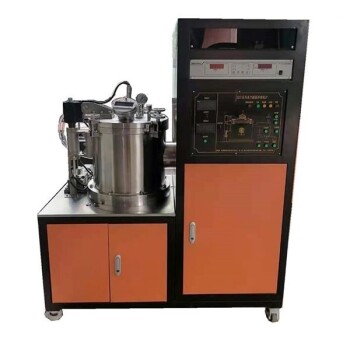
The vacuum resistance furnace serves as the central reaction vessel that enables the carbothermic reduction of magnesium oxide. It functions by creating a specialized environment combining extreme heat (typically above 1350°C) with low pressure (around 40 Pa). This precise combination lowers the energy required for the reaction, allowing magnesium to separate from oxygen and transition into a vapor phase for collection.

The carbothermic reduction of magnesium is thermodynamically difficult at standard pressures. The vacuum resistance furnace overcomes this by altering the kinetic conditions, effectively lowering the thermodynamic barrier to allow the reaction to proceed efficiently.

Creating the Necessary Reaction Conditions

Achieving High-Temperature Stability

The reduction of magnesium oxide is an endothermic process, meaning it requires a significant input of energy to occur.

To drive this reaction, the vacuum resistance furnace must maintain a stable high-temperature environment. The primary reference establishes that temperatures typically must exceed 1350°C.

The Critical Role of Low Pressure

High temperature alone is often insufficient to produce magnesium efficiently via this method.

The furnace creates a low-pressure vacuum environment, specifically targeting levels around 40 Pa. This vacuum is essential because it lowers the boiling point of the magnesium, facilitating the reaction at achievable temperatures.

Mechanisms of Action

Shifting Thermodynamic Equilibrium

The core function of the furnace is to manipulate the thermodynamics of the chemical bond between magnesium and oxygen.

By reducing the pressure to 40 Pa, the furnace significantly lowers the thermodynamic barrier. This shift encourages the reduction reaction to move forward, which would be energetically prohibitive at atmospheric pressure.

Facilitating Vapor Phase Separation

In this specific furnace environment, the magnesium is not produced as a liquid or solid, but as a vapor.

The vacuum resistance furnace ensures that as soon as the magnesium is reduced, it vaporizes. This allows the magnesium to be separated cleanly from the solid reactants and impurities.

Operational Constraints and Requirements

The Necessity of Precision Control

The effectiveness of the vacuum resistance furnace relies entirely on maintaining a stable environment.

The system must offer precise control over both thermal gradients and vacuum levels. A deviation in pressure (rising above 40 Pa) or a drop in temperature (below 1350°C) can instantly stall the reaction kinetics.

Equipment Stress and Durability

Running at 1350°C under a vacuum places immense stress on the equipment.

The furnace design must be robust enough to prevent leaks, as the ingress of air would disrupt the vacuum and oxidize the magnesium vapor. Consequently, the "trade-off" for using this method is the requirement for high-maintenance, high-integrity hardware.

Optimizing Process Parameters

To ensure successful production, you must balance thermal energy with vacuum efficiency.

  • If your primary focus is Reaction Initiation: Ensure your furnace can consistently sustain temperatures above 1350°C to provide the necessary activation energy.
  • If your primary focus is Yield and Efficiency: Prioritize maintaining a deep vacuum of 40 Pa, as this lowers the thermodynamic barrier and drives vapor formation.

Ultimately, the vacuum resistance furnace is not just a heat source; it is the thermodynamic tool that makes the extraction of magnesium chemically viable.

Summary Table:

Parameter Requirement Role in Process
Temperature > 1350°C Provides activation energy for endothermic reaction
Pressure ~ 40 Pa Lowers thermodynamic barrier and Mg boiling point
Atmosphere High Vacuum Prevents oxidation and facilitates vapor separation
Output Phase Magnesium Vapor Allows clean separation from solid reactants and impurities

Elevate Your Material Refining with KINTEK Precision

Ready to optimize your magnesium production or high-temperature research? KINTEK specializes in advanced laboratory equipment designed to withstand the rigors of extreme thermal and vacuum environments. From high-performance vacuum and atmosphere furnaces to robust crushing and milling systems, we provide the tools necessary to maintain precise thermodynamic control.

Our comprehensive range includes:

  • High-Temperature Furnaces: Muffle, tube, rotary, and specialized CVD/PECVD systems.
  • Processing Equipment: Hydraulic pellet presses, isostatic presses, and sieving solutions.
  • Specialized Labware: High-pressure reactors, autoclaves, and high-purity ceramic crucibles.

Ensure your lab's success with equipment engineered for durability and precision. Contact KINTEK today to discuss your project requirements!

Related Products

People Also Ask

Related Products

High Pressure Laboratory Vacuum Tube Furnace Quartz Tubular Furnace

High Pressure Laboratory Vacuum Tube Furnace Quartz Tubular Furnace

KT-PTF High Pressure Tube Furnace: Compact split tube furnace with strong positive pressure resistance. Working temp up to 1100°C and pressure up to 15Mpa. Also works under controller atmosphere or high vacuum.

1400℃ Laboratory High Temperature Tube Furnace with Alumina Tube

1400℃ Laboratory High Temperature Tube Furnace with Alumina Tube

Looking for a tube furnace for high-temperature applications? Our 1400℃ Tube Furnace with Alumina Tube is perfect for research and industrial use.

1700℃ Controlled Atmosphere Furnace Nitrogen Inert Atmosphere Furnace

1700℃ Controlled Atmosphere Furnace Nitrogen Inert Atmosphere Furnace

KT-17A Controlled atmosphere furnace: 1700℃ heating, vacuum sealing technology, PID temperature control, and versatile TFT smart touch screen controller for laboratory and industrial use.

Molybdenum Vacuum Heat Treat Furnace

Molybdenum Vacuum Heat Treat Furnace

Discover the benefits of a high-configuration molybdenum vacuum furnace with heat shield insulation. Ideal for high-purity, vacuum environments like sapphire crystal growth and heat treatment.

1700℃ Laboratory High Temperature Tube Furnace with Alumina Tube

1700℃ Laboratory High Temperature Tube Furnace with Alumina Tube

Looking for a high-temperature tube furnace? Check out our 1700℃ Tube Furnace with Alumina Tube. Perfect for research and industrial applications up to 1700C.

1200℃ Split Tube Furnace with Quartz Tube Laboratory Tubular Furnace

1200℃ Split Tube Furnace with Quartz Tube Laboratory Tubular Furnace

KT-TF12 split tube furnace: high-purity insulation, embedded heating wire coils, and max. 1200C. Widely used for new materials and chemical vapour deposition.

1800℃ Muffle Oven Furnace for Laboratory

1800℃ Muffle Oven Furnace for Laboratory

KT-18 muffle furnace with Japan Al2O3 polycrystalline fibe and Silicon Molybdenum heating element, up to 1900℃, PID temperature control and 7" smart touch screen. Compact design, low heat loss, and high energy efficiency. Safety interlock system and versatile functions.

Horizontal High Temperature Graphite Vacuum Graphitization Furnace

Horizontal High Temperature Graphite Vacuum Graphitization Furnace

Horizontal Graphitization Furnace: This type of furnace is designed with the heating elements placed horizontally, allowing for uniform heating of the sample. It's well-suited for graphitizing large or bulky samples that require precise temperature control and uniformity.

Vacuum Heat Treat and Molybdenum Wire Sintering Furnace for Vacuum Sintering

Vacuum Heat Treat and Molybdenum Wire Sintering Furnace for Vacuum Sintering

A vacuum molybdenum wire sintering furnace is a vertical or bedroom structure, which is suitable for withdrawal, brazing, sintering and degassing of metal materials under high vacuum and high temperature conditions. It is also suitable for dehydroxylation treatment of quartz materials.

Ultra-High Temperature Graphite Vacuum Graphitization Furnace

Ultra-High Temperature Graphite Vacuum Graphitization Furnace

The ultra-high temperature graphitization furnace utilizes medium frequency induction heating in a vacuum or inert gas environment. The induction coil generates an alternating magnetic field, inducing eddy currents in the graphite crucible, which heats up and radiates heat to the workpiece, bringing it to the desired temperature. This furnace is primarily used for graphitization and sintering of carbon materials, carbon fiber materials, and other composite materials.

Vertical High Temperature Graphite Vacuum Graphitization Furnace

Vertical High Temperature Graphite Vacuum Graphitization Furnace

Vertical high temperature graphitization furnace for carbonization and graphitization of carbon materials up to 3100℃.Suitable for shaped graphitization of carbon fiber filaments and other materials sintered in a carbon environment.Applications in metallurgy, electronics, and aerospace for producing high-quality graphite products like electrodes and crucibles.

1700℃ Muffle Oven Furnace for Laboratory

1700℃ Muffle Oven Furnace for Laboratory

Get superior heat control with our 1700℃ Muffle Furnace. Equipped with intelligent temperature microprocessor, TFT touch screen controller & advanced insulation materials for precise heating up to 1700C. Order now!

2200 ℃ Tungsten Vacuum Heat Treat and Sintering Furnace

2200 ℃ Tungsten Vacuum Heat Treat and Sintering Furnace

Experience the ultimate refractory metal furnace with our Tungsten vacuum furnace. Capable of reaching 2200℃, perfect for sintering advanced ceramics and refractory metals. Order now for high-quality results.

1400℃ Muffle Oven Furnace for Laboratory

1400℃ Muffle Oven Furnace for Laboratory

Get precise high-temperature control up to 1500℃ with KT-14M Muffle furnace. Equipped with a smart touch screen controller and advanced insulation materials.

2200 ℃ Graphite Vacuum Heat Treat Furnace

2200 ℃ Graphite Vacuum Heat Treat Furnace

Discover the power of the KT-VG Graphite Vacuum Furnace - with a maximum working temperature of 2200℃, it's perfect for vacuum sintering of various materials. Learn more now.

Laboratory Vacuum Tilt Rotary Tube Furnace Rotating Tube Furnace

Laboratory Vacuum Tilt Rotary Tube Furnace Rotating Tube Furnace

Discover the versatility of Laboratory Rotary Furnace: Ideal for calcination, drying, sintering, and high-temperature reactions. Adjustable rotating and tilting functions for optimal heating. Suitable for vacuum and controlled atmosphere environments. Learn more now!

Vacuum Dental Porcelain Sintering Furnace

Vacuum Dental Porcelain Sintering Furnace

Get precise and reliable results with KinTek's Vacuum Porcelain Furnace. Suitable for all porcelain powders, it features hyperbolic ceramic furnace function, voice prompt, and automatic temperature calibration.

Laboratory Rapid Thermal Processing (RTP) Quartz Tube Furnace

Laboratory Rapid Thermal Processing (RTP) Quartz Tube Furnace

Get lightning-fast heating with our RTP Rapid Heating Tube Furnace. Designed for precise, high-speed heating and cooling with convenient sliding rail and TFT touch screen controller. Order now for ideal thermal processing!

1200℃ Controlled Atmosphere Furnace Nitrogen Inert Atmosphere Furnace

1200℃ Controlled Atmosphere Furnace Nitrogen Inert Atmosphere Furnace

Discover our KT-12A Pro Controlled atmosphere furnace - high precision, heavy duty vacuum chamber, versatile smart touch screen controller, and excellent temperature uniformity up to 1200C. Ideal for both laboratory and industrial application.

Vacuum Heat Treat Sintering Brazing Furnace

Vacuum Heat Treat Sintering Brazing Furnace

A vacuum brazing furnace is a type of industrial furnace used for brazing, a metalworking process that joins two pieces of metal using a filler metal that melts at a lower temperature than the base metals. Vacuum brazing furnaces are typically used for high-quality applications where a strong, clean joint is required.


Leave Your Message