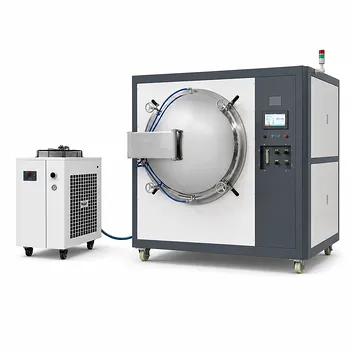
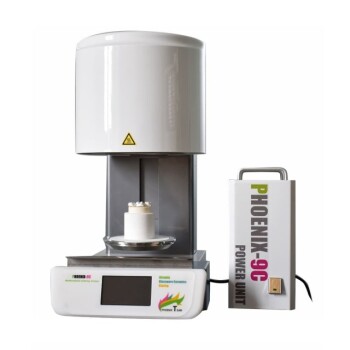
In the conversion of tungsten microstructures, an industrial ashing furnace serves as the critical tool for thermal debinding and intermediate phase formation. By heating materials to 600°C under a controlled air atmosphere, the furnace induces the complete thermal decomposition of polymer matrices while simultaneously converting tungsten precursors into stable tungsten oxide intermediates.
The industrial ashing furnace acts as a bridge between a polymer-supported green body and a stable metallic framework. It ensures the clean removal of organic binders and the uniform conversion of precursors into oxides without compromising the delicate geometry of the microstructures.
The Role of Thermal Debinding
Decomposition of the Polymer Matrix
The primary function of the ashing furnace is to remove the cross-linked polymer matrix that provides the initial shape to the tungsten precursor. As the temperature reaches 600°C, these organic binders undergo thermal decomposition, leaving behind only the inorganic components.
Managing the Escape of Organic Volatiles
Precise temperature control is vital to ensure that organic components escape the structure smoothly. If the heating rate is too aggressive, the rapid expansion of gases can cause internal pressure build-up, leading to cracks or the total collapse of the tungsten microstructure.
Strategic Conversion to Intermediates
Formation of Tungsten Oxide
Beyond binder removal, the ashing furnace facilitates the chemical transition of the tungsten source. Under an air atmosphere, the tungsten precursors are stably converted into tungsten oxide intermediates, which serve as the foundation for the final metallic state.
Maintaining Structural Integrity
The furnace must maintain a stable thermal environment to ensure this chemical conversion occurs uniformly. This stability prevents differential shrinkage or warping, ensuring that the microstructures retain their intended dimensions and complexity during the transition from a composite to a ceramic-like oxide.
Connecting Ashing to Final Reduction
Preparing for Hydrogen Reduction
The oxide intermediates created in the ashing furnace are the necessary starting point for high-purity metal production. Once the ashing process is complete, the material is typically moved to a rotary tube furnace for the final stage of manufacturing.
The Path to High-Purity Metal
In the subsequent stage, the tungsten oxides are subjected to hydrogen reduction at temperatures between 600°C and 1100°C. This step removes oxygen atoms, resulting in high-purity metal tungsten powder with a uniform particle size distribution.
Understanding the Trade-offs and Pitfalls
Atmospheric Sensitivity
The ashing furnace relies on a controlled air atmosphere to facilitate oxidation and binder burnout. Using an inert atmosphere during this specific stage would result in incomplete carbon removal, leading to carbon contamination in the final tungsten product.
The Risk of Thermal Shock
While high temperatures are necessary, the ramp-up and cool-down phases must be managed with extreme care. Thermal shock can cause the brittle oxide intermediates to shatter, destroying the intricate microstructures before they can be reduced to their durable metallic form.
How to Apply This to Your Process
Optimization Based on Production Goals
The configuration of your thermal process depends heavily on the specific complexity of the microstructures being produced.
- If your primary focus is structural precision: Prioritize a slow, multi-stage ramp-up in the ashing furnace to prevent the rapid outgassing of polymers from distorting the fine features.
- If your primary focus is material purity: Ensure the air atmosphere in the ashing furnace is highly filtered and consistently refreshed to guarantee the complete elimination of organic residues.
- If your primary focus is particle size uniformity: Focus on the transition between the ashing furnace and the rotary tube furnace to ensure the tungsten oxide intermediates are fed into the reduction stage with a consistent morphology.
By mastering the transition from polymer decomposition to oxide formation, you ensure the integrity and performance of the final tungsten microstructures.
Summary Table:
| Process Stage | Operating Temp | Primary Function | Key Outcome |
|---|---|---|---|
| Thermal Debinding | 600°C | Polymer matrix decomposition | Removal of organic binders without cracking |
| Oxide Formation | 600°C | Chemical conversion of precursors | Stable tungsten oxide (WO3) intermediates |
| Structural Control | Constant Stability | Managing outgassing & shrinkage | Retention of delicate microstructure geometry |
| Pre-Reduction Prep | Transition Phase | Uniform morphology setup | Ready for H2 reduction in rotary tube furnaces |
Optimize Your Tungsten Processing with KINTEK
Precision is paramount when converting delicate microstructures. KINTEK provides industry-leading laboratory equipment designed to handle rigorous thermal cycles with absolute control. Whether you need high-temperature muffle furnaces for ashing, rotary tube furnaces for hydrogen reduction, or vacuum and atmosphere furnaces for specialized sintering, our technology ensures material purity and structural integrity.
Our value to you:
- Comprehensive Range: From furnaces and hydraulic presses to high-purity ceramics and crucibles.
- Process Reliability: Systems engineered for uniform heating and precise atmospheric control.
- Expert Support: Specialized solutions for battery research, material science, and industrial manufacturing.
Contact our specialists today to find the perfect furnace solution for your advanced material applications!
References
- Manuel Luitz, Bastian E. Rapp. High‐Resolution Patterning of Organic–Inorganic Photoresins for Tungsten and Tungsten Carbide Microstructures. DOI: 10.1002/adem.202201927
This article is also based on technical information from Kintek Solution Knowledge Base .
Related Products
- High Temperature Muffle Oven Furnace for Laboratory Debinding and Pre Sintering
- Graphite Vacuum Furnace High Thermal Conductivity Film Graphitization Furnace
- Ultra-High Temperature Graphite Vacuum Graphitization Furnace
- Vertical High Temperature Graphite Vacuum Graphitization Furnace
- Large Vertical Graphite Vacuum Graphitization Furnace
People Also Ask
- Why is the annealing treatment in a high-temperature muffle furnace critical for the preparation of an Sb-SnO2 interlayer?
- What are the main components of a high-temperature muffle furnace? A Guide to the Core Systems
- What function does a high-temperature muffle furnace serve in Ti3AlC2 MAX phase synthesis? Master Molten Salt Diffusion
- Why is a high-temp muffle furnace essential for ZnO-WO3 & ZnO-BiOI? Optimize Heterojunction Catalyst Performance
- What role does a calcination furnace play in preparing hollow core-shell particles? Achieve Perfect Nano-Structures