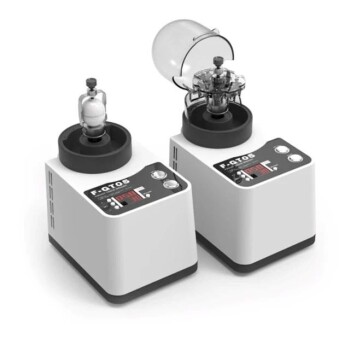
Laboratory grinding equipment, specifically planetary ball mills, serves as the critical mechanical interface between raw active components and a viable catalyst slurry. These machines are responsible for reducing materials to a precise, fine particle size—typically achieving a D50 (median diameter) of less than 15 µm. This reduction is the foundational step that dictates the quality of all subsequent formulation and testing phases.
The primary value of this equipment lies in eliminating variability; by standardizing particle size, you ensure that test results reflect the true chemistry of the catalyst rather than inconsistencies in its physical preparation.
Achieving Microscopic Uniformity
The Target Metric
The formulation stage requires strict adherence to particle size metrics.
Planetary ball mills are utilized to slurry active components until they reach a D50 of less than 15 µm.
Homogenizing the Mixture
Beyond simple size reduction, this equipment ensures the component uniformity of the catalyst particles.
The milling process disperses active ingredients evenly throughout the slurry.
This prevents the formation of "hot spots" or inactive zones that could skew performance data later in the development cycle.
Enabling Downstream Processing
Preparation for Drying and Crushing
The slurry created during the grinding phase is rarely the final product; it is an intermediate state.
Achieving a fine particle size is essential for the efficiency of the drying step that follows immediately after slurrying.
Facilitating Sieving
Once dried and crushed, the material must be sieved.
If the initial grinding does not achieve the <15 µm target, the crushing and sieving stages become inefficient, potentially leading to material loss or inconsistent batch quality.
The Critical Link to Testing Reliability
Ensuring Reproducibility
The ultimate goal of using laboratory grinding equipment is to secure consistent and reliable activity results.
In high-throughput screening tests, valid comparisons between different catalyst formulations are impossible without physical consistency.
High-Throughput Validity
High-throughput screening relies on the assumption that physical variables are constant across samples.
By controlling the particle size at the slurry stage, researchers guarantee that the data gathered during screening accurately represents the catalyst's intrinsic activity.
Understanding the Trade-offs
The Risk of Inadequate Grinding
While grinding adds time to the formulation process, skipping or shortening this step introduces a critical risk: data noise.
If the particle size exceeds the D50 < 15 µm threshold, the uniformity of the catalyst within the reactor is compromised.
This leads to unreliable screening results, where a promising chemical formulation might fail a test simply due to poor physical preparation rather than chemical inefficacy.
Making the Right Choice for Your Goal
To maximize the effectiveness of your catalyst development, align your equipment usage with your specific processing needs.
- If your primary focus is Data Integrity: Prioritize achieving the D50 < 15 µm metric above all else to ensure your high-throughput screening results are statistically valid.
- If your primary focus is Process Flow: focus on the uniformity of the slurry to ensure smooth transitions through the drying, crushing, and sieving stages.
Precision in the grinding jar translates directly to reliability in the reactor.
Summary Table:
| Process Goal | Target Metric | Impact on Catalyst Quality |
|---|---|---|
| Particle Size Reduction | D50 < 15 µm | Ensures efficient downstream drying and crushing |
| Mixture Homogenization | Microscopic Uniformity | Prevents inactive zones and "hot spots" |
| Testing Reliability | Physical Consistency | Eliminates data noise in high-throughput screening |
| Process Efficiency | Optimized Slurry | Facilitates smooth sieving and minimizes material loss |
Elevate Your Catalyst Research with KINTEK’s Precision Engineering
Consistency in the grinding jar is the foundation of reliability in the reactor. At KINTEK, we specialize in the high-performance laboratory equipment essential for automotive catalyst development. Whether you need to achieve a precise D50 < 15 µm using our advanced planetary ball mills and crushing systems, or require high-throughput sieving equipment and hydraulic presses, we provide the tools that eliminate variability and ensure data integrity.
From high-temperature furnaces for calcination to high-pressure reactors for performance testing, KINTEK offers a comprehensive portfolio designed for rigorous research environments. Don't let physical preparation inconsistencies compromise your chemical breakthroughs.
Ready to optimize your slurry formulation? Contact KINTEK today for a consultation and discover how our specialized equipment can streamline your laboratory workflow.
References
- Andreas Sundermann, Olga Gerlach. High-Throughput Screening as a Supplemental Tool for the Development of Advanced Emission Control Catalysts: Methodological Approaches and Data Processing. DOI: 10.3390/catal6020023
This article is also based on technical information from Kintek Solution Knowledge Base .
Related Products
- High Energy Planetary Ball Mill for Laboratory Horizontal Tank Type Milling Machine
- High-Energy Omnidirectional Planetary Ball Mill Milling Machine for Laboratory
- Laboratory Planetary Ball Mill Rotating Ball Milling Machine
- High Energy Planetary Ball Mill Milling Machine for Laboratory
- High Energy Planetary Ball Mill Machine for Laboratory Horizontal Tank Type
People Also Ask
- What is the role of a planetary ball mill in sulfide-based solid-state batteries? Engineer High-Performance Cathodes
- What are the parameters of a planetary ball mill? Master Speed, Time, and Media for Perfect Grinding
- What is the function of a planetary ball mill for nanostructured eutectic steel? Essential Prep for High-Strength Alloys
- What role does a planetary ball mill play in the preparation of NASICON-type solid electrolytes like LATP and LAGP?
- What is the function of a planetary ball mill in solid-state electrolyte prep? Milling vs. SDS Methods Explained