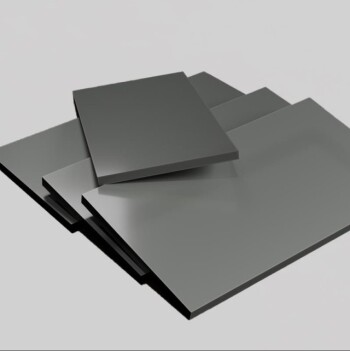
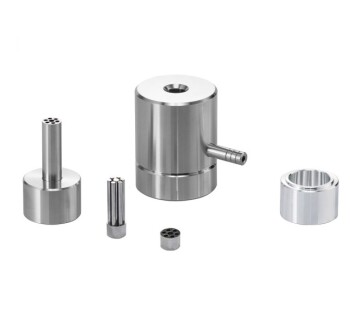
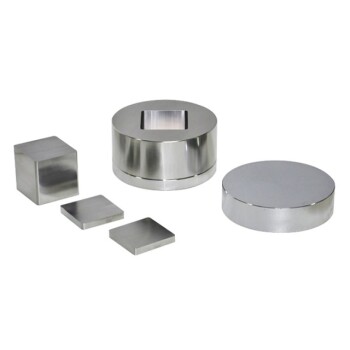
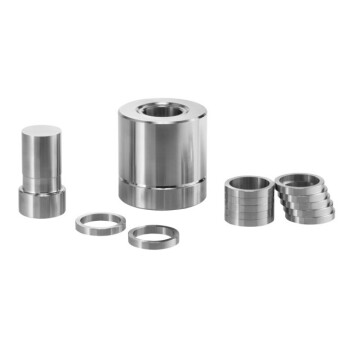
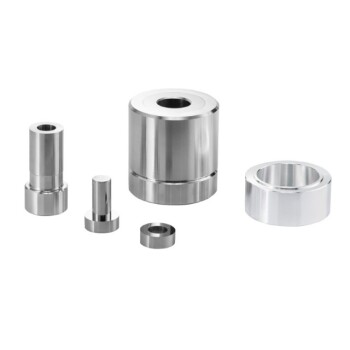
Graphite molds serve as the critical interface between the processing equipment and the composite material. During vacuum hot pressing, they function simultaneously as a high-strength pressure vessel, a precise thermal regulator, and a chemical shield.
The mold’s ability to withstand significant mechanical loads while maintaining high thermal conductivity allows for the uniform densification of metal matrix composites. Crucially, graphite creates a localized reducing environment, actively protecting reactive metal powders from oxidation during the sintering cycle.
Mechanical Containment and Pressure Transfer
Sustaining High-Temperature Loads
Graphite exhibits exceptional high-temperature strength, allowing it to withstand significant mechanical pressure without substantial deformation. It functions as a pressure-bearing component, enduring axial pressures that often range from 35 MPa to 80 MPa. This structural integrity ensures that the force from the hydraulic press is effectively transferred to the powder sample to force consolidation.
Defining Geometric Precision
The mold acts as the primary containment vessel, fixing the mixed powders into a specific shape, such as a circular disk or preform. By maintaining dimensional stability under load, the mold ensures the final sintered product achieves precise geometric tolerances. This confinement is essential for forcing powder particles into close contact, a requirement for proper densification.
Thermal Regulation and Sintering Uniformity
Ensuring Uniform Heating
Graphite possesses high thermal conductivity, which allows it to transfer heat quickly and evenly from the heating source to the composite sample. This capability eliminates thermal gradients that could lead to uneven sintering or internal stresses. Consequently, the mold ensures consistent structural homogeneity across the entire specimen.
Withstanding Thermal Shock
The material facilitates efficient thermal cycling due to its resistance to thermal shock. This property ensures the mold remains intact and effective even during the rapid heating and cooling phases inherent to the hot pressing process.
Chemical Protection and Atmosphere Control
Creating a Reducing Environment
Beyond mechanics and thermodynamics, the graphite mold actively modifies the local chemical environment. It creates a reducing atmosphere within the vacuum chamber. This helps scavenge residual oxygen, protecting sensitive metal powders from oxidation and preserving the purity of the metal matrix.
Surface Quality and Demolding
High-purity graphite is generally chemically stable when in contact with metals like aluminum or copper at high temperatures. This stability minimizes severe adhesion between the mold and the matrix. This assists in the demolding process, ensuring the final sample maintains a high-quality surface finish.
Understanding the Operational Trade-offs
Mechanical Limits and Brittleness
While graphite retains strength at high temperatures, it is inherently brittle. Unlike metal dies that might yield or bend, graphite molds may fracture catastrophically if the applied pressure exceeds their specific rating (e.g., significantly surpassing 70-80 MPa).
Chemical Reactivity Risks
Although graphite protects against oxidation, it is carbon-based and can react with certain carbide-forming metals at extreme temperatures. Operators must verify that the mold material will not form unwanted reaction layers with the specific metal matrix being pressed.
Making the Right Choice for Your Goal
To maximize the effectiveness of your vacuum hot pressing process, align your mold usage with your specific objectives:
- If your primary focus is densification: Ensure the graphite grade chosen has a compressive strength that exceeds your target pressure (e.g., >80 MPa) to prevent deformation during the consolidation phase.
- If your primary focus is material purity: Leverage the graphite's reducing nature to minimize oxide formation, but verify the mold surface is high-purity to prevent carbon contamination of the matrix.
Graphite molds are not just containers; they are active participants in the thermal and chemical success of your composite material.
Summary Table:
| Function | Description | Key Performance Metric |
|---|---|---|
| Pressure Transfer | Sustains axial loads to force powder consolidation | 35 MPa - 80 MPa |
| Thermal Regulation | Ensures uniform heating and prevents thermal gradients | High Thermal Conductivity |
| Atmosphere Control | Creates a reducing environment to prevent oxidation | Chemical Purity |
| Geometric Precision | Maintains dimensional stability for precise shapes | Low Thermal Expansion |
| Demolding | Minimizes adhesion for high-quality surface finishes | Chemical Stability |
Elevate Your Material Research with KINTEK Precision Solutions
Unlock the full potential of your metal matrix composites with KINTEK’s industry-leading laboratory equipment. Whether you are performing vacuum hot pressing, induction melting, or high-pressure sintering, our high-purity graphite molds and advanced hydraulic pellet presses ensure uniform densification and superior material purity.
Why choose KINTEK?
- Comprehensive Range: From muffle and vacuum furnaces to CVD and PECVD systems.
- Precision Engineering: High-performance crushing, milling, and sieving systems for optimal powder preparation.
- Complete Workflow Support: We provide essential consumables like ceramics, crucibles, and PTFE products alongside our high-temperature high-pressure reactors.
Contact KINTEK today to consult with our experts and find the perfect high-temperature solution for your laboratory’s unique requirements.
Related Products
- Double Plate Heating Press Mold for Lab
- Ball Press Mold for Lab
- Lab Infrared Press Mold
- Anti-Cracking Press Mold for Lab Use
- Carbon Graphite Plate Manufactured by Isostatic Pressing Method
People Also Ask
- How to use a press mold? Master the Art of Creating Consistent Ceramic Forms
- What is the process of mold press? A Step-by-Step Guide to Compression Molding
- What is the primary function of mold pressing for LAGP powders? Achieve High-Performance Solid Electrolytes
- Why are pressure molds with non-conductive resin inner walls required for battery testing? Ensure Data Accuracy
- What is the press mould method? A Guide to Consistent, Detailed Ceramic Forms