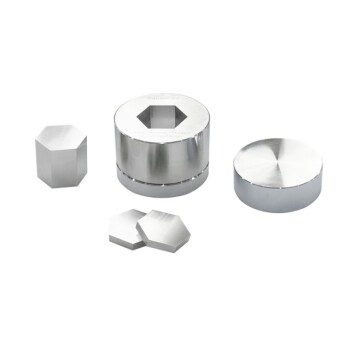
Graphite molds function as the central processing interface during the Spark Plasma Sintering (SPS) of nickel-based alloys, serving simultaneously as a shaping vessel, a heating element, and a mechanical ram. They do not merely contain the powder; they actively facilitate the generation of heat and the transmission of force required to turn loose powder into a dense solid.
The effectiveness of SPS relies on the graphite mold’s unique ability to conduct electrical current to generate Joule heat while enduring the high mechanical pressure necessary to densify the nickel alloy.
The Active Role in Heat Generation
Acting as a Resistance Heater
In standard sintering, the heat source is external. In SPS, the graphite mold itself acts as a resistance heating element.
Because graphite is electrically conductive, the pulsed direct current passes through the mold walls (and the conductive nickel powder).
Generating Joule Heat
This flow of electricity generates Joule heat directly within the mold assembly.
This mechanism allows for rapid heating rates that external heating methods cannot match.
Transferring Thermal Energy
The heat generated is rapidly transferred from the mold walls to the nickel alloy powder.
This ensures uniform thermal distribution, which is critical for maintaining consistent microstructure across the alloy.
Facilitating Densification Under Pressure
Functioning as a Pressure Vessel
The mold must possess sufficient structural integrity to withstand significant uniaxial mechanical pressure.
It acts as a constraint, preventing the powder from expanding outwardly while force is applied vertically.
Transmitting Compaction Force
The graphite assembly serves as a transmission medium that applies external force directly to the powder particles.
This pressure assists in particle rearrangement and plastic flow, which are essential mechanisms for achieving high densification.
Enabling Lower Temperature Sintering
By combining this pressure with rapid heating, the mold allows the nickel alloy to reach full density at temperatures lower than those required in pressureless sintering.
Shaping and Containment
Defining Component Geometry
The primary physical function of the mold is to act as a forming container.
It defines the final macroscopic shape and dimensions of the sintered nickel-based alloy component.
Containing the Powder Bed
The mold keeps the loose powder confined in a specific volume before and during the densification process.
Understanding the Trade-offs
Mechanical Limits
While graphite is robust, it has specific mechanical limits compared to metal dies.
Excessive pressure (typically beyond 100 MPa, though references suggest typical SPS usage around 40-50 MPa) can cause the graphite to fracture.
Consumable Nature
Graphite molds are often considered consumables in the SPS process.
Repeated exposure to high electrical current and mechanical stress can lead to wear or degradation over time, requiring replacement to maintain geometric accuracy.
Making the Right Choice for Your Goal
To optimize the SPS process for nickel-based alloys, consider how the mold design impacts your specific objectives:
- If your primary focus is rapid cycle times: Ensure high-purity graphite is used to maximize electrical conductivity and the efficiency of Joule heat generation.
- If your primary focus is maximum density: Verify the mold wall thickness is sufficient to withstand the higher uniaxial pressures required to mechanically force pore closure.
The graphite mold is not just a container; it is the active engine that drives the thermal and mechanical dynamics of the sintering process.
Summary Table:
| Function | Role in SPS Process | Benefit to Nickel Alloys |
|---|---|---|
| Resistance Heater | Conducts pulsed DC to generate Joule heat | Rapid heating rates and uniform thermal distribution |
| Pressure Vessel | Withstands high uniaxial mechanical pressure | Facilitates particle rearrangement and plastic flow |
| Transmission Medium | Transfers external force directly to powder | Enables full densification at lower sintering temperatures |
| Forming Container | Defines final macroscopic geometry | Ensures precise component dimensions and powder containment |
Elevate Your Advanced Material Research with KINTEK
Precision in Spark Plasma Sintering starts with the right equipment. At KINTEK, we specialize in providing high-performance laboratory solutions tailored for demanding applications like nickel-based alloy development.
Our extensive portfolio includes:
- Advanced High-Temperature Furnaces: From vacuum and atmosphere systems to specialized CVD and PECVD units.
- Precision Sample Preparation: High-durability crushing, milling, and sieving systems.
- Force & Pressure Solutions: Reliable hydraulic presses, including pellet, hot, and isostatic models for superior densification.
- Specialized Labware: High-purity ceramics, crucibles, and PTFE products designed for extreme environments.
Whether you are refining your SPS parameters or expanding your lab’s capabilities in battery research and thermal processing, KINTEK delivers the quality and expertise you need to succeed.
Ready to optimize your sintering results? Contact KINTEK Today and let our experts find the perfect solution for your lab.
Related Products
- Spark Plasma Sintering Furnace SPS Furnace
- Ultra-High Temperature Graphite Vacuum Graphitization Furnace
- High Purity Pure Graphite Crucible for Evaporation
- Polygon Press Mold for Lab
- High Purity Pure Graphite Crucible for Electron Beam Evaporation
People Also Ask
- What is SPS sintering method? A Guide to High-Speed, High-Performance Material Fabrication
- Why are Spark Plasma Sintering (SPS) furnaces or hot presses utilized in the preparation of Li3PS4 solid electrolytes?
- What is the difference between spark plasma sintering and flash sintering? A Guide to Advanced Sintering Methods
- What technical advantages does a Spark Plasma Sintering (SPS) furnace offer for LZP ceramics? Enhance Ionic Conductivity
- What is the theory of spark plasma sintering? A Guide to Rapid, Low-Temperature Densification