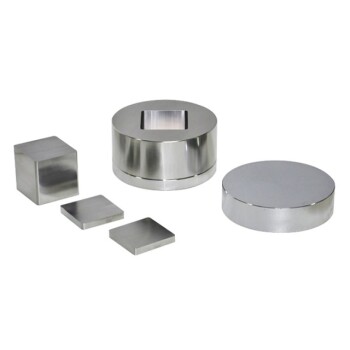
High-purity graphite molds function as a simultaneous heating, containment, and pressure system during the Transient Liquid Phase (TLP) sintering of nacre-like alumina. They do not merely hold the material; they actively facilitate the process by serving as resistance heating elements and pressure transfer media to ensure the precise formation of the material's layered structure.
The success of sintering nacre-like alumina relies on the mold's ability to convert electrical current into uniform heat while simultaneously transmitting high uniaxial pressure. This dual functionality is critical for forcing mineral precursors between alumina layers to achieve the desired in-situ crystallization.
The Triple Functionality of Graphite Molds
In this specialized sintering process, the mold replaces the need for separate heating and loading components. It performs three distinct, simultaneous roles that drive the consolidation of the ceramic.
Acting as a Resistance Heating Element
The primary reference highlights that high-purity graphite possesses excellent electrical conductivity.
Instead of relying solely on external heaters, the mold itself becomes the heat source. As current passes through the graphite, its resistance generates thermal energy.
This ensures uniform heat generation directly around the sample, minimizing thermal gradients that could lead to inconsistent sintering or structural defects in the alumina.
Serving as a Pressure Transfer Medium
Achieving a nacre-like structure requires significant force to align the alumina platelets.
Graphite offers high mechanical strength even at elevated temperatures. This allows the mold to act as a piston, applying uniaxial pressure evenly across the alumina platelets and mineral precursors.
This pressure is vital for densification, facilitating plastic flow and diffusion to eliminate voids within the composite.
Providing High-Temperature Containment
The sintering environment for these ceramics is extreme.
Graphite serves as a robust high-temperature resistant container. It maintains the shape of the powder assembly while withstanding the thermal shock and mechanical stress of the process.
This stability ensures the sample dimensions remain defined throughout the transition from powder to solid composite.
Critical Impact on Nacre-Like Microstructure
The specific goal of this process is to mimic the toughness of natural nacre (mother of pearl). The graphite mold plays a direct role in achieving this complex architecture.
Promoting In-Situ Crystallization
The application of even pressure is not just for density; it dictates material distribution.
The pressure applied by the graphite mold promotes the uniform distribution of mineral precursors between the alumina layers.
This environment facilitates in-situ crystallization, where the mineral-strengthened phases grow specifically within the gaps of the alumina platelets, creating the "brick-and-mortar" structure of nacre.
Ensuring Homogeneity
Inconsistent pressure or heat leads to structural weak points.
Because the graphite transmits pressure and heat uniformly, the resulting microstructure is homogeneous. This uniformity is essential for translating the theoretical mechanical properties of the design into the final physical part.
Understanding the Trade-offs
While high-purity graphite is the standard for this process, it is important to recognize the operational constraints to ensure process reliability.
Oxidation Sensitivity
Graphite is highly susceptible to oxidation at sintering temperatures.
To prevent rapid degradation of the mold, the process generally requires a vacuum or protective atmosphere. While this extends the service life of the mold, it adds complexity to the equipment setup.
Mechanical Limitations vs. Metal
While strong, graphite is brittle compared to refractory metals.
It can withstand pressures of tens of megapascals (e.g., 40 MPa), which is sufficient for this process. However, exceeding these limits or introducing shear forces can lead to catastrophic fracture of the mold, unlike metal dies which might yield plastically.
Making the Right Choice for Your Goal
To maximize the effectiveness of graphite molds in TLP sintering, consider your specific processing objectives:
- If your primary focus is Microstructural Alignment: Prioritize the mechanical precision of the mold design to ensure the uniaxial pressure is applied perfectly perpendicular to the platelet orientation.
- If your primary focus is Thermal Uniformity: Ensure the graphite grade has consistent electrical density and purity, as impurities can create hot spots that warp the delicate nacre-like layers.
Ultimately, the graphite mold is not just a vessel, but an active processing tool that dictates the alignment and crystallization of the final ceramic composite.
Summary Table:
| Function | Description | Impact on Sintering |
|---|---|---|
| Resistance Heating | Converts electrical current into thermal energy | Ensures uniform heat generation and minimizes thermal gradients |
| Pressure Transfer | Applies high uniaxial pressure via mechanical strength | Facilitates densification and aligns alumina platelets |
| Containment | High-temperature resistant powder assembly vessel | Maintains sample shape and resists thermal shock stresses |
| Crystallization Aid | Promotes uniform mineral precursor distribution | Enables the 'brick-and-mortar' in-situ crystallization process |
Elevate Your Material Research with KINTEK Precision Solutions
Achieving the perfect "brick-and-mortar" microstructure in nacre-like ceramics requires uncompromising thermal and mechanical control. KINTEK specializes in high-performance laboratory equipment designed for these rigorous processes.
Our extensive portfolio includes:
- Advanced Sintering Systems: High-temperature muffle, vacuum, and atmosphere furnaces tailored for TLP and Spark Plasma Sintering.
- Mechanical Precision: High-tonnage hydraulic presses (pellet, hot, and isostatic) and crushing/milling systems for perfect precursor preparation.
- Essential Consumables: High-purity graphite components, technical ceramics, and crucibles designed to withstand extreme thermal environments.
- Integrated Solutions: From cooling solutions (ULT freezers) to battery research tools, we provide the full ecosystem for material science.
Ready to optimize your sintering results? Contact our technical experts today to discover how KINTEK can enhance your lab’s efficiency and research accuracy.
References
- Florian Bouville. Strong and tough nacre-like aluminas: Process–structure–performance relationships and position within the nacre-inspired composite landscape. DOI: 10.1557/jmr.2019.418
This article is also based on technical information from Kintek Solution Knowledge Base .
Related Products
- High Purity Pure Graphite Crucible for Evaporation
- High Purity Pure Graphite Crucible for Electron Beam Evaporation
- High Purity Alumina Granulated Powder for Engineering Advanced Fine Ceramics
- Horizontal High Temperature Graphite Vacuum Graphitization Furnace
- Ultra-High Temperature Graphite Vacuum Graphitization Furnace
People Also Ask
- Why are high-purity graphite crucibles preferred for sulfide solid electrolytes? Achieve Superior Material Purity
- Why is a high-purity graphite crucible required for Chromel-TaC composites? Ensure Peak Purity at 1400°C
- What role do high-purity graphite crucibles play in molten salt corrosion research? Ensure Reactor-Grade Precision
- Why are high-purity graphite crucibles used for magnesium distillation? Ensure 3N8 Purity & Thermal Stability
- Why is a high-purity graphite crucible ideal for nitrogen-doped graphene at 1500 °C? Maximize Purity and Stability