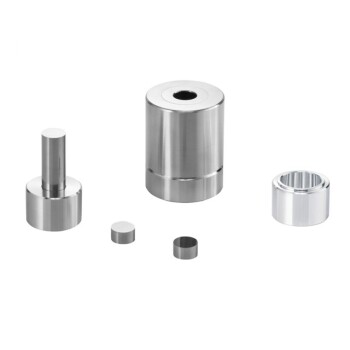
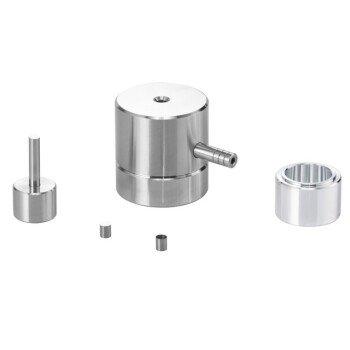
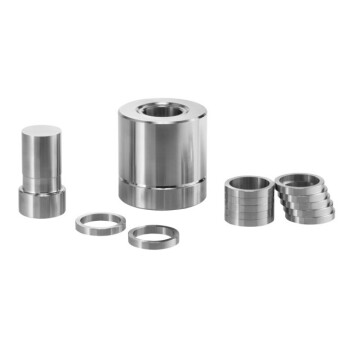
High-purity graphite molds act as the multifunctional heart of the sintering process for Ti2AlN ceramics. Far more than simple containers, they serve three simultaneous functions: acting as the shaping vessel, the primary heating element that converts electrical energy into heat, and the mechanical piston that transmits hydraulic pressure to densify the powder.
Core Takeaway: In both SPS and vacuum hot pressing, the graphite mold is not a passive tool but an active participant. It integrates thermal generation, electrical conduction, and mechanical compression into a single component to ensure the uniform densification of the ceramic matrix.
The Functional Trinity of Graphite Molds
In the context of processing Ti2AlN ceramics, the graphite mold dictates the success of the sintering cycle through three distinct physical roles.
Defining Geometry and Containment
The most fundamental role of the high-purity graphite mold is to serve as the containment vessel. It holds the loose Ti2AlN mixed powders in a confined space.
Because graphite is easily machined, it defines the final near-net shape and size of the sintered product. This reduces the need for extensive post-process machining of the hard ceramic material.
Acting as an Active Heating Element
Unlike conventional furnaces where heat is applied externally, graphite molds in Spark Plasma Sintering (SPS) are part of the heating circuit.
Due to their excellent electrical conductivity, the molds facilitate the flow of pulsed electrical current. This converts electrical energy directly into thermal energy (Joule heating).
In vacuum hot pressing, the mold often acts as an induction receptor. It converts electromagnetic energy into heat, ensuring the sample is heated uniformly from the outside in.
Transmitting Mechanical Pressure
For Ti2AlN ceramics to reach high density, significant pressure is required to force particle rearrangement and plastic flow.
The graphite mold acts as the transmission medium for the hydraulic system. It must possess high mechanical strength to withstand axial pressures (often ranging from 20 to 35 MPa) without deforming.
This pressure transmission forces powder particles into close contact, facilitating diffusion and densification even at temperatures exceeding 1500°C.
The Role of the Vacuum Environment
The interaction between the graphite mold and the vacuum environment is critical for the quality of the final Ti2AlN ceramic.
Creating a Protective Atmosphere
High-purity graphite contributes to a local reducing atmosphere within the vacuum chamber.
This environment helps scavenge residual oxygen, protecting sensitive ceramic powders from oxidation during the high-temperature phases of sintering.
Ensuring Mold Longevity
Operating in a vacuum is essential for the mold itself. While graphite is robust thermally, it oxidizes rapidly in air at high temperatures.
The vacuum environment minimizes oxidative loss, significantly extending the service life of the mold compared to conventional hot pressing. This reusability is a key factor in controlling production costs.
Understanding the Trade-offs
While high-purity graphite is the industry standard for these processes, it is important to understand its operational boundaries to avoid process failure.
Pressure vs. Deformation Limits
Graphite is strong, but it is not infinitely rigid. If the required densification pressure exceeds the compressive strength of the specific graphite grade used, the mold may undergo permanent deformation.
This can result in dimensional inaccuracies in the final ceramic part or catastrophic mold failure during the pressure ramp-up.
Chemical Compatibility
Generally, graphite allows for smooth demolding because it does not easily bond with many metal or ceramic matrices.
However, at extreme temperatures and pressures, there is always a risk of carbon diffusion or surface reaction with the ceramic powder. Ensuring high-purity graphite is used minimizes contamination, but the interface chemistry should always be considered for new material compositions.
Making the Right Choice for Your Goal
To optimize your sintering process for Ti2AlN ceramics, consider how the mold's properties align with your specific objectives.
- If your primary focus is Maximum Density: Ensure your graphite grade is rated for pressures exceeding 35 MPa to facilitate maximum particle rearrangement without mold deformation.
- If your primary focus is Cost Efficiency: Prioritize maintaining a high-quality vacuum to minimize oxidative wear on the mold, allowing for more sintering cycles per unit.
- If your primary focus is Heating Uniformity: distinct attention must be paid to the electrical conductivity of the graphite to ensure the pulsed current (in SPS) or induction field (in Hot Pressing) generates heat evenly across the sample.
High-purity graphite is the essential enabler that transforms loose ceramic powder into a dense, high-performance solid through the precise orchestration of heat, pressure, and containment.
Summary Table:
| Function | Role in Sintering Process | Impact on Ti2AlN Ceramics |
|---|---|---|
| Containment | Defines near-net shape & size | Reduces post-process machining costs |
| Heating | Joule heating (SPS) / Induction (Hot Press) | Ensures rapid, uniform thermal distribution |
| Pressure | Transmits 20–35 MPa axial load | Facilitates particle rearrangement & densification |
| Atmosphere | Creates a local reducing environment | Prevents powder oxidation at high temperatures |
Elevate Your Material Research with KINTEK Precision
To achieve full densification and superior mechanical properties in Ti2AlN ceramics, your lab needs equipment that masters the balance of heat, pressure, and vacuum. KINTEK specializes in advanced laboratory solutions designed for high-performance material science.
From Spark Plasma Sintering (SPS) systems and vacuum hot presses to specialized graphite crucibles and high-temperature furnaces, we provide the tools required for precision sintering. Our portfolio also features high-pressure reactors, crushing systems, and hydraulic presses tailored for demanding research environments.
Ready to optimize your sintering cycle? Contact KINTEK today to consult with our experts on the right equipment and consumables for your next breakthrough.
Related Products
- High Purity Pure Graphite Crucible for Evaporation
- High Purity Pure Graphite Crucible for Electron Beam Evaporation
- High Purity Alumina Granulated Powder for Engineering Advanced Fine Ceramics
- Horizontal High Temperature Graphite Vacuum Graphitization Furnace
- Ultra-High Temperature Graphite Vacuum Graphitization Furnace
People Also Ask
- Why are high-purity graphite crucibles preferred for sulfide solid electrolytes? Achieve Superior Material Purity
- Why is a high-purity graphite crucible required for Chromel-TaC composites? Ensure Peak Purity at 1400°C
- What role do high-purity graphite crucibles play in molten salt corrosion research? Ensure Reactor-Grade Precision
- Why are high-purity graphite crucibles used for magnesium distillation? Ensure 3N8 Purity & Thermal Stability
- Why is a high-purity graphite crucible ideal for nitrogen-doped graphene at 1500 °C? Maximize Purity and Stability