Knowledge Vacuum Furnace What temperature does tungsten carbide sinter at? Master the 1350°C-1500°C Liquid-Phase Sintering Process
Author avatar

Tech Team · Kintek Solution

Updated 3 months ago

What temperature does tungsten carbide sinter at? Master the 1350°C-1500°C Liquid-Phase Sintering Process


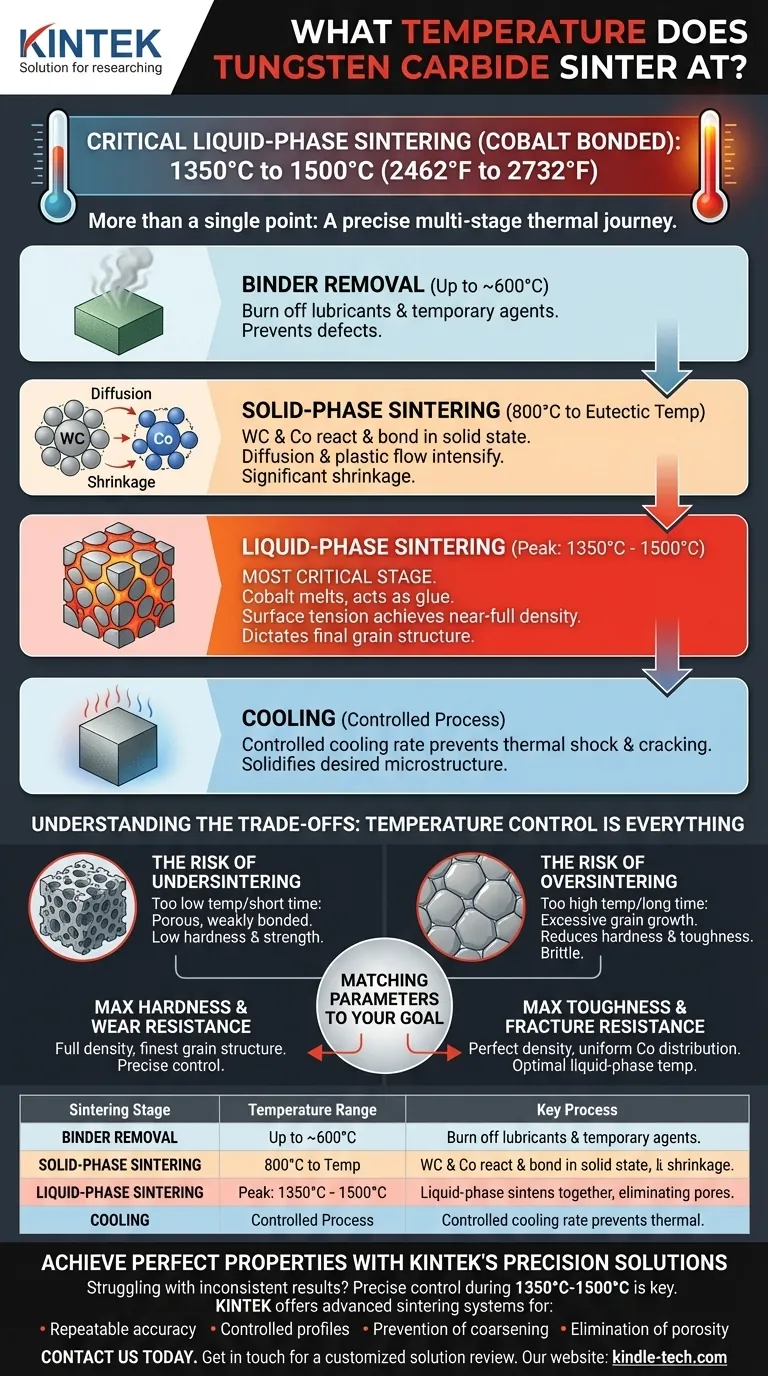
For tungsten carbide bonded with cobalt, the critical liquid-phase sintering occurs at a peak temperature typically ranging from 1350°C to 1500°C (2462°F to 2732°F). This is not a single point but the culmination of a carefully controlled heating process where the cobalt binder melts and fuses the tungsten carbide grains into a solid, dense mass.

Sintering tungsten carbide is not about reaching a single temperature. It is a precise, multi-stage thermal process where the final material properties are determined by the temperature profile, particularly the peak temperature reached during the liquid-phase stage.
What temperature does tungsten carbide sinter at? Master the 1350°C-1500°C Liquid-Phase Sintering Process

The Four Stages of Tungsten Carbide Sintering

To understand why a temperature range is more accurate than a single number, you must understand the journey the material takes. The process is typically divided into four distinct stages, each occurring at a different temperature range and serving a unique purpose.

Stage 1: Binder Removal (Up to ~600°C)

Before true sintering begins, the compacted raw material (called "green" compact) is gently heated.

This initial stage burns off any pressing lubricants or temporary molding agents used to shape the part. This step is critical for preventing defects in the final product.

Stage 2: Solid-Phase Sintering (800°C to Eutectic Temperature)

As the temperature rises past 800°C, the tungsten carbide (WC) grains and cobalt (Co) particles begin to react and bond while still in their solid state.

During this phase, diffusion and plastic flow intensify. The part shrinks significantly as the particles rearrange and pack more closely, but no melting has occurred yet.

The end of this stage is defined by the eutectic temperature, which is the lowest temperature at which the cobalt binder alloy can begin to melt.

Stage 3: Liquid-Phase Sintering (Peak Temperature: 1350°C - 1500°C)

This is the most critical stage. The furnace temperature is raised above the eutectic point, causing the cobalt binder to melt and become a liquid.

This liquid cobalt acts like a powerful glue. Through surface tension, it pulls the solid tungsten carbide grains tightly together, eliminating the remaining pores and achieving near-full density. The precise peak temperature and the time spent there dictate the final grain structure.

Stage 4: Cooling

The final stage is a controlled cooling process. The rate of cooling is managed carefully to prevent thermal shock, which could cause cracking, and to solidify the desired microstructure of the finished carbide part.

Understanding the Trade-offs: Temperature Control is Everything

Achieving the correct peak sintering temperature is a balancing act. Minor deviations can have a significant impact on the final material's performance.

The Risk of Undersintering

If the peak temperature is too low or the hold time is too short, the cobalt binder may not fully melt or distribute evenly.

This results in a porous and weakly bonded material. The part will lack the required hardness, strength, and wear resistance.

The Risk of Oversintering

If the temperature is too high or the hold time is too long, the tungsten carbide grains will grow excessively large.

While the part will be fully dense, this coarse grain structure reduces hardness and toughness, making the material more brittle and less effective in demanding applications.

Matching Sintering Parameters to Your Goal

The ideal sintering profile depends directly on the desired properties of the final product.

  • If your primary focus is maximum hardness and wear resistance: The goal is to achieve full density with the finest possible grain structure, requiring precise control to avoid excessive temperatures or hold times.
  • If your primary focus is maximum toughness and fracture resistance: The goal is a perfectly dense part with uniform cobalt distribution, which demands reaching the optimal liquid-phase temperature to ensure complete pore elimination.

Ultimately, mastering the sintering of tungsten carbide is about the precise and repeatable control of its entire thermal journey.

Summary Table:

Sintering Stage Temperature Range Key Process
Binder Removal Up to ~600°C Burn off lubricants/molding agents
Solid-Phase Sintering 800°C to Eutectic Temp WC/Co diffusion & particle bonding
Liquid-Phase Sintering 1350°C - 1500°C Cobalt melts, densifies WC grains
Controlled Cooling Gradual decrease Solidify microstructure, prevent cracking

Achieve Perfect Tungsten Carbide Properties with KINTEK's Precision Sintering Solutions

Are you struggling with porous, brittle, or inconsistent tungsten carbide results? The difference between superior performance and product failure lies in precise temperature control during the 1350°C-1500°C liquid-phase sintering stage.

KINTEK specializes in laboratory sintering equipment and consumables that deliver the exact thermal profiles needed for your specific application—whether you require maximum hardness for wear resistance or optimal toughness for fracture resistance.

Our advanced sintering systems provide:

  • Repeatable temperature accuracy within critical liquid-phase ranges
  • Controlled multi-stage heating profiles for complete densification
  • Prevention of grain coarsening that reduces material hardness
  • Elimination of porosity that weakens final products

Contact us today to discuss how KINTEK's sintering expertise can help you achieve consistent, high-performance tungsten carbide components. Get in touch with our experts for a customized solution review.

Visual Guide
What temperature does tungsten carbide sinter at? Master the 1350°C-1500°C Liquid-Phase Sintering Process Visual Guide

Related Products

People Also Ask

Related Products

2200 ℃ Tungsten Vacuum Heat Treat and Sintering Furnace

2200 ℃ Tungsten Vacuum Heat Treat and Sintering Furnace

Experience the ultimate refractory metal furnace with our Tungsten vacuum furnace. Capable of reaching 2200℃, perfect for sintering advanced ceramics and refractory metals. Order now for high-quality results.

Small Vacuum Heat Treat and Tungsten Wire Sintering Furnace

Small Vacuum Heat Treat and Tungsten Wire Sintering Furnace

The small vacuum tungsten wire sintering furnace is a compact experimental vacuum furnace specially designed for universities and scientific research institutes. The furnace features a CNC welded shell and vacuum piping to ensure leak-free operation. Quick-connect electrical connections facilitate relocation and debugging, and the standard electrical control cabinet is safe and convenient to operate.

High Temperature Muffle Oven Furnace for Laboratory Debinding and Pre Sintering

High Temperature Muffle Oven Furnace for Laboratory Debinding and Pre Sintering

KT-MD High temperature debinding and pre-sintering furnace for ceramic materials with various molding processes. Ideal for electronic components such as MLCC and NFC.

Vacuum Heat Treat and Molybdenum Wire Sintering Furnace for Vacuum Sintering

Vacuum Heat Treat and Molybdenum Wire Sintering Furnace for Vacuum Sintering

A vacuum molybdenum wire sintering furnace is a vertical or bedroom structure, which is suitable for withdrawal, brazing, sintering and degassing of metal materials under high vacuum and high temperature conditions. It is also suitable for dehydroxylation treatment of quartz materials.

Vacuum Heat Treat and Sintering Furnace with 9MPa Air Pressure

Vacuum Heat Treat and Sintering Furnace with 9MPa Air Pressure

The air pressure sintering furnace is a high-tech equipment commonly used for the sintering of advanced ceramic materials. It combines vacuum sintering and pressure sintering techniques to achieve high-density and high-strength ceramics.

Spark Plasma Sintering Furnace SPS Furnace

Spark Plasma Sintering Furnace SPS Furnace

Discover the benefits of Spark Plasma Sintering Furnaces for rapid, low-temperature material preparation. Uniform heating, low cost & eco-friendly.

600T Vacuum Induction Hot Press Furnace for Heat Treat and Sintering

600T Vacuum Induction Hot Press Furnace for Heat Treat and Sintering

Discover the 600T Vacuum Induction Hot Press Furnace, designed for high-temperature sintering experiments in vacuum or protected atmospheres. Its precise temperature and pressure control, adjustable working pressure, and advanced safety features make it ideal for nonmetal materials, carbon composites, ceramics, and metal powders.

Mesh belt controlled atmosphere furnace

Mesh belt controlled atmosphere furnace

Discover our KT-MB mesh belt sintering furnace - perfect for high-temperature sintering of electronic components & glass insulators. Available for open air or controlled atmosphere environments.

Vacuum Heat Treat and Pressure Sintering Furnace for High Temperature Applications

Vacuum Heat Treat and Pressure Sintering Furnace for High Temperature Applications

Vacuum pressure sintering furnaces are designed for high temperature hot pressing applications in metal and ceramic sintering. Its advanced features ensure precise temperature control, reliable pressure maintenance, and a robust design for seamless operation.

Vacuum Dental Porcelain Sintering Furnace

Vacuum Dental Porcelain Sintering Furnace

Get precise and reliable results with KinTek's Vacuum Porcelain Furnace. Suitable for all porcelain powders, it features hyperbolic ceramic furnace function, voice prompt, and automatic temperature calibration.

Ultra-High Temperature Graphite Vacuum Graphitization Furnace

Ultra-High Temperature Graphite Vacuum Graphitization Furnace

The ultra-high temperature graphitization furnace utilizes medium frequency induction heating in a vacuum or inert gas environment. The induction coil generates an alternating magnetic field, inducing eddy currents in the graphite crucible, which heats up and radiates heat to the workpiece, bringing it to the desired temperature. This furnace is primarily used for graphitization and sintering of carbon materials, carbon fiber materials, and other composite materials.

Dental Porcelain Zirconia Sintering Ceramic Vacuum Press Furnace

Dental Porcelain Zirconia Sintering Ceramic Vacuum Press Furnace

Get precise dental results with Dental Vacuum Press Furnace. Automatic temperature calibration, low noise tray, and touch screen operation. Order now!

Dental Porcelain Zirconia Sintering Ceramic Furnace Chairside with Transformer

Dental Porcelain Zirconia Sintering Ceramic Furnace Chairside with Transformer

Experience top-notch sintering with Chairside Sintering Furnace with Transformer. Easy to operate, noise-free pallet, and automatic temperature calibration. Order now!

2200 ℃ Graphite Vacuum Heat Treat Furnace

2200 ℃ Graphite Vacuum Heat Treat Furnace

Discover the power of the KT-VG Graphite Vacuum Furnace - with a maximum working temperature of 2200℃, it's perfect for vacuum sintering of various materials. Learn more now.

Vacuum Heat Treat Furnace with Ceramic Fiber Liner

Vacuum Heat Treat Furnace with Ceramic Fiber Liner

Vacuum furnace with polycrystalline ceramic fiber insulation liner for excellent heat insulation and uniform temperature field. Choose from 1200℃ or 1700℃ max. working temperature with high vacuum performance and precise temperature control.

Controlled Nitrogen Inert Hydrogen Atmosphere Furnace

Controlled Nitrogen Inert Hydrogen Atmosphere Furnace

KT-AH Hydrogen atmosphere furnace - induction gas furnace for sintering/annealing with built-in safety features, dual housing design, and energy-saving efficiency. Ideal for lab and industrial use.

Large Vertical Graphite Vacuum Graphitization Furnace

Large Vertical Graphite Vacuum Graphitization Furnace

A large vertical high-temperature graphitization furnace is a type of industrial furnace used for the graphitization of carbon materials, such as carbon fiber and carbon black. It is a high-temperature furnace that can reach temperatures of up to 3100°C.

Graphite Vacuum Furnace Bottom Discharge Graphitization Furnace for Carbon Materials

Graphite Vacuum Furnace Bottom Discharge Graphitization Furnace for Carbon Materials

Bottom-out graphitization furnace for carbon materials, ultra-high temperature furnace up to 3100°C, suitable for graphitization and sintering of carbon rods and carbon blocks. Vertical design, bottom discharging, convenient feeding and discharging, high temperature uniformity, low energy consumption, good stability, hydraulic lifting system, convenient loading and unloading.

Vertical High Temperature Graphite Vacuum Graphitization Furnace

Vertical High Temperature Graphite Vacuum Graphitization Furnace

Vertical high temperature graphitization furnace for carbonization and graphitization of carbon materials up to 3100℃.Suitable for shaped graphitization of carbon fiber filaments and other materials sintered in a carbon environment.Applications in metallurgy, electronics, and aerospace for producing high-quality graphite products like electrodes and crucibles.

Vacuum Arc Induction Melting Furnace

Vacuum Arc Induction Melting Furnace

Discover the power of Vacuum Arc Furnace for melting active & refractory metals. High-speed, remarkable degassing effect, and free of contamination. Learn more now!


Leave Your Message