Knowledge Vacuum Furnace What type of brazing works at lower temperature? Silver Alloys for Heat-Sensitive Materials
Author avatar

Tech Team · Kintek Solution

Updated 2 months ago

What type of brazing works at lower temperature? Silver Alloys for Heat-Sensitive Materials


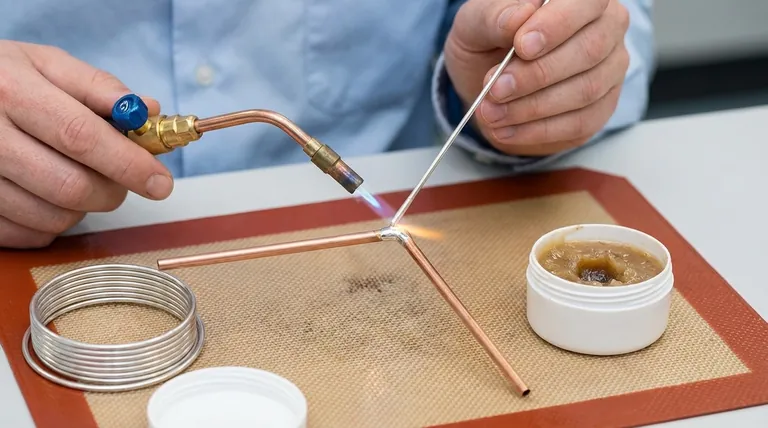
When high temperatures are a risk, the solution is not a different brazing process, but a different brazing material. Low-temperature brazing is achieved by using filler metals with lower melting points, most commonly alloys with a high silver (Ag) content. These alloys, often called "silver solder," allow you to create strong, permanent joints while minimizing heat distortion and damage to the base materials.

The key to low-temperature brazing is selecting a filler metal with a lower melting point, typically a silver-based alloy. This choice directly impacts the joint's properties, cost, and the level of preparation required for a successful bond.
What type of brazing works at lower temperature? Silver Alloys for Heat-Sensitive Materials

What Defines "Low-Temperature" Brazing?

The distinction between high and low-temperature brazing lies almost entirely in the filler metal alloy being used. The fundamental process of heating two parent metals and drawing a molten filler between them via capillary action remains the same.

The Central Role of the Filler Metal

Brazing, by definition, occurs above 840°F (450°C). "Low-temperature" is a relative term within this context, referring to processes at the lower end of this spectrum. The process temperature is dictated by the liquidus (fully molten) temperature of the chosen filler alloy.

Silver Alloys: The Industry Standard

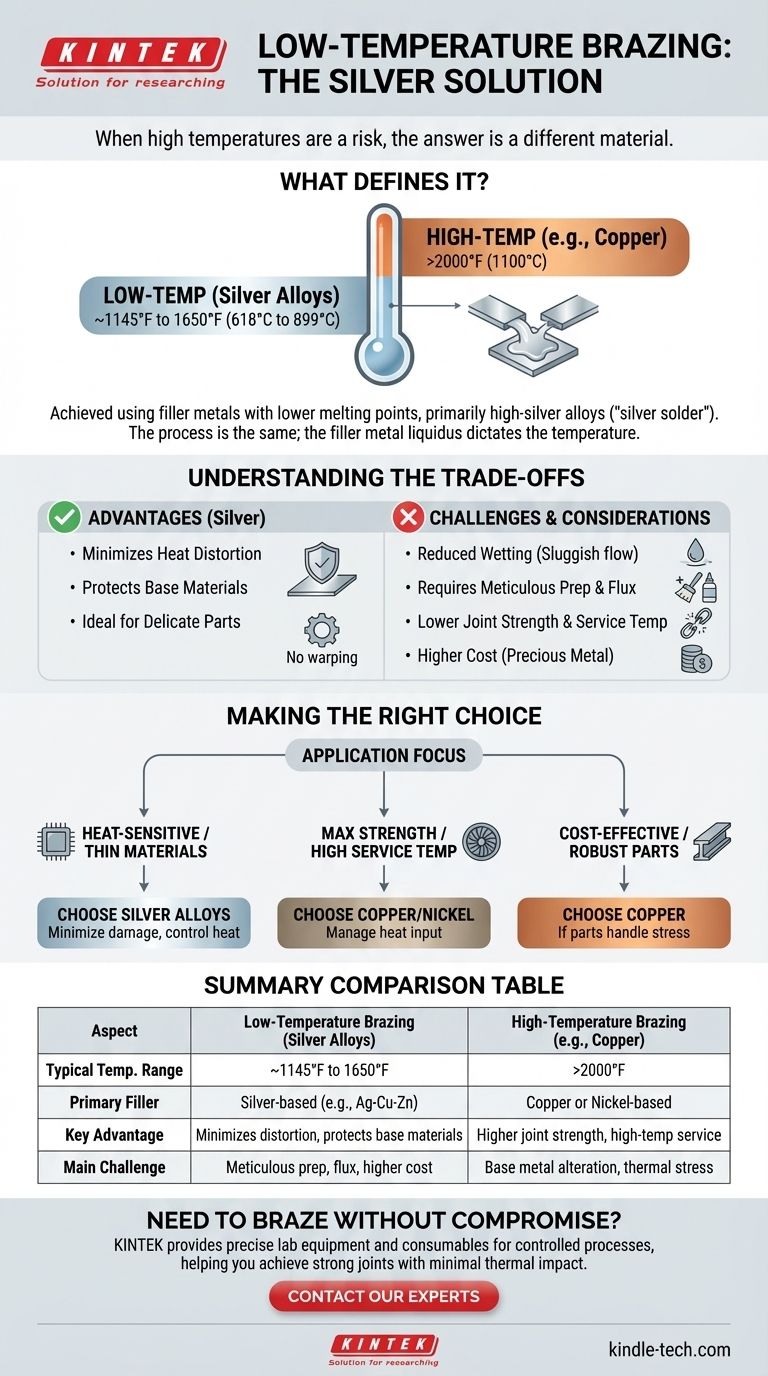
Filler metals containing silver are the primary choice for lowering brazing temperatures. These alloys, often combined with copper, zinc, and sometimes cadmium or tin, can have liquidus temperatures ranging from around 1145°F (618°C) to 1650°F (899°C).

Contrasting with High-Temperature Brazing

This stands in sharp contrast to high-temperature brazing, which often uses copper or nickel-based alloys. For example, brazing steel with a pure copper filler requires temperatures exceeding 2000°F (1100°C), which can significantly alter the properties of the base metal.

Understanding the Trade-offs and Challenges

Choosing a low-temperature approach is a strategic decision that comes with a distinct set of advantages and disadvantages. It is not a universally superior method.

Reduced Reactivity and Wetting

At lower temperatures, the molten braze alloy is naturally more sluggish and less chemically reactive with the base metal. This reduced "wetting" action means that surface cleanliness and the use of an appropriate flux are absolutely critical for the filler to flow properly and form a strong bond.

Joint Strength and Service Temperature

Lower melting point fillers generally create joints with lower ultimate strength than their high-temperature counterparts. Furthermore, the maximum temperature the finished joint can withstand in service will be correspondingly lower.

The Cost Factor of Silver

Silver is a precious metal, making these filler alloys significantly more expensive than common copper or bronze fillers. For large-scale production, this cost difference can be a major factor in the decision-making process.

Risk of Damaging Sensitive Materials

While the goal is to protect the base metals, improper technique can still cause damage. It is crucial to use a controlled heat source and heat the joint evenly to avoid overheating and warping thin sections or undoing a prior heat treatment.

Making the Right Choice for Your Application

Selecting the correct brazing temperature is a calculated balance between protecting your materials and achieving the required joint performance.

  • If your primary focus is joining heat-sensitive or thin materials: A silver-based brazing alloy is your best option to minimize the heat-affected zone and prevent damage.
  • If your primary focus is maximum joint strength at high service temperatures: You will need to use higher-temperature copper or nickel-based filler metals and develop a process to manage the heat input.
  • If your primary focus is cost-effectiveness on robust parts (like thick steel): High-temperature copper brazing is often the more economical and stronger choice, provided the components can handle the thermal stress.

Ultimately, understanding your material's limits and your joint's performance requirements will guide you to the correct brazing temperature.

Summary Table:

Aspect Low-Temperature Brazing (Silver Alloys) High-Temperature Brazing (e.g., Copper)
Typical Temp. Range ~1145°F to 1650°F (618°C to 899°C) >2000°F (1100°C)
Primary Filler Metal Silver-based alloys (e.g., Ag-Cu-Zn) Copper or Nickel-based alloys
Key Advantage Minimizes heat distortion, protects base materials Higher joint strength, suitable for high-temp service
Main Challenge Requires meticulous surface prep and flux; higher material cost Risk of base metal property alteration; higher thermal stress

Need to Braze Heat-Sensitive Components Without Compromise?

KINTEK specializes in providing the precise lab equipment and consumables needed for controlled brazing processes. Whether you're working with delicate instruments, thin-walled assemblies, or materials prone to heat distortion, our solutions help you achieve strong, reliable joints with minimal thermal impact.

Let us help you select the right materials and equipment for your low-temperature brazing application.

Contact our experts today to discuss your specific needs and ensure optimal results for your laboratory or production environment.

Visual Guide
What type of brazing works at lower temperature? Silver Alloys for Heat-Sensitive Materials Visual Guide

Related Products

People Also Ask

Related Products

Boron Nitride (BN) Ceramic Plate

Boron Nitride (BN) Ceramic Plate

Boron nitride (BN) ceramic plates do not use aluminum water to wet, and can provide comprehensive protection for the surface of materials that directly contact molten aluminum, magnesium, zinc alloys and their slag.

Laboratory CVD Boron Doped Diamond Materials

Laboratory CVD Boron Doped Diamond Materials

CVD boron-doped diamond: A versatile material enabling tailored electrical conductivity, optical transparency, and exceptional thermal properties for applications in electronics, optics, sensing, and quantum technologies.

Vacuum Heat Treat Sintering Brazing Furnace

Vacuum Heat Treat Sintering Brazing Furnace

A vacuum brazing furnace is a type of industrial furnace used for brazing, a metalworking process that joins two pieces of metal using a filler metal that melts at a lower temperature than the base metals. Vacuum brazing furnaces are typically used for high-quality applications where a strong, clean joint is required.

Reference Electrode Calomel Silver Chloride Mercury Sulfate for Laboratory Use

Reference Electrode Calomel Silver Chloride Mercury Sulfate for Laboratory Use

Find high-quality reference electrodes for electrochemical experiments with complete specifications. Our models offer resistance to acid and alkali, durability, and safety, with customization options available to meet your specific needs.

Advanced Engineering Fine Ceramics Alumina Ceramic Saggar for Fine Corundum

Advanced Engineering Fine Ceramics Alumina Ceramic Saggar for Fine Corundum

Alumina sagger products have the characteristics of high temperature resistance, good thermal shock stability, small expansion coefficient, anti-stripping, and good anti-powdering performance.

Battery Lab Equipment 304 Stainless Steel Strip Foil 20um Thick for Battery Test

Battery Lab Equipment 304 Stainless Steel Strip Foil 20um Thick for Battery Test

304 is a versatile stainless steel, which is widely used in the production of equipment and parts that require good overall performance (corrosion resistance and formability).

High Quality Alumina Ceramic Screw for Engineering Advanced Fine Ceramics with High Temperature Resistance and Insulation

High Quality Alumina Ceramic Screw for Engineering Advanced Fine Ceramics with High Temperature Resistance and Insulation

Alumina ceramic screws are fastening components made of 99.5% alumina, ideal for extreme applications requiring excellent thermal resistance, electrical insulation and chemical resistance.

Vacuum Heat Treat and Molybdenum Wire Sintering Furnace for Vacuum Sintering

Vacuum Heat Treat and Molybdenum Wire Sintering Furnace for Vacuum Sintering

A vacuum molybdenum wire sintering furnace is a vertical or bedroom structure, which is suitable for withdrawal, brazing, sintering and degassing of metal materials under high vacuum and high temperature conditions. It is also suitable for dehydroxylation treatment of quartz materials.

Electron Beam Evaporation Coating Gold Plating Tungsten Molybdenum Crucible for Evaporation

Electron Beam Evaporation Coating Gold Plating Tungsten Molybdenum Crucible for Evaporation

These crucibles act as containers for the gold material evaporated by the electron evaporation beam while precisely directing the electron beam for precise deposition.

Optical Window Glass Substrate Wafer Quartz Plate JGS1 JGS2 JGS3

Optical Window Glass Substrate Wafer Quartz Plate JGS1 JGS2 JGS3

The quartz plate is a transparent, durable, and versatile component widely used in various industries. Made from high-purity quartz crystal, it exhibits excellent thermal and chemical resistance.

Molybdenum Tungsten Tantalum Special Shape Evaporation Boat

Molybdenum Tungsten Tantalum Special Shape Evaporation Boat

Tungsten Evaporation Boat is ideal for vacuum coating industry and sintering furnace or vacuum annealing. we offers tungsten evaporation boats that are designed to be durable and robust, with long operating lifetimes and to ensure consistent smooth and even spreading of the molten metals.

Engineering Advanced Fine Ceramics Alumina Al2O3 Crucible With Lid Cylindrical Laboratory Crucible

Engineering Advanced Fine Ceramics Alumina Al2O3 Crucible With Lid Cylindrical Laboratory Crucible

Cylindrical Crucibles Cylindrical crucibles are one of the most common crucible shapes, suitable for melting and processing a wide variety of materials, and are easy to handle and clean.

Silicon Carbide (SIC) Ceramic Plate for Engineering Advanced Fine Ceramics

Silicon Carbide (SIC) Ceramic Plate for Engineering Advanced Fine Ceramics

Silicon nitride (sic) ceramic is an inorganic material ceramic that does not shrink during sintering. It is a high-strength, low-density, high-temperature-resistant covalent bond compound.

Hemispherical Bottom Tungsten Molybdenum Evaporation Boat

Hemispherical Bottom Tungsten Molybdenum Evaporation Boat

Used for gold plating, silver plating, platinum, palladium, suitable for a small amount of thin film materials. Reduce the waste of film materials and reduce heat dissipation.

Engineering Advanced Fine Ceramics Alumina Crucibles (Al2O3) for Thermal Analysis TGA DTA

Engineering Advanced Fine Ceramics Alumina Crucibles (Al2O3) for Thermal Analysis TGA DTA

TGA/DTA thermal analysis vessels are made of aluminum oxide (corundum or aluminum oxide). It can withstand high temperature and is suitable for analyzing materials that require high temperature testing.

High Purity Gold Platinum Copper Iron Metal Sheets

High Purity Gold Platinum Copper Iron Metal Sheets

Elevate your experiments with our high-purity sheet metal. Gold, platinum, copper, iron, and more. Perfect for electrochemistry and other fields.

High Temperature Wear-Resistant Alumina Al2O3 Plate for Engineering Advanced Fine Ceramics

High Temperature Wear-Resistant Alumina Al2O3 Plate for Engineering Advanced Fine Ceramics

High temperature wear-resistant insulating alumina plate has excellent insulation performance and high temperature resistance.

Ceramic Evaporation Boat Set Alumina Crucible for Laboratory Use

Ceramic Evaporation Boat Set Alumina Crucible for Laboratory Use

It can be used for vapor deposition of various metals and alloys. Most metals can be evaporated completely without loss. Evaporation baskets are reusable.1

Lab-Scale Vacuum Induction Melting Furnace

Lab-Scale Vacuum Induction Melting Furnace

Get precise alloy composition with our Vacuum Induction Melting Furnace. Ideal for aerospace, nuclear energy, and electronic industries. Order now for effective smelting and casting of metals and alloys.

Custom-Made Alumina Zirconia Special-Shaped Ceramic Plates for Engineering Advanced Fine Ceramics Processing

Custom-Made Alumina Zirconia Special-Shaped Ceramic Plates for Engineering Advanced Fine Ceramics Processing

Alumina ceramics have good electrical conductivity, mechanical strength and high temperature resistance, while zirconia ceramics are known for their high strength and high toughness and are widely used.


Leave Your Message