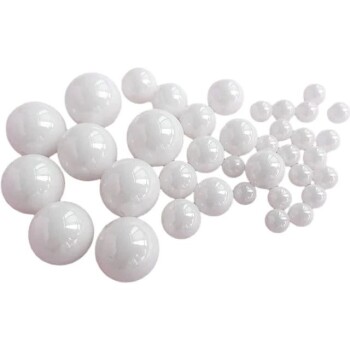
The selection of 2mm diameter zirconia grinding balls for wet ball milling LLZ-CaSb powders is a strategic decision driven by the requirement for extreme material purity. This specific media configuration optimizes the grinding efficiency needed to refine the powder while leveraging the chemical inertness of zirconia to prevent contamination.
Core Takeaway The success of solid-state electrolytes relies on maintaining high ionic conductivity, which is easily degraded by impurities. Using 2mm zirconia balls provides the necessary kinetic energy to refine particles without introducing metallic contaminants that destroy the material's electrochemical performance.
The Criticality of Material Purity
Eliminating Metallic Contamination
The most significant risk in milling solid-state electrolytes is the introduction of conductive impurities. Standard steel or metallic media will shed microscopic particles of iron or chromium due to wear.
These metallic inclusions can compromise the electrical properties of the LLZ-CaSb material. By using zirconia, you effectively eliminate the risk of introducing metallic contaminants that could lead to internal short circuits or performance degradation.
Preserving Ionic Conductivity
For an electrolyte to function correctly, it must facilitate the unimpeded flow of ions. Impurities introduced during the milling process act as barriers or traps for these ions.
Zirconia is chemically inert and highly wear-resistant. This ensures that the precursor powders remain pure, maintaining the high ionic conductivity required for the final solid-state battery application.
Mechanical Advantages of Zirconia Media
Optimized Grinding Efficiency
The primary reference specifies 2mm diameter balls to optimize efficiency. This size represents a calculated balance between impact force and contact frequency.
Larger balls might crush particles but lack the surface area for fine milling, while smaller beads might lack the mass to break down tough agglomerates. The 2mm size provides the precise kinetic energy needed to refine LLZ-CaSb powders effectively.
High Hardness and Density
Zirconia is characterized by extreme hardness and high density. This allows the media to impart high-energy mechanical forces necessary to break through tough impurity layers on raw particles.
This physical durability ensures that the media retains its shape and effectiveness even during prolonged milling durations, such as 5 to 12-hour cycles.
Understanding the Trade-offs
Media Wear vs. Contamination Impact
While zirconia is highly wear-resistant, no grinding media is completely immune to abrasion. Small amounts of zirconia may still wear off into the mixture over time.
However, unlike metallic wear, zirconia contamination is generally benign in this context. Because the electrolyte itself is often an oxide-based ceramic (containing Zirconium in the case of LLZTO), minor zirconia inclusions are far less detrimental than metallic particulates.
Cost Implications
High-quality, high-density zirconia media is significantly more expensive than standard steel or agate alternatives.
This increased cost is a necessary trade-off. The expense of the media is justified by the prevention of wasted batches of expensive LLZ-CaSb powder that would otherwise be ruined by lower-quality milling tools.
Making the Right Choice for Your Goal
When setting up your wet ball milling process, consider your specific performance targets:
- If your primary focus is Electrochemical Performance: Prioritize the chemical inertness of zirconia to ensure zero metallic contamination, as this directly correlates to ionic conductivity.
- If your primary focus is Particle Size Uniformity: Adhere strictly to the 2mm diameter specification, as this geometry has been identified to optimize the refinement of this specific powder type.
Ultimately, the use of 2mm zirconia media is not just about grinding; it is a contamination control strategy essential for viable solid-state electrolytes.
Summary Table:
| Feature | Advantage for LLZ-CaSb Processing |
|---|---|
| Material: Zirconia | Chemically inert; prevents metallic contamination and short circuits. |
| 2mm Diameter | Optimal balance between kinetic impact force and surface area frequency. |
| High Hardness | Provides the mechanical energy needed to break down tough agglomerates. |
| Wear Resistance | Minimizes media degradation during long 5-12 hour milling cycles. |
| Compatibility | Zirconia wear is benign for oxide-based ceramic electrolytes like LLZ. |
Elevate Your Battery Research with KINTEK Precision Solutions
Don't let metallic contamination compromise your solid-state electrolyte performance. KINTEK specializes in high-performance laboratory equipment designed for the rigorous demands of material science. From high-density zirconia grinding media and advanced crushing and milling systems to our precision hydraulic presses and vacuum furnaces, we provide the tools you need to achieve superior material purity and electrochemical results.
Ready to optimize your LLZ-CaSb powder processing? Contact our technical experts today to find the perfect milling and sintering solutions for your laboratory.
Related Products
- Laboratory Jar Ball Mill with Alumina Zirconia Grinding Jar and Balls
- Precision Machined Zirconia Ceramic Ball for Engineering Advanced Fine Ceramics
- Laboratory Jar Mill with Agate Grinding Jar and Balls
- Laboratory Ball Mill Jar Mill with Metal Alloy Grinding Jar and Balls
People Also Ask
- What are the primary functions of using a ball mill for BZCY72 powder? Achieve High Purity and Enhanced Sintering
- In what way does a laboratory ball mill affect material properties when modifying PHBV/pulp fiber composites?
- Why is a laboratory ball mill required for ultra-fine fly ash? Unlock Nano-Scale Adsorption Power
- What is the function of a laboratory ball mill in the preparation of AMMCs? Optimize Dispersion & Grain Refinement
- What is the function of a laboratory ball mill in the pretreatment of waste tire char (WTC)? Optimize Material Reactivity