Managing chemical stability under extreme heat is the primary reason for using alumina crucibles and mother powder when sintering Lithium Lanthanum Zirconium Oxide (LLZO).
Because lithium is highly volatile at sintering temperatures, LLZO pellets are prone to rapid lithium loss, which degrades their ionic conductivity; sealing the pellets in an alumina crucible with "mother powder" (loose powder of the same composition) creates a lithium-saturated environment that prevents this evaporation and stabilizes the material's crystal structure.
Core Takeaway The combination of an alumina crucible and mother powder creates a controlled micro-environment that counteracts lithium volatility. This setup ensures the preservation of the material’s stoichiometry and facilitates the stabilization of the highly conductive cubic phase, which is essential for the performance of solid-state electrolytes.
The Challenge: Lithium Volatility
The fundamental difficulty in processing LLZO ceramics lies in the behavior of lithium at high temperatures.
The Mechanism of Loss
During high-temperature sintering, the lithium within the LLZO structure becomes highly volatile. Without containment, this lithium evaporates from the surface of the material into the furnace atmosphere.
Consequences for Performance
As lithium leaves the material, the stoichiometry of the pellet changes. This depletion often leads to phase transitions at the surface, causing the material to revert to a less conductive phase or resulting in a significant reduction in overall ionic conductivity.
The Solution: The Role of Mother Powder
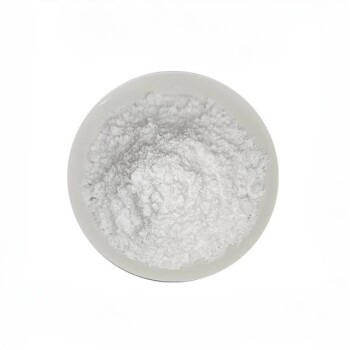
To combat volatility, engineers employ "mother powder"—excess LLZO powder of the same composition as the pellet—to act as a sacrificial buffer.
Creating a Lithium-Rich Atmosphere
By burying or covering the green pellets with mother powder, you artificially saturate the immediate atmosphere with lithium vapor. Because the vapor pressure is equilibrated by the powder, the thermodynamic drive for lithium to evaporate from the densifying pellet is effectively neutralized.
Preventing Direct Contact
The mother powder also serves as a physical barrier. It prevents the pellet from adhering directly to the crucible walls, which minimizes physical stress and uncontrolled chemical reactions between the pellet and the container.
The Function of the Alumina Crucible
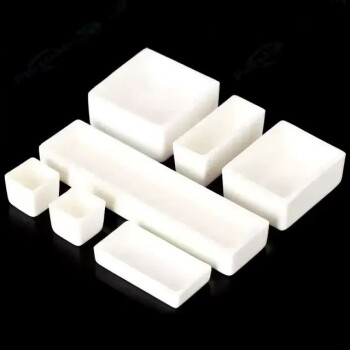
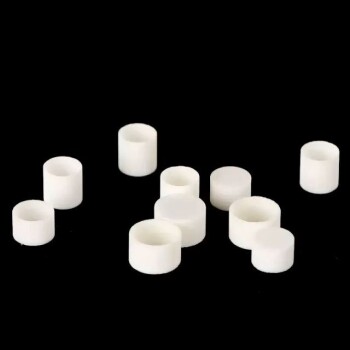
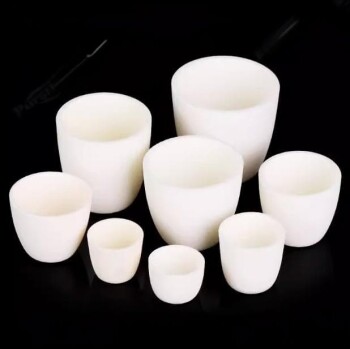
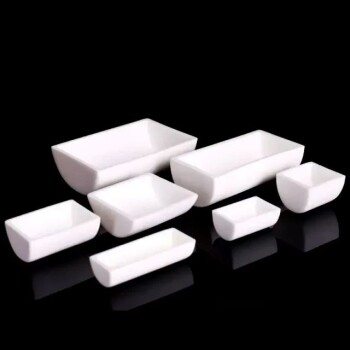
While the mother powder manages the atmosphere, the alumina ($Al_2O_3$) crucible serves a dual purpose: containment and structural stabilization.
Thermal and Chemical Stability
Alumina is selected for its ability to withstand the extreme temperatures required for sintering (often exceeding 1000°C). It remains structurally sound and relatively inert, providing a robust vessel for the densification process.
Beneficial Aluminum Doping
Beyond simple containment, the alumina crucible often plays an active chemical role. At sintering temperatures, small amounts of aluminum can diffuse from the crucible into the LLZO. This is frequently intentional, as aluminum acts as a dopant that stabilizes the cubic phase of LLZO—the phase with the highest ionic conductivity—preventing it from transforming into the less conductive tetragonal phase upon cooling.
Understanding the Trade-offs
While this setup is standard, it is not without risks. You must carefully balance the interaction between the vessel and the sample.
Risk of Impurity Formation
While some aluminum diffusion is beneficial for phase stabilization, excessive reaction can be detrimental. If the LLZO reacts too aggressively with the alumina crucible, it can form insulating impurity phases, such as lanthanum aluminate ($LaAlO_3$), which impedes lithium ion movement.
Control Limitations
Relying solely on the crucible for aluminum doping can be imprecise. The rate of diffusion depends on contact area and temperature, potentially leading to inconsistent doping levels across the ceramic pellet compared to pre-doping the powder intentionally.
Making the Right Choice for Your Goal
The specific configuration of your sintering setup should depend on the precise chemical properties you require in the final ceramic.
- If your primary focus is maximizing cubic phase stability: Utilize the alumina crucible to provide a compatible interface that supports aluminum doping, ensuring high ionic conductivity.
- If your primary focus is absolute stoichiometric purity: Use a thicker layer of mother powder to completely isolate the pellet from the crucible walls, or consider alternative crucible materials (like platinum) to eliminate aluminum diffusion entirely.
By controlling the atmosphere with mother powder and leveraging the stabilizing properties of the alumina crucible, you ensure a densified, phase-pure ceramic ready for high-performance electrochemical applications.
Summary Table:
| Component | Primary Function | Impact on LLZO Quality |
|---|---|---|
| Mother Powder | Creates Li-saturated atmosphere | Prevents Li-volatility & maintains stoichiometry |
| Alumina Crucible | Thermal containment & Al-doping | Stabilizes high-conductivity cubic phase |
| Sintering Process | High-temperature densification | Ensures structural integrity & ionic conductivity |
Elevate Your Battery Research with KINTEK
Precision matters when managing lithium volatility and phase stabilization. KINTEK specializes in advanced laboratory equipment and consumables designed for the most demanding material science applications. Whether you are developing solid-state electrolytes or advanced ceramics, our high-quality alumina crucibles, high-temperature muffle and tube furnaces, and crushing/milling systems provide the controlled environment your research requires.
From pellet and isostatic hydraulic presses for green body formation to ULT freezers and PTFE consumables for chemical processing, KINTEK offers a comprehensive portfolio to support your entire workflow.
Ready to achieve superior LLZO sintering results? Contact our technical experts today to find the perfect equipment solution for your laboratory.
Related Products
- Engineering Advanced Fine Ceramics Alumina Al2O3 Crucible With Lid Cylindrical Laboratory Crucible
- Engineering Advanced Fine Alumina Al2O3 Ceramic Crucible for Laboratory Muffle Furnace
- Engineering Advanced Fine Ceramics Alumina Crucibles (Al2O3) for Thermal Analysis TGA DTA
- Arc-Shaped Alumina Ceramic Crucible High Temperature Resistant for Engineering Advanced Fine Ceramics
- Alumina Al2O3 Ceramic Crucible Semicircle Boat with Lid for Engineering Advanced Fine Ceramics
People Also Ask
- Why are high-purity alumina crucibles used for liquid lead corrosion experiments? Ensure Data Accuracy at 550°C
- Why are alumina crucibles and mother powder essential for LATP sintering? Optimize Your Solid Electrolyte Performance
- What is the primary purpose of using alumina crucibles for LLTO ceramics? Optimize Your High-Temperature Sintering
- Why Use Alumina Crucibles & Powder Burial for NaSICON? Ensure Phase Purity and Prevent Elemental Volatilization
- Why are alumina crucibles used as containers during the tungsten diffusion coating process on diamond surfaces?