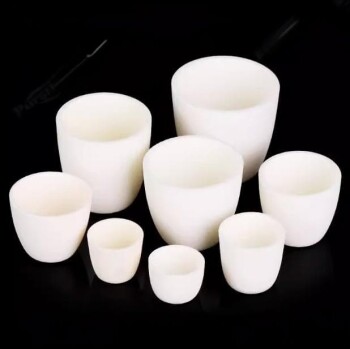
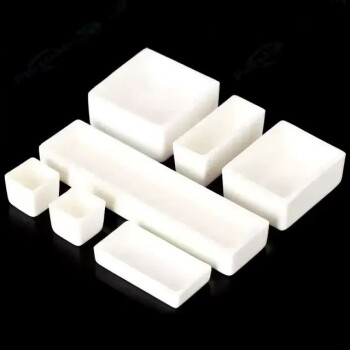
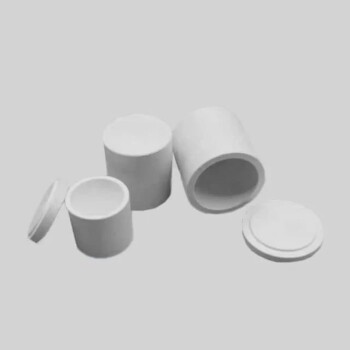
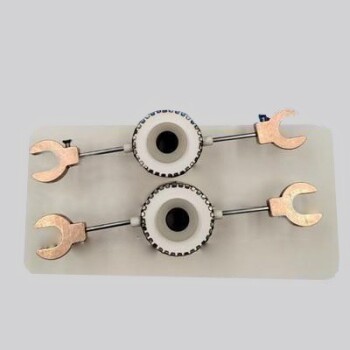
Alumina crucibles are the critical standard for high-temperature FeCrAl coating experiments due to their exceptional combination of thermal stability and chemical inertness. They act as a neutral barrier, resisting reactions with both the metallic coating and corrosive media (such as molten potassium chloride) at temperatures exceeding 450°C. This neutrality is essential for isolating the specific chemical interactions researchers intend to study, without interference from the container itself.
The selection of alumina is fundamentally about data fidelity; its inert properties prevent container interference, ensuring that kinetic analysis relies solely on the interaction between the coating and the environment.
Preserving Experimental Integrity
Resisting Chemical Interference
The primary reason for selecting alumina is its refusal to chemically interact with the sample or the environment.
In experiments involving FeCrAl coatings, reactive agents like hydrogen chloride (HCl) and potassium chloride (KCl) are often present.
Alumina remains inert in these conditions, ensuring that the crucible does not introduce impurities or alter the corrosive atmosphere.
Withstanding Extreme Thermal Loads
High-temperature exposure experiments often push materials to their limits, sometimes exceeding 1000°C.
Alumina possesses high structural strength and stability, maintaining its shape and integrity well beyond the melting points of many other container materials.
This allows it to support the weight of the sample and any reaction mixtures without deforming during prolonged heat treatments.
Ensuring Precise Kinetic Measurement
Isolating Mass Gain Sources
To determine how well a coating protects a substrate, researchers measure "mass gain"—the weight added to the sample as it reacts with the environment.
Because alumina does not react with the FeCrAl sample, any measured change in weight can be attributed solely to the corrosion products formed on the metal.
This isolation is vital for calculating accurate reaction kinetics and understanding the degradation rate of the coating.
Capturing Spallation
During intense heating and cooling cycles, protective oxide scales on the sample may crack and flake off (spallation).
An alumina crucible acts as a catch basin for these detached flakes.
By collecting this debris, researchers can account for the total mass of the reaction products, preventing data loss that would occur if the flakes were lost to the furnace floor.
Preventing Cross-Contamination
In laboratories testing multiple variables simultaneously, maintaining sample isolation is paramount.
Individual alumina crucibles prevent volatile chlorides or deposits from one sample from contaminating another.
This physical separation ensures that the results for each specific FeCrAl coating formulation remain distinct and valid.
Understanding the Trade-offs
The Necessity of High Purity
Not all alumina is created equal; lower-grade ceramics may contain binders or impurities like silica.
To achieve the results described above, high-purity alumina is required.
Using lower-grade crucibles can introduce trace contaminants that interfere with the formation of protective layers, compromising the experiment.
Thermal Shock Sensitivity
While chemically robust, alumina is a ceramic and is susceptible to thermal shock.
Rapid heating or cooling rates can cause the crucible to crack or shatter.
Researchers must program furnace ramp rates carefully to protect the container, ensuring the sample is not exposed to the open furnace environment mid-experiment.
Making the Right Choice for Your Goal
When designing high-temperature corrosion experiments, your choice of containment dictates the reliability of your data.
- If your primary focus is kinetic accuracy: Ensure you utilize a crucible geometry that fully captures any potential oxide spallation to account for total mass change.
- If your primary focus is chemical purity: Verify the purity grade of the alumina to prevent trace elements from interfering with sensitive diffusion layers in the coating.
By selecting high-purity alumina, you transform the sample container from a potential variable into a reliable constant.
Summary Table:
| Feature | Benefit for FeCrAl Coating Experiments |
|---|---|
| Chemical Inertness | Prevents reactions with metallic coatings and corrosive media (HCl/KCl). |
| Thermal Stability | Maintains structural integrity at temperatures exceeding 1000°C. |
| Mass Gain Accuracy | Isolates weight changes to the sample only, allowing precise kinetic analysis. |
| Debris Collection | Acts as a catch basin for spalled oxide flakes to ensure complete data. |
| Contamination Control | Prevents cross-contamination between different samples in the furnace. |
Elevate Your Research Precision with KINTEK
Don't let container interference compromise your data fidelity. KINTEK specializes in providing high-purity alumina crucibles and ceramic consumables designed to withstand the rigors of high-temperature laboratory research. Whether you are conducting kinetic analysis on FeCrAl coatings or performing complex materials synthesis in our high-temperature muffle or vacuum furnaces, we provide the reliable tools your lab needs.
From high-purity ceramics to advanced crushing, milling, and hydraulic press systems, KINTEK is your partner in achieving repeatable, accurate results. Contact us today to find the perfect containment solution for your experiment!
References
- Liam Reddy, Tanvir Hussain. Influence of KCl and HCl on a laser clad FeCrAl alloy: In-Situ SEM and controlled environment High temperature corrosion. DOI: 10.1016/j.corsci.2019.07.003
This article is also based on technical information from Kintek Solution Knowledge Base .
Related Products
- Arc-Shaped Alumina Ceramic Crucible High Temperature Resistant for Engineering Advanced Fine Ceramics
- Alumina Al2O3 Ceramic Crucible Semicircle Boat with Lid for Engineering Advanced Fine Ceramics
- Engineering Advanced Fine Ceramics Alumina Al2O3 Crucible With Lid Cylindrical Laboratory Crucible
- Engineering Advanced Fine Ceramics Alumina Crucibles (Al2O3) for Thermal Analysis TGA DTA
- Engineering Advanced Fine Alumina Al2O3 Ceramic Crucible for Laboratory Muffle Furnace
People Also Ask
- Why Use Alumina Crucibles & Powder Burial for NaSICON? Ensure Phase Purity and Prevent Elemental Volatilization
- What is the primary purpose of using alumina crucibles for LLTO ceramics? Optimize Your High-Temperature Sintering
- Why are alumina crucibles and mother powder essential for LATP sintering? Optimize Your Solid Electrolyte Performance
- Why are high-purity alumina crucibles used for liquid lead corrosion experiments? Ensure Data Accuracy at 550°C
- Primary considerations for choosing alumina crucibles and quartz tubes in indium intercalation: Ensure Material Purity