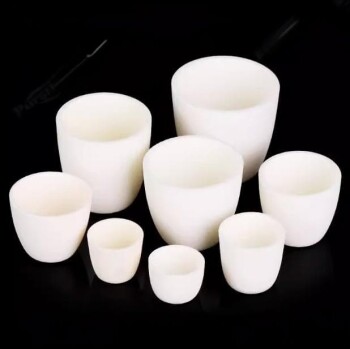
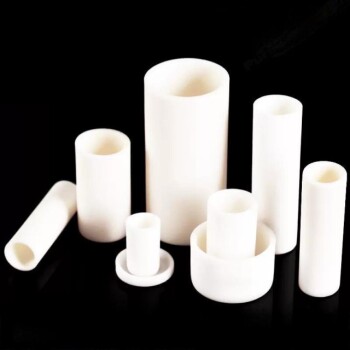
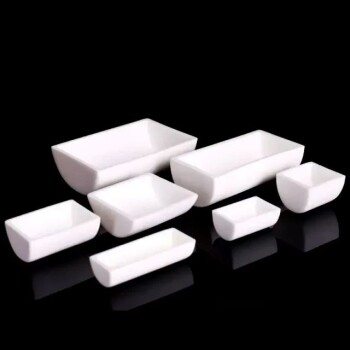
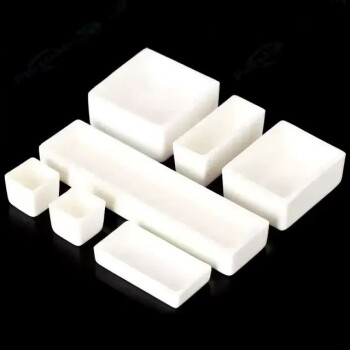
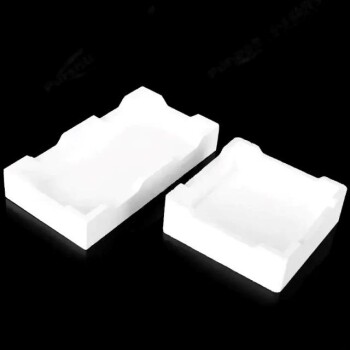
The necessity of specialized crucibles stems from the extreme chemical aggression of Potassium Hydroxide (KOH) at high temperatures. When used for chemical activation, KOH creates a highly corrosive environment that rapidly degrades standard laboratory vessels like quartz or common metals. High-purity nickel or alumina crucibles are required because they possess the specific chemical resistance needed to withstand this attack, ensuring the vessel survives and the final activated carbon remains free of metallic contamination.
The success of KOH activation depends on maintaining a pristine reaction environment. Without corrosion-resistant crucibles, the vessel will degrade, leading to equipment failure and the leaching of impurities that compromise the activated carbon's pore structure and surface area.
The Hostile Environment of Chemical Activation
To understand why standard equipment fails, you must understand the severity of the conditions inside the furnace.
Extreme Thermal Conditions
The activation process occurs in a controlled thermal environment, typically ranging from 400°C to 900°C. At these temperatures, materials that are stable at room temperature often lose their structural integrity or chemical resistance.
The Aggressive Nature of Molten KOH
As the furnace heats up, the solid KOH melts and initiates a violent solid-liquid reaction with the carbon source. This agent actively etches the carbon skeleton through redox reactions to generate porosity.
Potassium Vapor Attack
Beyond the liquid phase, the process generates potassium vapor and CO2. This vapor permeates the furnace chamber, attacking any material that is not chemically inert to alkali metals at high temperatures.
Why Standard Materials Fail
Using the wrong crucible is not just a matter of durability; it is a matter of reaction chemistry.
The Vulnerability of Quartz
Standard quartz containers, which are common in many high-temperature applications, cannot withstand the alkalinity of molten KOH. The activation agent will react with the silica in the quartz, causing the crucible to crack or dissolve.
Leaching and Contamination
If a standard metallic container is used, the corrosive KOH will strip metal ions from the vessel walls. These dissolved metals become impurities within the activated carbon matrix, altering its surface chemistry and reducing its potential applications.
The Role of Nickel and Alumina
High-purity nickel and alumina are the industry standards for this specific synthesis method due to their unique properties.
Superior Chemical Resistance
Both nickel and high-purity alumina are exceptionally resistant to attack by strong alkalis like KOH. They remain stable even when exposed to the intense etching reactions and potassium intercalation occurring within the carbon layers.
Preserving Product Purity
By resisting corrosion, these crucibles ensure that no foreign materials are introduced into the reaction. This is critical for achieving ultra-high specific surface areas (exceeding 3000 m²/g) and a precise, hierarchical pore structure.
Understanding the Trade-offs
While nickel and alumina are necessary, they introduce specific operational challenges that must be managed.
Thermal Shock Sensitivity
Alumina crucibles, while chemically resistant, can be brittle. Rapid heating or cooling can cause thermal shock, leading to cracking. Ramping temperatures slowly is essential to preserve the lifespan of the crucible.
Oxidation Risks for Nickel
Nickel crucibles are robust but can oxidize if exposed to air at high temperatures. The inert atmosphere provided by the furnace is not just for protecting the carbon from over-oxidation; it also protects the nickel crucible itself from degradation.
Making the Right Choice for Your Goal
Selecting the correct vessel is the first step toward reproducible results in activated carbon synthesis.
- If your primary focus is maximizing surface area: Ensure your crucible is high-purity (99%+) to prevent trace metals from blocking the extensive micropores generated during lattice expansion.
- If your primary focus is equipment longevity: Prioritize strict temperature controls and inert gas flow to protect your nickel or alumina crucibles from thermal shock and oxidation.
The quality of your activated carbon is defined not just by the precursor, but by the integrity of the vessel in which it is born.
Summary Table:
| Crucible Material | Chemical Resistance (KOH) | Max Operating Temp | Key Benefits | Main Risks |
|---|---|---|---|---|
| High-Purity Nickel | Excellent (Alkali resistant) | ~600-800°C (Inert) | High durability; no metal leaching | Oxidation in air |
| Alumina (99%+) | Very Good | Up to 1700°C | High thermal stability; inert | Thermal shock/cracking |
| Quartz | Poor (Reactive) | ~1100°C | Low cost (not for KOH) | Dissolves in alkalis |
| Standard Steel | Poor | ~500°C | Inexpensive | Heavy metal contamination |
Maximize Your Material Purity with KINTEK Precision Equipment
Don't let crucible degradation compromise your high-surface-area activated carbon research. KINTEK provides the specialized laboratory equipment and consumables needed for aggressive chemical synthesis. Whether you require corrosion-resistant nickel/alumina crucibles, high-temperature atmosphere furnaces, or crushing and milling systems for your precursors, we deliver the quality your lab demands.
Our value to you:
- Comprehensive Range: From muffle and tube furnaces to advanced CVD and induction systems.
- High-Purity Consumables: Premium PTFE products, ceramics, and crucibles designed for extreme environments.
- Total Solutions: Specialized tools for battery research, hydraulic presses, and cooling solutions like ULT freezers.
Contact KINTEK today to optimize your synthesis process!
References
- Shuling Liu, Baojun Li. Catalytically Active Carbon for Oxygen Reduction Reaction in Energy Conversion: Recent Advances and Future Perspectives. DOI: 10.1002/advs.202308040
This article is also based on technical information from Kintek Solution Knowledge Base .
Related Products
- Arc-Shaped Alumina Ceramic Crucible High Temperature Resistant for Engineering Advanced Fine Ceramics
- Engineering Advanced Fine Ceramics Alumina Al2O3 Crucible With Lid Cylindrical Laboratory Crucible
- Alumina Al2O3 Ceramic Crucible Semicircle Boat with Lid for Engineering Advanced Fine Ceramics
- Engineering Advanced Fine Alumina Al2O3 Ceramic Crucible for Laboratory Muffle Furnace
- Engineering Advanced Fine Ceramics Alumina Crucibles (Al2O3) for Thermal Analysis TGA DTA
People Also Ask
- Why Use Alumina Crucibles & Powder Burial for NaSICON? Ensure Phase Purity and Prevent Elemental Volatilization
- What is the primary purpose of using alumina crucibles for LLTO ceramics? Optimize Your High-Temperature Sintering
- Why are alumina crucibles and mother powder essential for LATP sintering? Optimize Your Solid Electrolyte Performance
- Why are high-purity alumina crucibles used for liquid lead corrosion experiments? Ensure Data Accuracy at 550°C
- Primary considerations for choosing alumina crucibles and quartz tubes in indium intercalation: Ensure Material Purity