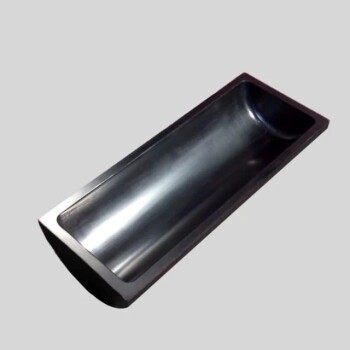
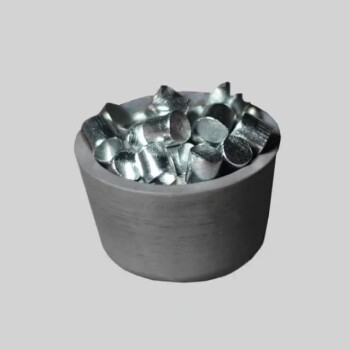
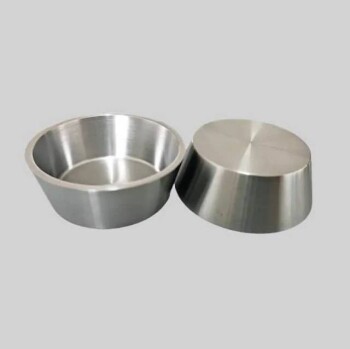
Glassy carbon crucibles are preferred for molten chloride salt experiments because they offer superior chemical inertness and thermal shock resistance at high temperatures, specifically around 700 °C. Unlike standard metal or quartz vessels, glassy carbon resists corrosion from aggressive salts like MgCl2, NaCl, and KCl, ensuring the vessel maintains its integrity even during long-duration immersion tests.
Core Takeaway The aggressive nature of molten chloride salts causes standard crucibles to degrade, introducing foreign impurities into the experiment. Glassy carbon provides a chemically stable environment that prevents this contamination, ensuring that the purity of the molten salt is maintained and experimental results are not skewed by container corrosion.
The Critical Role of Chemical Inertness
Resistance to Aggressive Salts
Molten chloride salts, such as mixtures of MgCl2, NaCl, and KCl, create a highly corrosive environment, particularly at elevated temperatures of 700 °C.
Standard materials often fail to withstand this chemical attack. Glassy carbon, however, demonstrates exceptional chemical inertness, allowing it to survive contact with these aggressive fluids without degrading.
Preserving Melt Purity
The primary goal of immersion experiments is often to study the properties of the salt or the behavior of materials submerged within it.
If the crucible corrodes, it leaches material into the melt. Glassy carbon ensures no external impurities are introduced, maintaining the exact chemical composition of the salt throughout the test.
Durability in Long-Duration Testing
Surviving Extended Exposures
Many experiments require materials to be submerged for long periods to accurately simulate real-world conditions.
Glassy carbon has been proven effective in experiments lasting as long as 500 hours. While other materials might fail structurally over this timeframe, glassy carbon retains its performance.
Thermal Shock Resistance
In addition to chemical stability, reaction vessels must withstand rapid temperature changes.
Glassy carbon exhibits high thermal shock resistance, reducing the risk of the crucible cracking or shattering during the heating and cooling cycles inherent to high-temperature experimentation.
Comparing Alternatives: The Trade-offs
The Limitations of Metal Crucibles
Metal crucibles are commonly used in other applications, but they are prone to active corrosion in chloride environments.
As the metal reacts with the salt, it alters the chemistry of the bath, potentially ruining the validity of the experiment.
The Limitations of Quartz
Quartz is often a go-to for high-temperature work, but it lacks the necessary resistance for these specific aggressive salts.
Compared to glassy carbon, quartz is more susceptible to attack by molten chlorides, making it a less reliable choice for maintaining absolute purity over long durations.
Making the Right Choice for Your Goal
Selecting the correct crucible is about prioritizing data integrity over initial cost or availability.
- If your primary focus is experimental accuracy: Choose glassy carbon to eliminate the risk of container-induced contamination and ensure your data reflects only the variables you intended to test.
- If your primary focus is long-term structural integrity: Choose glassy carbon to prevent catastrophic vessel failure during tests exceeding several hundred hours at 700 °C.
By utilizing glassy carbon, you effectively remove the "container variable" from your analysis, ensuring reliable and reproducible results.
Summary Table:
| Feature | Glassy Carbon | Metal Crucibles | Quartz Vessels |
|---|---|---|---|
| Corrosion Resistance | Excellent (MgCl2, NaCl, KCl) | Poor (Active corrosion) | Moderate to Low |
| Chemical Inertness | High (No impurities leached) | Low (Leaches metal ions) | Moderate (Susceptible to attack) |
| Thermal Shock Resistance | High | High | Moderate |
| Typical Test Duration | Up to 500+ Hours | Short-term only | Variable (Risk of failure) |
| Operating Temperature | Up to 700°C+ | Dependent on alloy | Limited by chemical attack |
Elevate Your Material Research with KINTEK Precision
Don't let crucible corrosion compromise your experimental integrity. KINTEK specializes in high-performance laboratory solutions, providing researchers with the premium glassy carbon crucibles and ceramics needed for aggressive molten salt environments.
Whether you are conducting long-duration immersion tests at 700°C or exploring complex battery chemistries, our comprehensive portfolio—including high-temperature furnaces, crushing systems, and advanced consumables—is designed to deliver reproducible results.
Take the "container variable" out of your analysis today.
Contact KINTEK Experts to find the perfect solution for your lab
References
- Wenjin Ding, Thomas Bauer. Characterization of corrosion resistance of C/C–SiC composite in molten chloride mixture MgCl2/NaCl/KCl at 700 °C. DOI: 10.1038/s41529-019-0104-3
This article is also based on technical information from Kintek Solution Knowledge Base .
Related Products
- Glassy Carbon Sheet RVC for Electrochemical Experiments
- Glassy Carbon Electrochemical Electrode
- High Purity Pure Graphite Crucible for Electron Beam Evaporation
- Carbon Graphite Boat -Laboratory Tube Furnace with Cover
- Electron Beam Evaporation Coating Oxygen-Free Copper Crucible and Evaporation Boat
People Also Ask
- What is an RVC glassy carbon sheet? A High-Performance Material for Demanding Applications
- What is the applicable potential range for an RVC glassy carbon sheet? Master Your Electrochemical Analysis
- What is the porosity of an RVC glassy carbon sheet? Understanding the Critical Difference Between PPI and Porosity
- What are the key characteristics of RVC glassy carbon sheets? Unlock Superior Electrochemical Performance
- What consideration should be given to ancillary equipment used with RVC glassy carbon sheets? Ensure Reliable Performance and Protect Your Investment