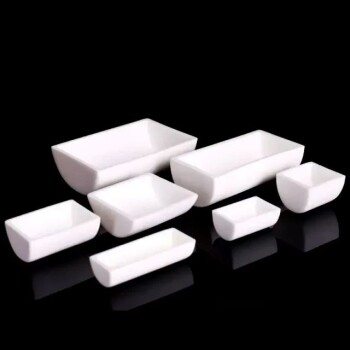
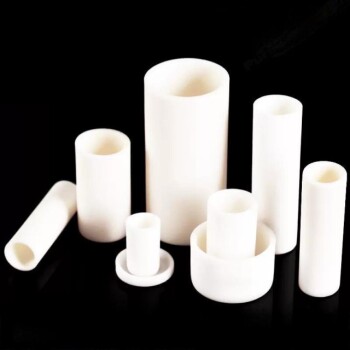
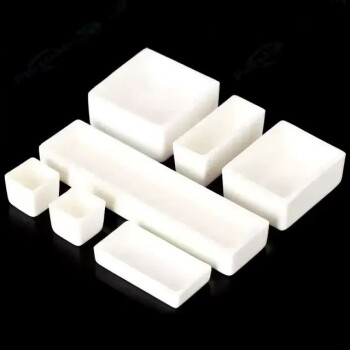
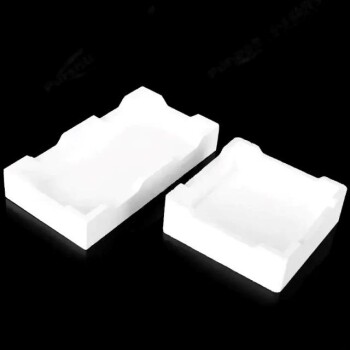
High-purity alumina boats are the preferred containers for zinc oxide (ZnO) nanowire synthesis because they provide an exceptionally stable, non-reactive environment at the extreme temperatures required for vaporization. Their chemical inertness ensures that no foreign elements leach into the source materials, which is critical for maintaining the single-crystal quality and semiconductor properties of the resulting nanowires.
Core Takeaway: Alumina’s high melting point and chemical stability prevent contamination and structural deformation during synthesis, ensuring that the zinc vapor remains pure enough to facilitate precise Vapor-Liquid-Solid (VLS) or Vapor-Solid (VS) growth.
Superior Thermal Performance at Scale
Maintaining Structural Integrity
Zinc oxide nanowire synthesis typically occurs at temperatures ranging from 600°C to over 1000°C. High-purity alumina (Al2O3) possesses a melting point near 2072°C, allowing it to remain rigid and resistant to deformation while other materials might sag or soften.
Consistent Vaporization Environments
Because the boat does not warp or degrade, it provides a stable platform for the zinc powder or precursors. This stability ensures a uniform surface area for vaporization, which is essential for controlling the concentration of zinc vapor within the furnace tube.
Resistance to Thermal Cycling
High-purity alumina is designed to withstand the repeated heating and cooling cycles inherent in laboratory and industrial synthesis. This thermal durability makes it a cost-effective choice for long-term production compared to more fragile alternatives.
Chemical Inertness and Contamination Control
Preventing Metallic Leaching
At high temperatures, many container materials can react with the source powder, introducing metallic impurities into the growth system. Alumina is chemically "lazy," meaning it does not react with zinc powder or the resulting zinc vapor, preserving the chemical purity of the nanowires.
Compatibility with Reducing Agents
Many synthesis methods use carbothermal reduction, involving a mixture of ZnO and graphite. Alumina boats remain chemically indifferent to these carbon-rich environments at 1000°C, ensuring the reaction remains confined to the intended precursors.
Eliminating Interaction with the Furnace
Alumina boats prevent direct contact between the reactants and the quartz furnace tube. This prevents silicon contamination and protects the expensive quartz glassware from chemical etching or bonding with the zinc precursors.
Impact on Nanostructure Quality
Protecting Growth Mechanisms
The growth of ZnO nanowires often relies on the Vapor-Liquid-Solid (VLS) mechanism. Even trace amounts of impurities from a container could disrupt the catalyst droplet or alter the growth kinetics, leading to structural defects or branched "tetrapod" formations where straight wires are desired.
Optimizing Optical and Electrical Properties
The functionality of ZnO nanowires depends on their crystal lattice perfection. By eliminating extrinsic impurities, alumina boats help ensure the nanowires achieve the high optical transparency and precise electrical conductivity required for optoelectronic applications.
Facilitating Single-Crystal Formation
The absence of leached elements from the boat allows the zinc and oxygen atoms to arrange themselves without interference. This results in high-quality single crystals with minimal point defects or dislocations in the lattice.
Understanding the Trade-offs
Sensitivity to Thermal Shock
While alumina is heat-resistant, it is susceptible to thermal shock if the temperature changes too rapidly. If a boat is removed from a 1000°C furnace and placed directly on a cold bench, it is likely to crack.
Porosity and Cleaning Challenges
Standard alumina boats can be slightly porous, potentially trapping residues from previous experiments. High-purity, high-density alumina is required to minimize this risk, though it comes at a higher procurement cost.
Cost vs. Purity Grades
Not all alumina is equal; lower-purity boats may contain binders or silica that can outgas at high temperatures. Researchers must ensure they are using 99.5% or 99.9% purity to avoid the very contamination the material is intended to prevent.
How to Apply This to Your Synthesis Project
- If your primary focus is maximum crystal purity: Always select 99.9% high-purity alumina to eliminate the risk of trace metal contamination during long-duration growth cycles.
- If your primary focus is boat longevity: Implement strict heating and cooling ramp rates (typically <10°C per minute) to prevent cracking due to thermal shock.
- If your primary focus is preventing cross-contamination: Dedicate specific boats to specific materials (e.g., one boat for ZnO, another for SnO2) to avoid the "memory effect" where residues from previous runs vaporize in subsequent experiments.
Selecting high-purity alumina is a foundational step in ensuring the structural and chemical integrity of synthesized ZnO nanostructures.
Summary Table:
| Feature | Benefit for ZnO Synthesis | Technical Reason |
|---|---|---|
| Chemical Inertness | Prevents metallic leaching | Non-reactive with zinc vapor and reducing agents |
| High Melting Point | Structural integrity | Remains rigid and stable at temperatures >1000°C |
| Thermal Durability | Long-term cost savings | High resistance to repeated heating/cooling cycles |
| 99.9% Purity | Optimizes electrical properties | Eliminates extrinsic impurities and lattice defects |
Elevate Your Nanotechnology Research with KINTEK
Precision is non-negotiable in nanomaterial synthesis. KINTEK specializes in providing high-performance laboratory equipment and consumables tailored for advanced material science. Whether you require 99.9% high-purity alumina boats and ceramic crucibles to prevent contamination or advanced tube and muffle furnaces for precise temperature control, our solutions ensure the structural and chemical integrity of your ZnO nanowires.
Don't let inferior containers compromise your semiconductor quality. Contact KINTEK today to explore our full range of high-temperature ceramics, furnace systems, and specialized lab consumables designed for superior research outcomes.
References
- Pham Hong Thach, Tran Van Khai. Thermal Evaporation Synthesis, Optical and Gas-Sensing Properties of ZnO Nanowires. DOI: 10.3390/cryst13091380
This article is also based on technical information from Kintek Solution Knowledge Base .
Related Products
- High Purity Alumina Granulated Powder for Engineering Advanced Fine Ceramics
- Alumina Al2O3 Ceramic Crucible Semicircle Boat with Lid for Engineering Advanced Fine Ceramics
- Aluminized Ceramic Evaporation Boat for Thin Film Deposition
- Ceramic Evaporation Boat Set Alumina Crucible for Laboratory Use
- High Purity Pure Graphite Crucible for Evaporation
People Also Ask
- What is the function of high-purity alumina powder in pack cementation? Ensure Uniform Aerospace Blade Coatings
- How should alumina powder be selected for polishing a disc electrode, and what is the procedure for removing scratches? Achieve a Perfect Mirror Finish
- What are the properties and handling precautions for alumina powder as a polishing material? Achieve a Flawless Finish with Precision
- Why is it necessary to apply alumina powder to graphite molds for TiC10/Cu-Al2O3? Ensure Smooth Release.
- What measures should be taken to prevent cross-contamination when using different sizes of alumina powder?