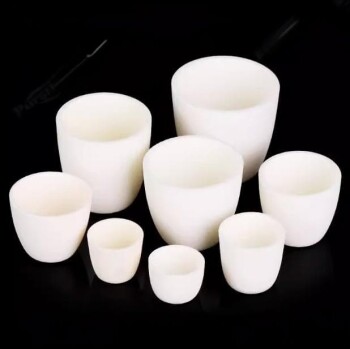
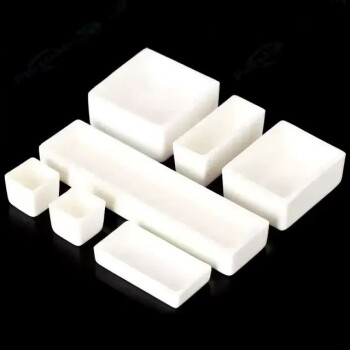
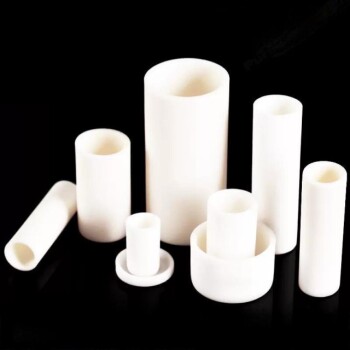
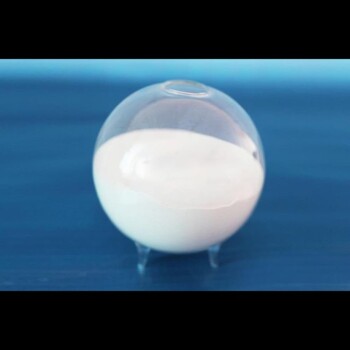
High-purity alumina crucibles are the industry standard for $MoS_2$ synthesis because they maintain structural and chemical integrity under extreme thermal conditions. During the Chemical Vapor Deposition (CVD) process, these carriers must withstand temperatures typically exceeding 700°C while remaining completely inert to volatile precursors like molybdenum trioxide ($MoO_3$) and sulfur. Their primary role is to prevent the introduction of metallic impurities that would otherwise degrade the crystal quality and optoelectronic performance of the resulting monolayer.
High-purity alumina provides a non-reactive, high-refractory environment that ensures the chemical purity of precursors during thermal transition. By eliminating side reactions and container-based contamination, it enables the growth of high-quality, two-dimensional $MoS_2$ with consistent electronic properties.
Extreme Thermal Stability and Refractoriness
Withstanding High Growth Temperatures
The synthesis of monolayer $MoS_2$ often requires environments reaching 700°C to 850°C to facilitate proper crystallization. High-purity alumina (aluminum oxide) possesses a high melting point and exceptional refractoriness, allowing it to operate safely at these temperatures—and even up to 1050°C—without deforming.
Long-term Structural Integrity
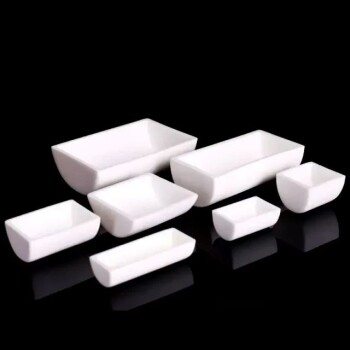
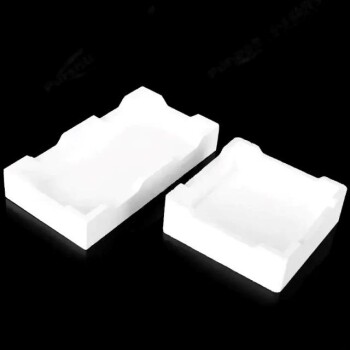
Unlike lower-grade materials that may soften or degrade, alumina boats maintain their physical shape during prolonged heating cycles. This stability is critical for supporting solid precursors and ensuring that the substrates remain in the correct orientation within the vapor flow path.
Chemical Inertness in Reactive Environments
Resistance to Precursor Interaction
During CVD, the crucible is in direct contact with molybdenum trioxide ($MoO_3$) and sulfur powder. Alumina is chosen because it does not undergo side reactions with these specific precursors or the resulting vapors, ensuring that the chemical reaction remains limited to the intended synthesis path.
Prevention of Vapor Contamination
Because the material is chemically inert, it does not release stray elements into the gas transport phase. This prevents metallic impurities from entering the vapor stream, which is essential for maintaining the high purity required for semiconductor-grade 2D materials.
Impact on Crystal Quality and Performance
Safeguarding Optoelectronic Properties
The electronic and optical performance of monolayer $MoS_2$ is highly sensitive to lattice defects and foreign atoms. By using high-purity alumina, researchers ensure that no external contaminants compromise the charge carrier mobility or the photoluminescence efficiency of the synthesized material.
Maintaining Precise Concentration Gradients
The specific geometry of alumina crucibles allows for the stable containment of a fixed mass of precursor powder. This stability helps maintain a constant vaporization rate, which is necessary to preserve the concentration gradients required for uniform monolayer growth across the substrate.
Understanding the Trade-offs
Thermal Shock Sensitivity
While alumina is thermally stable, it is susceptible to thermal shock if heated or cooled too rapidly. Sudden temperature gradients can cause the crucible to crack, meaning heating and cooling rates must be carefully controlled during the CVD process.
Cost and Brittleness
High-purity alumina is more expensive than standard porcelain or quartz and is inherently brittle. It requires careful handling to avoid mechanical failure, and its higher cost must be weighed against the specific purity requirements of the final $MoS_2$ application.
Making the Right Choice for Your Goal
How to Apply This to Your Project
- If your primary focus is high-performance electronics: Always use 99.9% (or higher) purity alumina to eliminate trace metallic contamination that creates deep-level defects.
- If your primary focus is large-scale batch uniformity: Select crucibles with a consistent deep-well geometry to ensure a stable and reproducible vaporization rate across different runs.
- If your primary focus is rapid prototyping and cost-reduction: Use standard porcelain boats only for initial temperature testing, but transition to alumina for final material characterization to ensure data reliability.
By selecting high-purity alumina carriers, you ensure that the synthesized $MoS_2$ reflects the intrinsic properties of the material rather than the limitations of the container.
Summary Table:
| Feature | Advantage in MoS2 CVD | Impact on Results |
|---|---|---|
| Thermal Stability | Operates safely up to 1050°C | No deformation; maintains vapor flow path |
| Chemical Inertness | Resistance to $MoO_3$ and Sulfur | Prevents side reactions & vapor contamination |
| High Purity | 99.9%+ Aluminum Oxide | Safeguards optoelectronic & lattice integrity |
| Geometry Stability | Deep-well powder containment | Ensures constant, reproducible vaporization rates |
Elevate Your 2D Material Research with KINTEK
Achieving high-quality monolayer $MoS_2$ requires more than just the right precursors—it demands high-performance equipment and consumables that maintain purity under pressure. KINTEK specializes in providing the precision tools necessary for advanced material synthesis, including high-purity alumina crucibles, CVD/PECVD/MPCVD systems, and atmosphere furnaces.
Whether you need robust high-temperature reactors, precision crushing and milling systems, or essential ceramic consumables, our portfolio is engineered to eliminate contamination and ensure repeatable results for laboratories and industrial researchers alike.
Ready to optimize your CVD process? Contact our experts today to discover how KINTEK’s comprehensive range of laboratory solutions can enhance your research efficiency and material quality.
References
- Yiru Zhu, Manish Chhowalla. Room-Temperature Photoluminescence Mediated by Sulfur Vacancies in 2D Molybdenum Disulfide. DOI: 10.1021/acsnano.3c02103
This article is also based on technical information from Kintek Solution Knowledge Base .
Related Products
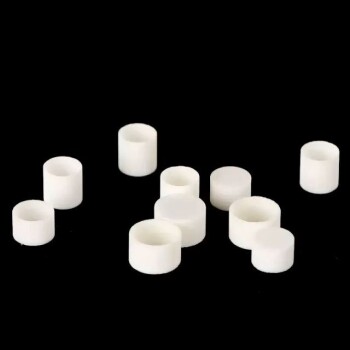
- Arc-Shaped Alumina Ceramic Crucible High Temperature Resistant for Engineering Advanced Fine Ceramics
- Engineering Advanced Fine Alumina Al2O3 Ceramic Crucible for Laboratory Muffle Furnace
- Engineering Advanced Fine Ceramics Alumina Al2O3 Crucible With Lid Cylindrical Laboratory Crucible
- High Purity Pure Graphite Crucible for Evaporation
- High Purity Alumina Granulated Powder for Engineering Advanced Fine Ceramics
People Also Ask
- Why Use Alumina Crucibles & Powder Burial for NaSICON? Ensure Phase Purity and Prevent Elemental Volatilization
- What is the primary purpose of using alumina crucibles for LLTO ceramics? Optimize Your High-Temperature Sintering
- Why are alumina crucibles and mother powder essential for LATP sintering? Optimize Your Solid Electrolyte Performance
- Why are high-purity alumina crucibles used for liquid lead corrosion experiments? Ensure Data Accuracy at 550°C
- Primary considerations for choosing alumina crucibles and quartz tubes in indium intercalation: Ensure Material Purity