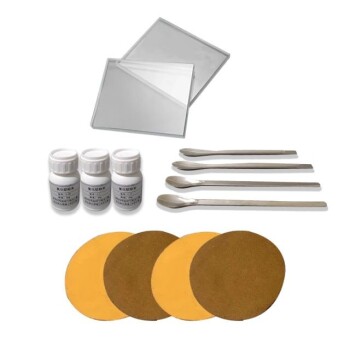
Electrolytic polishing and etching systems are essential because they exploit the electrochemical differences between microstructural phases to create visible contrast. While stainless steel components may appear uniform to the naked eye, these systems apply a specific voltage and electrolyte to induce differential corrosion. This process allows researchers to distinguish between phases like austenite and ferrite, identifying critical features in the heat-affected zone of welded joints that are otherwise invisible.
The Core Insight Mechanical polishing alone cannot reveal the complex internal architecture of stainless steel welds. Electrolytic systems are required to translate invisible differences in electrochemical stability into visible topographic features, providing the necessary data to predict failure mechanisms like Stress Corrosion Cracking (SCC).
The Mechanism: Differential Corrosion
Exploiting Electrochemical Activity
Stainless steel is not a singular material but a composite of various phases, such as austenite, ferrite, sigma, and chi. Each of these phases possesses a unique level of electrochemical activity.
When an external voltage is applied, these phases dissolve at different rates. This fundamental difference is the engine that drives microstructural analysis.
Creating Visual Contrast
By controlling the voltage and the chemical electrolyte, the system forces one phase to corrode or color differently than its neighbor.
For example, using a 10% oxalic acid solution, these systems can render ferrite dark gray while leaving austenite light gray. This high contrast is the only way to perform accurate optical inspections of the material's internal structure.
Critical Applications in Welded Joints
Revealing the Heat-Affected Zone (HAZ)
The heat-affected zone is often the weakest point in a welded joint. Electrolytic etching is vital for identifying secondary phase precipitates that form in this volatile region.
In materials like 2304 duplex stainless steel, clearly identifying these precipitates provides the visual evidence needed to understand structural integrity and potential failure points.
Revealing Grain Structures and Defects
Beyond simple phase identification, these systems expose the geometry of the grains themselves.
For 304L stainless steel, electrolytic etching selectively corrodes grain boundaries to reveal refined equiaxed grains and annealing twins. It can even expose specific defect structures, such as "lazy-S" features in friction stir welds, which are critical for quality control.
Quantitative Phase Analysis
To ensure a weld meets engineering specifications, you often need to calculate the exact ratio of phases.
Using specific electrolytes like a 30% KOH solution, researchers can create the high contrast needed to perform quantitative analysis. This allows for the precise measurement of phase fractions and grain sizes, confirming whether the weld maintains the correct balance for mechanical strength.
The Role in Failure Analysis
Investigating Stress Corrosion Cracking (SCC)
Understanding why a weld failed often requires looking at the microscopic interaction between phases.
By differentiating phases in the heat-affected zone, these systems provide a visual basis for analyzing the mechanisms behind Stress Corrosion Cracking (SCC). Without this clarity, it is nearly impossible to determine the root cause of a fracture.
Removing Stress Layers
Before analysis can begin, the sample surface must be pristine. Mechanical polishing can induce artificial stress layers that obscure the true microstructure.
Electrolytic polishing systems (often using electrolytes like oxalic acid at specific voltages, such as 6V) effectively remove these deformed layers. This reveals the true grain boundaries and carbide precipitates, allowing for an accurate evaluation of microstructural degradation.
Understanding the Trade-offs
Parameter Sensitivity
Success relies on precise control. The difference between a perfect etch and a ruined sample often lies in a variation of just a few volts or seconds.
For instance, specific results often require exact settings, such as 5V or 9V depending on the electrolyte. Deviating from these parameters can lead to over-etching, where the grain boundaries are destroyed, or under-etching, where no contrast is visible.
Chemical Specificity
There is no universal electrolyte. Different alloys and goals require distinct chemical solutions.
While 10% oxalic acid is common for general structure, 30% KOH might be required for phase tinting, and nitric acid solutions are preferred for exposing deformation-induced shear bands. Using the wrong solution will yield misleading or useless data.
Making the Right Choice for Your Goal
To select the correct electrolytic approach for your specific analysis, consider your primary objective:
- If your primary focus is Failure Analysis (SCC): Use systems capable of differential corrosion (e.g., oxalic acid) to distinguish between austenite and ferrite, as phase interaction is often the driver of cracking.
- If your primary focus is Quantitative Measurement: Prioritize high-contrast electrolytes (e.g., KOH) that allow for distinct phase boundary definition to calculate phase ratios and grain sizes accurately.
- If your primary focus is Defect Detection: Ensure your system can perform controlled anodic dissolution to reveal fine details like annealing twins and shear bands without damaging the bulk structure.
The ultimate value of these systems lies in their ability to strip away surface uniformity and reveal the microscopic "DNA" of the weld that dictates its performance and longevity.
Summary Table:
| Feature | Electrolytic Polishing/Etching Benefit | Key Application |
|---|---|---|
| Phase Contrast | Exploits electrochemical activity to distinguish phases | Identifying Austenite vs. Ferrite |
| HAZ Analysis | Reveals secondary phase precipitates in heat zones | Failure analysis in 2304 Duplex |
| Surface Quality | Removes mechanically deformed stress layers | Preparing samples for true grain evaluation |
| Quantitative Data | Creates high contrast for phase fraction calculation | Ensuring weld engineering compliance |
| Defect Detection | Selectively corrodes boundaries to show twins/shear bands | Quality control in friction stir welds |
Elevate Your Microstructural Analysis with KINTEK
Don't let surface stress and poor contrast obscure your research. KINTEK specializes in high-precision laboratory equipment and consumables designed for the most demanding metallurgical workflows. From advanced electrolytic cells and electrodes to our comprehensive range of high-temperature furnaces and sample preparation tools—including crushing systems and hydraulic presses—we provide everything you need to reveal the microscopic 'DNA' of your materials.
Our value to you:
- Precision Engineering: Achieve repeatable, high-contrast etches for accurate quantitative analysis.
- Comprehensive Support: Expert solutions ranging from cooling systems (ULT freezers) to essential PTFE and ceramic consumables.
- Failure Prevention: Detect Stress Corrosion Cracking (SCC) and HAZ defects before they lead to structural failure.
Ready to enhance your lab's efficiency and accuracy? Contact KINTEK Today to Find Your Perfect System.
References
- Thiago AmaroVicente, Nelson Alcântara. Stress Corrosion Cracking Behaviour of Dissimilar Welding of AISI 310S Austenitic Stainless Steel to 2304 Duplex Stainless Steel. DOI: 10.3390/met8030195
This article is also based on technical information from Kintek Solution Knowledge Base .
Related Products
- Electrode Polishing Material for Electrochemical Experiments
- Electrolytic Electrochemical Cell for Coating Evaluation
- Three-dimensional electromagnetic sieving instrument
- Quartz Electrolytic Electrochemical Cell for Electrochemical Experiments
- Side Window Optical Electrolytic Electrochemical Cell
People Also Ask
- How do you prepare the polishing setup for an electrode? Achieve a Flawless Mirror Finish for Reliable Electrochemistry
- What is the general procedure and what precautions should be taken during the polishing process? Achieve a Flawless Electrode Finish
- What are the electrode materials? A Guide to Choosing the Right Conductor for Your Application
- What are the examples of electrode materials? From Platinum to Graphite for Your Application
- How is a polished electrode tested for quality? Validate Performance with Cyclic Voltammetry