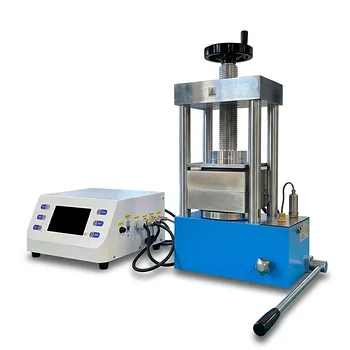
Laboratory hydraulic presses and metal molds are critical for transforming loose diamond and copper powder mixtures into a solid, cohesive form known as a "green compact." This mechanical pre-pressing step serves to expel trapped air, optimize particle arrangement, and establish a specific relative density—often around 75%—which is essential for the stability and accuracy of the subsequent hot-press sintering process.
The Core Takeaway Pre-pressing is not merely about shaping; it is a foundational densification step that removes air and creates a stable "green body." Without this initial compression in a metal mold, the mixture would lack the structural integrity and uniformity required to fit precisely into graphite sintering molds, compromising the final product's dimensional accuracy.
The Physics of Pre-Pressing
Creating the "Green Compact"
The primary function of the hydraulic press is to consolidate loose powder into a semi-solid shape, technically referred to as a green compact.
Using a metal mold of a specific diameter, the press applies sufficient force to achieve a target relative density (e.g., 75%). This transforms a difficult-to-handle powder mixture into a cohesive unit that holds its shape.
Expelling Trapped Air
Loose powders naturally contain significant amounts of air in the voids between particles.
Pre-pressing effectively expels this air before the material enters the vacuum hot-pressing stage. Removing air early is vital to prevent pockets of gas from expanding during heating, which would otherwise create voids or cracks in the final composite.
Enhancing Particle Contact
Pressure promotes the initial rearrangement of particles.
By forcing copper and diamond particles into tighter proximity, the press ensures uniform contact points throughout the material. This mechanical interlocking provides the necessary foundation for the chemical reactions and infiltration that occur during sintering.
Operational Benefits for Sintering
Facilitating Graphite Mold Loading
Hot-press sintering typically utilizes high-strength graphite molds, which are excellent for heat conduction but can be brittle or complex to load with loose powder.
Pre-pressing creates a compact "puck" that can be easily and precisely loaded into these graphite molds. This simplifies the workflow and protects the graphite mold from the uneven stresses associated with compressing loose powder.
Ensuring Dimensional Accuracy
The final dimensions of the sintered diamond/copper composite are heavily influenced by the initial state of the powder.
By pre-densifying the material, you significantly reduce the amount of shrinkage that occurs during the heating phase. This ensures the final sintered product maintains high dimensional accuracy and uniform density.
Understanding the Trade-offs
The Risk of Direct Sintering
It is often tempting to skip pre-pressing to save time, attempting to compress loose powder directly in the hot press.
However, relying solely on the hot press often leads to macroscopic defects. Without the pre-pressing stage, the volume shrinkage during sintering is drastic and unpredictable, leading to warped samples and uneven densities that even high-temperature vacuum pressing cannot correct.
Metal vs. Graphite Molds
It is critical to distinguish between the two mold types required.
Metal molds are used with the hydraulic press for cold pre-pressing because they can withstand the high mechanical impact needed for initial compaction. Graphite molds are reserved for the hot-pressing stage because they withstand high temperatures (over 800°C) but are not designed for the initial cold compaction of loose powders.
Making the Right Choice for Your Goal
To maximize the quality of your diamond/copper composites, align your process with your specific objectives:
- If your primary focus is Structural Integrity: Prioritize achieving a high relative density (approx. 75%) during the pre-press stage to minimize internal voids.
- If your primary focus is Dimensional Precision: Ensure your metal pre-press mold diameter matches the graphite sintering mold tolerance tightly to prevent expansion during the transfer.
Successful sintering begins before the heat is ever turned on; a uniform green compact is the single best predictor of a defect-free final product.
Summary Table:
| Feature | Pre-Pressing (Cold) | Hot-Press Sintering |
|---|---|---|
| Equipment | Laboratory Hydraulic Press | Vacuum Hot Press |
| Mold Material | High-Strength Metal Mold | High-Purity Graphite Mold |
| Primary Goal | Creating a 75% density 'Green Compact' | Diffusion & Chemical Bonding |
| Material State | Loose powder to cohesive puck | Cohesive puck to dense composite |
| Key Benefit | Expels air and ensures dimensional accuracy | Final densification and material properties |
Elevate Your Material Research with KINTEK Precision
Maximize the success of your sintering process with KINTEK’s high-performance laboratory hydraulic presses and precision-engineered metal molds. We specialize in providing researchers and engineers with the robust tools needed to create perfect 'green compacts'—the foundation for defect-free diamond/copper composites.
From pellet and isostatic hydraulic presses to our industry-leading high-temperature furnaces, crushing systems, and specialized consumables (PTFE, ceramics, and crucibles), KINTEK offers a comprehensive ecosystem for advanced material science. Whether you are working on battery research, dental materials, or high-pressure reactors, our equipment ensures uniform density and unmatched dimensional accuracy.
Ready to optimize your lab’s workflow? Contact KINTEK today for a consultation and discover how our laboratory solutions can enhance your material integrity.
Related Products
- 30T 40T Split Automatic Heated Hydraulic Press Machine with Heated Plates for Laboratory Hot Press
- Automatic High Temperature Heated Hydraulic Press Machine with Heated Plates for Lab
- 24T 30T 60T Heated Hydraulic Press Machine with Heated Plates for Laboratory Hot Press
- Ball Press Mold for Lab
- Automatic Laboratory Hydraulic Press for XRF & KBR Pellet Press
People Also Ask
- What are the advantages of using a laboratory hydraulic press for hot pressing? Achieve Peak Nano-Composite Density
- What are the core advantages of using a laboratory hot press to produce Bi2Se3? Achieve 93% Density & High Conductivity
- Why is a laboratory hydraulic hot press essential for high-density, additive-free Silicon Carbide? Unlock Pure SiC.
- How does a laboratory hydraulic hot press ensure the quality of PHBV/natural fiber composites? Expert Guide
- What is the function of a laboratory hydraulic hot press in the assembly of solid-state photoelectrochemical cells?