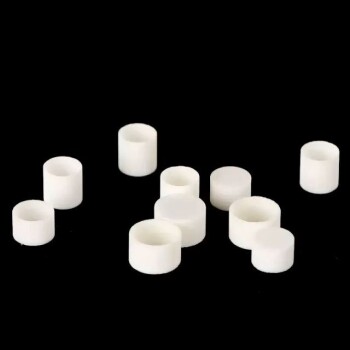
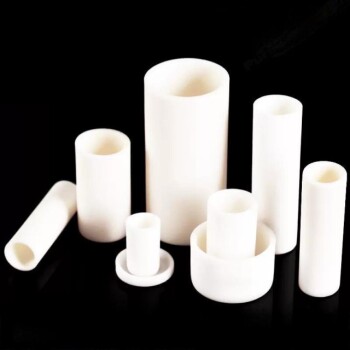
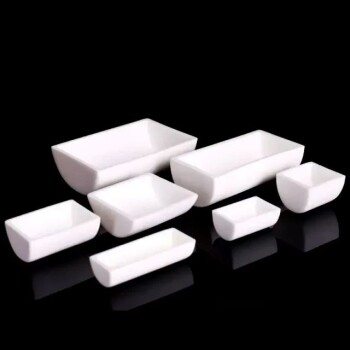
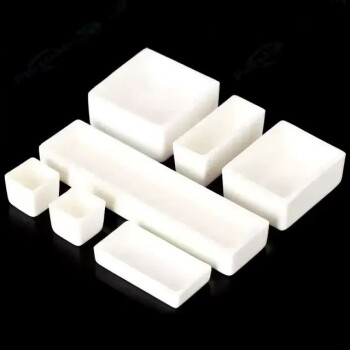
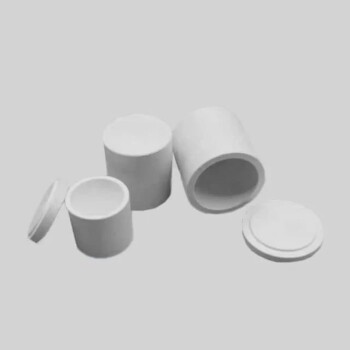
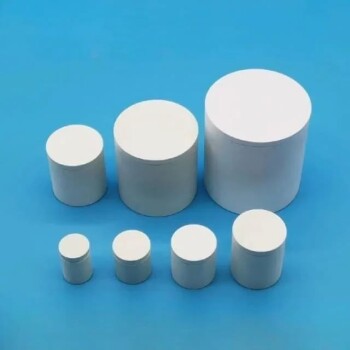
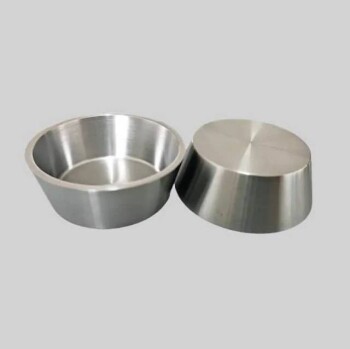
MgO crucibles and mother powder are utilized to prevent chemical contamination and maintain the precise lithium content required for high ionic conductivity. During high-temperature sintering (approximately 1100°C), these components work together to ensure the Ta-LLZO ceramic retains its specific crystal structure and does not react with its environment.
The use of MgO crucibles and mother powder is a dual-layered protection strategy: the crucible provides a chemically inert container that prevents impurity diffusion, while the mother powder regulates the local atmosphere to suppress the evaporation of volatile lithium.
The Critical Role of MgO Crucibles
Chemical Stability and Inertness
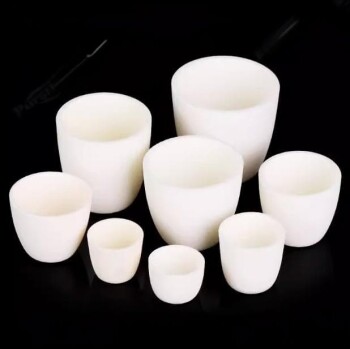
Unlike standard alumina containers, Magnesium Oxide (MgO) crucibles exhibit exceptional chemical stability when in contact with garnet-type electrolytes. At sintering temperatures, many materials become reactive, but MgO remains inert, ensuring the ceramic sample does not fuse to the container.
Prevention of Unintentional Doping
Standard alumina ($Al_2O_3$) crucibles can lead to the diffusion of aluminum into the LLZO lattice or the formation of impurity phases like $LaAlO_3$. Using MgO eliminates the risk of this unintentional aluminum doping, which is known to create resistive glassy phases at the grain boundaries.
Maintaining Chemical Purity
By providing a non-reactive environment, MgO crucibles ensure that the Tantalum-doped Lithium Lanthanum Zirconium Oxide maintains its intended stoichiometry. This purity is essential for achieving the high "garnet-phase" stability required for efficient lithium-ion transport.
The Necessity of Mother Powder
Suppressing Lithium Volatilization
Lithium is highly volatile at temperatures exceeding 1000°C, meaning it can easily evaporate from the ceramic pellet during the sintering process. Covering the sample with mother powder—which has the same composition as the pellet—creates a localized lithium vapor atmosphere.
Preventing Phase Transitions
If lithium loss is not controlled, the material may undergo a phase transition into a lithium-deficient pyrochlore phase (such as $La_2Zr_2O_7$). This secondary phase is detrimental because it possesses significantly lower ionic conductivity than the desired cubic garnet structure.
Compensating for Stoichiometric Drift
The mother powder acts as a sacrificial source of lithium, effectively "saturating" the air inside the sealed crucible. This prevents the lithium within the Ta-LLZO pellet from escaping, thereby ensuring the final ceramic membrane maintains its electrochemical performance.
Understanding the Trade-offs
Material Sensitivity and Cost
While MgO is superior for purity, it is often more expensive and physically more fragile than common alumina. This requires careful handling and precise thermal ramping to avoid cracking the crucible during high-temperature cycles.
Complexity of the Sintering Setup
Using a "powder bed" or mother powder technique adds complexity to the manufacturing process, as the powder must be carefully prepared and applied. If the powder is not distributed evenly, it can lead to inhomogeneous sintering or surface defects on the ceramic pellet.
Risk of Surface Adhesion
Although mother powder prevents reaction with the crucible, the ceramic pellet can sometimes adhere to the powder itself if the temperature is not strictly controlled. This may necessitate post-sintering surface polishing to ensure a smooth interface for battery assembly.
How to Apply This to Your Project
Recommendations for Sintering Ta-LLZO
Depending on your specific goals, the choice of materials and the use of mother powder should be adjusted:
- If your primary focus is maximum ionic conductivity: You must use both an MgO crucible and a generous layer of mother powder to ensure the cubic garnet phase is perfectly preserved without lithium loss.
- If your primary focus is preventing impurity phases: Prioritize the use of MgO or even platinum crucibles to eliminate any chance of aluminum or silicon diffusion from the container into your sample.
- If your primary focus is structural integrity and surface finish: Ensure the mother powder is finely ground and the crucible is tightly sealed to maintain a uniform lithium vapor pressure, preventing surface decomposition.
Mastering the high-temperature environment through chemical inertness and atmospheric control is the only way to produce high-performance Ta-LLZO electrolytes.
Summary Table:
| Component | Primary Function | Impact on Ta-LLZO Quality |
|---|---|---|
| MgO Crucible | Chemical Inertness | Prevents Al contamination and unwanted impurity phases like $LaAlO_3$. |
| Mother Powder | Lithium Vapor Control | Suppresses lithium volatilization, preventing transition to low-conductivity phases. |
| Combined System | Atmospheric Regulation | Maintains precise stoichiometry and stabilizes the high-performance cubic garnet structure. |
Elevate Your Solid-State Battery Research with KINTEK
Achieving the perfect cubic garnet phase in Ta-LLZO ceramics requires uncompromising control over purity and atmosphere. KINTEK specializes in providing high-performance laboratory equipment designed for advanced material synthesis.
Our extensive portfolio supports every stage of your ceramic processing:
- Specialized Consumables: High-purity MgO and Alumina crucibles, ceramic tubes, and precision-engineered crucibles for volatile material sintering.
- Thermal Processing: High-temperature muffle, tube, and atmosphere furnaces tailored for precise lithium-ion electrolyte fabrication.
- Sample Preparation: Hydraulic pellet presses, crushing systems, and planetary ball mills for uniform mother powder preparation.
Whether you are a researcher optimizing ionic conductivity or a manufacturer scaling up solid-state electrolyte production, KINTEK offers the technical expertise and reliable supply chain you need to succeed.
Ready to optimize your sintering process? Contact our technical experts at KINTEK today!
References
- Changmin Shi, Eric D. Wachsman. High Sulfur Loading and Capacity Retention in Bilayer Garnet Sulfurized‐Polyacrylonitrile/Lithium‐Metal Batteries with Gel Polymer Electrolytes. DOI: 10.1002/aenm.202301656
This article is also based on technical information from Kintek Solution Knowledge Base .
Related Products
- Engineering Advanced Fine Ceramics Alumina Crucibles (Al2O3) for Thermal Analysis TGA DTA
- Engineering Advanced Fine Ceramics Alumina Al2O3 Crucible With Lid Cylindrical Laboratory Crucible
- Alumina Al2O3 Ceramic Crucible Semicircle Boat with Lid for Engineering Advanced Fine Ceramics
- Engineering Advanced Fine Alumina Al2O3 Ceramic Crucible for Laboratory Muffle Furnace
- Electron Beam Evaporation Coating Tungsten Crucible and Molybdenum Crucible for High Temperature Applications
People Also Ask
- Why Use Alumina Crucibles for TGA of Bicyclic Carbonates? Ensure Data Purity & Chemical Inertness
- Why are alumina crucibles and mother powder essential for LATP sintering? Optimize Your Solid Electrolyte Performance
- Why are high-purity alumina crucibles used for liquid lead corrosion experiments? Ensure Data Accuracy at 550°C
- What is the primary purpose of using alumina crucibles for LLTO ceramics? Optimize Your High-Temperature Sintering
- Why Use Alumina Crucibles & Powder Burial for NaSICON? Ensure Phase Purity and Prevent Elemental Volatilization